
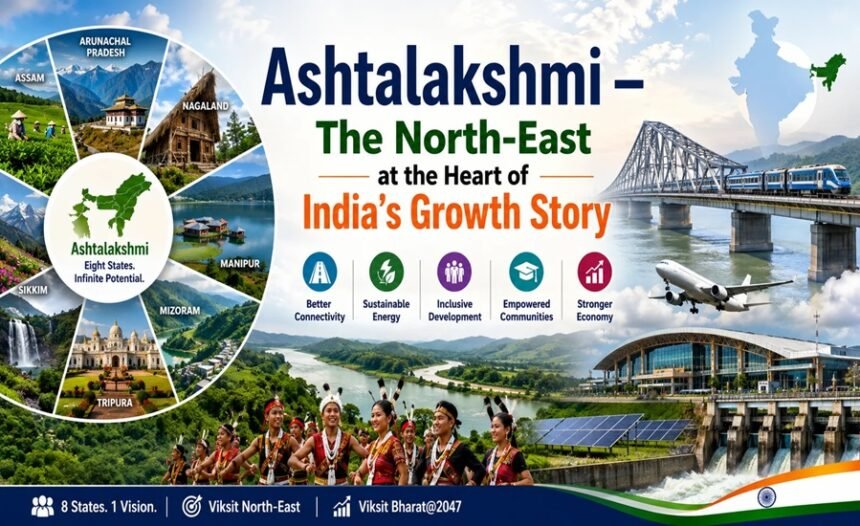
Ashtalakshmi, used to refer to the eight states of India’s North-East: Assam, Arunachal Pradesh, Manipur, Meghalaya, Mizoram, Nagaland, Tripura and Sikkim, look meaningfully different from how they did in 2014. Twelve years of concentrated policy support, infrastructure spending and welfare delivery have shifted the region’s position within India’s development story: from geographically isolated periphery to active contributor to the country’s connectivity, energy and Act East ambitions.
Roads, rail, air and the engineering that made Ashtalakshmi possible
Connectivity was the first and most consistent focus. The National Highway network in the North-East grew from 10,905 km in 2014 to 16,207 km by April 2025. Under Bharatmala Pariyojana, over 2,100 km of roads have been awarded and more than 1,800 km completed. Rural roads also expanded substantially 50,850 km constructed under PMGSY.
Rail tells a similar story. Track commissioning went from 333 km during the entire 2009–14 period to over 1,900 km between 2014 and 2026. The average annual railway budget allocation for the region rose from ₹2,122 crore to ₹11,486 crore. Arunachal Pradesh, Meghalaya, Nagaland, Mizoram and Tripura have all achieved 100% railway electrification, and nearly 60 stations have been selected for redevelopment under the Amrit Bharat Station Scheme.
Several large engineering projects have tackled the terrain directly. The Bogibeel Bridge, Dhola-Sadiya Bridge, Noney Railway Bridge and Sela Tunnel have each addressed specific connectivity gaps that previously made movement across the region difficult and slow. Air connectivity has kept pace, the number of airports rose from 9 in 2014 to 17 in 2026 under the UDAN scheme, with around 90 regional air routes now operationalised across the region.
Dedicated policy mechanisms and the Act East vision
The Ministry of Development of North Eastern Region has sanctioned 3,746 projects, of which 2,730 have been completed at a cost exceeding ₹27,963 crore. PM-DevINE, a fully centrally funded scheme with an outlay of ₹6,600 crore, is currently implementing 48 infrastructure and social development projects. NESIDS and programmes run by the North Eastern Council have supported thousands of additional projects across roads, healthcare, education, water supply, livelihoods and tourism.
The Act East Policy has repositioned the North-East as India’s primary gateway to Southeast Asia. The India–Myanmar–Thailand Trilateral Highway and the Kaladan Multi-Modal Transit Transport Project are both aimed at deepening cross-border trade and physical connectivity with the region’s neighbours. Integrated Check Posts and Border Haats are adding further layers of economic integration along these corridors.
Digital infrastructure and the energy transition
BharatNet and Digital Bharat Nidhi-supported projects have brought digital infrastructure into areas that previously had little. As of December 2025, 6,355 Gram Panchayats were service-ready for high-speed internet, while 3,718 mobile towers were providing connectivity to over 5,300 villages.
On energy, the North-East has become a significant part of India’s clean energy equation. The 2,880 MW Dibang Multipurpose Hydropower Project and the 2,000 MW Subansiri Lower Hydroelectric Project are among the largest renewable energy projects currently underway anywhere in the country. The North East Gas Grid, spanning approximately 1,656 km, is connecting all eight states to the national gas network. Solar parks, PM-KUSUM implementation, rooftop solar expansion and a 25 MW green hydrogen project in Assam round out an energy portfolio that has grown considerably in both scale and ambition.
Water, housing, health and education
Basic service delivery has improved across the board. Under Jal Jeevan Mission, Arunachal Pradesh and Mizoram have achieved 100% rural tap water coverage; several other states have crossed 80%. All eight states have achieved Open Defecation Free status under Swachh Bharat Mission (Gramin), with around 57 lakh household toilets constructed. PMAY-Gramin has delivered over 28 lakh rural houses; PMAY-Urban has completed more than 3.24 lakh urban houses. Household electrification has reached 100% across all eight states under the Saubhagya scheme.
Healthcare infrastructure has expanded through AIIMS Guwahati, 12 approved medical colleges, over 8,200 Health and Wellness Centres and widespread rollout of Ayushman Bharat PM-JAY. More than 2.43 crore Ayushman cards have been issued, supporting over 46 lakh hospital admissions.
Education has followed a similar trajectory. The region now has nearly 96,500 schools, 79 universities, 1,001 colleges, 110 ITIs and 48 Eklavya Model Residential Schools. Student enrolment in higher education rose from 9.36 lakh in 2014–15 to 12.02 lakh in 2021–22.
Agriculture, fisheries and what the land produces
Agriculture and allied sectors remain central to the region’s economy, and the numbers here have moved too. Inland fish production grew by over 68%, from 4.03 lakh tonnes in 2014–15 to 6.78 lakh tonnes in 2024–25. Milk production rose from 1,293.5 thousand tonnes to 1,739.9 thousand tonnes over the same period.
The Mission Organic Value Chain Development for North East has brought 2.36 lakh hectares under organic cultivation, benefiting nearly 2.7 lakh farmers. PM-KISAN has registered 26.98 lakh beneficiaries in the region; PMFBY has insured more than 78 lakh farmer applications.
The North-East has also built a distinct identity around niche agricultural products. It currently holds 89 GI-tagged products: Lakadong Turmeric, Queen Pineapple, King Chilli and Large Cardamom among the better-known ones. Agarwood cultivation has gained significant momentum, with nearly 150 million trees across India, around 90% of them in the North-East.
Key takeaway: Twelve years of sustained, multi-sector investment have shifted the North-East’s position within India’s development architecture. The region is no longer defined primarily by its isolation it is now a functioning part of India’s connectivity grid, energy transition, digital infrastructure rollout and Act East strategy. The quality of life indicators, while still a work in progress, have moved in the right direction across water, housing, health and education. Ashtalakshmi’s transformation is real, measurable and, by most indicators, still underway.
MCQ:
Question 1:
The term “Ashtalakshmi” refers to:
A. Eight flagship welfare schemes of the Government of India
B. Eight North-Eastern states of India
C. Eight economic corridors under Act East Policy
D. Eight major hydropower projects in North-East India
Question 2:
PM-DevINE, a scheme for the development of North-East India, has an outlay of:
A. ₹4,500 crore
B. ₹5,500 crore
C. ₹6,600 crore
D. ₹8,000 crore