

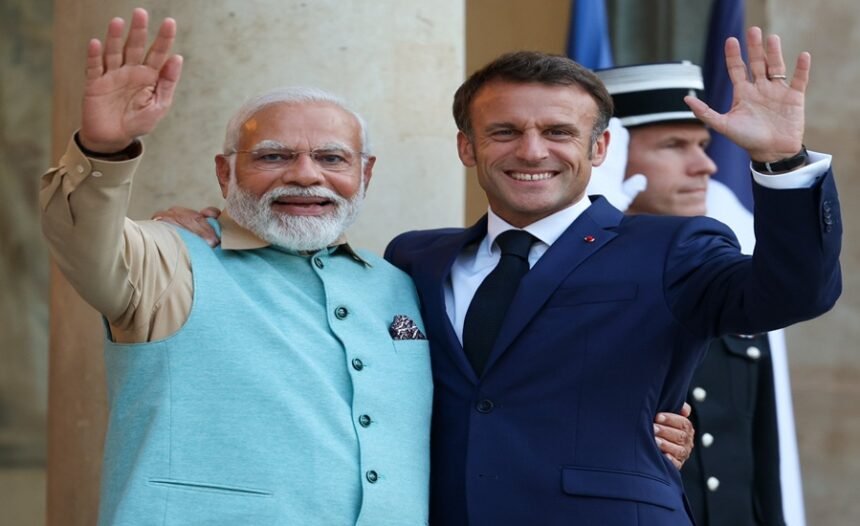
On 17 February 2026, Prime Minister Narendra Modi and President Emmanuel Macron elevated the bilateral relationship to a “Special Global Strategic Partnership.” The two leaders also jointly inaugurated the India-France Year of Innovation 2026, calling for cooperation to expand and diversify across artificial intelligence, innovation, research, technology, digital technology and cyber space, health, culture, economy, educational links, and people-to-people ties.
Building on the Horizon 2047 Roadmap and the two countries’ shared innovation journey, India and France see innovation as a central driver of economic resilience, sustainable development, strategic autonomy, and technological and industrial sovereignty. Both sides agree that a strengthened innovation partnership will help unlock their full innovation potential and contribute to solutions for global challenges.
Adopting the Roadmap
India’s vision of Viksit Bharat 2047 and France’s ambition under France 2030 give the two countries strong common ground for a future-oriented innovation partnership, opening the door to new investment in disruptive innovation. On this basis, India and France are adopting the India-France Innovation Roadmap 2030 as a framework to guide joint efforts on co-developing critical and emerging technologies, strengthening trusted technology ecosystems, deepening academic and research mobility, and delivering concrete results for people, the planet, and shared prosperity.
The Roadmap rests on four pillars, set out below.
I. Trusted AI as a Central Pillar
Building on the India-France Declaration on Artificial Intelligence of February 2025 and the AI Action and Impact Summits hosted by France and India in 2025 and 2026 respectively, both countries agree to make “trusted AI” a central pillar of their innovation partnership.
Safe, secure and trustworthy AI systems. Both sides will work together to promote AI systems that are safe, secure and trustworthy, aligned with democratic values and human rights, and designed to prevent discrimination and the spread of misinformation while supporting the 2030 Agenda for Sustainable Development. They will encourage cooperation between regulators, standards bodies, and technical experts to advance interoperable, risk-based approaches to AI governance, including for frontier and generative models, while making sure innovation and national development aren’t held back in the process.
Child Safety Online and Data Sharing
Cooperation on child safety online. India and France recognize the serious risks that AI-enabled services pose to vulnerable groups, particularly children, online, and agree to deepen cooperation on child safety as a priority within their AI partnership. Building on the Expert Engagement Group on AI and Child Safety convened at the AI Impact Summit 2026, along with India’s developing techno-legal framework on child safety online, the two sides will build concrete links between their existing initiatives. This includes privacy-preserving age assurance, safety-by-design architectures, and outcome-based safety standards for AI systems that interact directly with children.
Privacy-preserving data sharing frameworks. India and France agree that privacy-preserving data sharing frameworks are central to unlocking the full potential of AI and data-driven innovation while protecting fundamental rights. India’s Data Empowerment and Protection Architecture (DEPA) and France’s work on trusted data spaces and health data platforms bring complementary strengths that can support secure, consent-based data flows for research, healthcare, and public services.
II. Academic Mobility and People-to-People Ties
In line with the shared goals of the Horizon 2047 framework, both sides agree that investment in STEM education, research partnerships, talent mobility, and institutional collaboration will be critical to preparing future generations for global challenges. They acknowledge France’s goal of welcoming 30,000 Indian students by 2030, and reaffirm their commitment to strengthening people-to-people ties as a foundation of the bilateral relationship. Both sides welcome the following initiatives.
Mutual Recognition of Qualifications (MRQ). Given the central role mobility and academic integration play in sustaining long-term innovation partnerships, both sides reaffirm the importance of strengthening mutual recognition frameworks for higher education and professional qualifications. France was the first country to conclude an MRQ agreement with India, back in 2018, and both sides now intend to work toward an expanded and updated framework covering a wider range of academic disciplines, regulated professions, and emerging technology domains. This cooperation would support greater academic mobility, make dual-degree programmes and doctoral co-supervision arrangements easier to run, and meaningfully strengthen the long-term talent and knowledge partnership between the two countries.
Institutional collaboration. Several institutions from India and France have also agreed to collaborate on academic mobility through student exchanges and research collaboration (see the list of MoUs in the annexure).
III. Technological Sovereignty Through Industry-Academia Links
Both countries agree that closer collaboration between governments, industries, startups, universities, and research institutions is essential to drive innovation-led growth and build resilient, trusted supply chains in strategic sectors. In this context, both sides recognize:
- a. the central role of the Indo-French Centre for the Promotion of Advanced Research (CEFIPRA), a flagship instrument of bilateral scientific cooperation, now with a sharper focus on innovation and on co-developing and scaling strategically relevant technologies;
- b. the importance of the India-France Innovation Network (IFIN) as a major achievement of the India-France Year of Innovation and a powerful tool for connecting the two countries’ innovation ecosystems, with both countries committed to its long-term vitality, including through the possible creation of a joint Indo-French steering committee to govern it; and
- c. the relevance of the Franco-Indian Campus in Life Sciences for Health (FIC-LSH) as an existing platform for cooperation in biomedical sciences and health innovation, with both sides interested in continuing discussions on strengthening its contribution to bilateral research, academic collaboration, and health-sector innovation partnerships.
Through reciprocal access to research laboratories, CEFIPRA, the Joint Science and Technology Committee, startup collaboration at Station-F and FRIND-X, and the launch of the India-France Innovation Network, both countries are committed to securing their technological sovereignty and making sure the next generation of researchers and entrepreneurs can tackle global challenges independently.
New Initiatives Under Pillar III
Both sides also agreed to the following:
Franco-Indian Campus for Aeronautics Training and Careers. France and India will set up an aeronautical training campus in Kanpur, in partnership with MSDE, to develop and share training in this strategically important sector.
India-France InnoXchange Bridge. Both sides see potential in the India-France InnoXchange Bridge as a bilateral startup and innovation exchange initiative, aimed at building a dedicated research and entrepreneurship corridor between the two countries. Building on existing bilateral initiatives, it could provide structured, reciprocal access to research laboratories, technology platforms, innovation clusters, investors, and startup ecosystems in both countries, letting startups and innovators take part in research residencies, collaborative innovation immersion, joint collaboration programmes, and soft landings across both jurisdictions.
SME cooperation. Recognizing the vital role small and medium enterprises play in driving innovation, employment, and inclusive economic growth, both sides intend to explore further interaction between their SME ecosystems.
Space cooperation. France and India remain committed to strengthening their existing space partnership, both at the institutional level and between their private space ecosystems. The two countries will host two major international space events during the same week: the Bengaluru Space Expo (BSX) on 7 to 9 September in Bengaluru, and the International Space Summit on 9 to 10 September in Paris. These events will help lay the groundwork for a structured, shared ambition to deepen bilateral space cooperation in Earth observation and human exploration, including joint activity tied to French Zero-G capabilities and expertise and to India’s planned future space station in Low Earth Orbit, and to bring the French and Indian space ecosystems closer together.
IV. AI and Research-Based Solutions for Global Health Challenges
Consent-based data sharing. Building on ongoing collaborations, including the pilot project between India’s ICMR and France’s Health Data Hub (HDH), the two sides will work on consent-based architectures for secure data sharing, in line with their respective national legal frameworks. The goal is a model that can be scaled, adapted to other sectors, and shared with interested partners, including in the Global South. India and France will encourage joint work between their data intermediaries, technical standards bodies, and regulators to advance interoperable, rights-protecting data infrastructure that supports AI innovation and public-interest research.
M.C.Q.
Question 1: The India-France Innovation Roadmap 2030 was adopted under which bilateral framework?
- A. Comprehensive Economic Partnership
- B. Special Global Strategic Partnership
- C. Indo-Pacific Economic Framework
- D. Strategic Trade Partnership
Question 2: CEFIPRA, mentioned in the India-France Innovation Roadmap 2030, is primarily associated with:
- A. Defence procurement
- B. Bilateral scientific research and innovation cooperation
- C. Space launch services
- D. Maritime security cooperation
Read More: India Elected FATF Vice-President for the First Time Making Sensation