
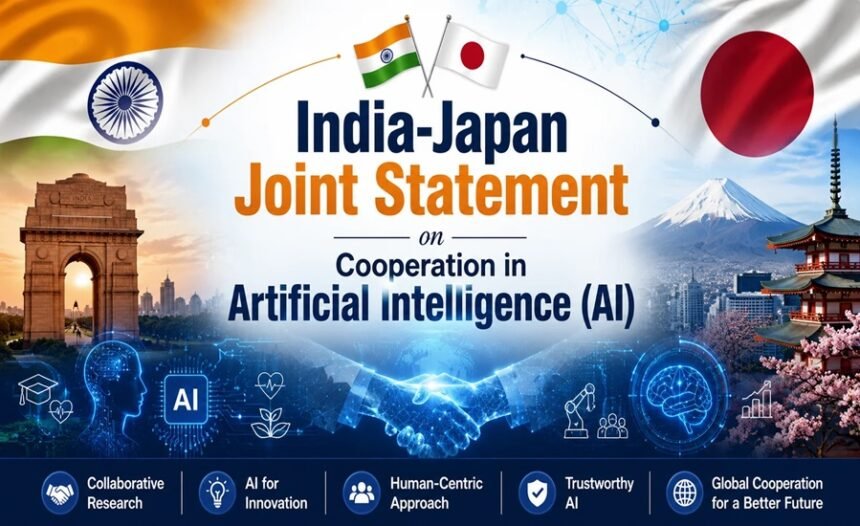
India and Japan have laid out an extensive framework for AI cooperation, with both governments treating the technology as something that will reshape economies, governance, scientific research and national security in ways that are still being understood. In a joint statement following discussions between Prime Minister Narendra Modi and Sanae Takaichi, the two leaders described AI as an “era-defining” general-purpose technology whose development and governance will have long-range consequences for innovation, economic resilience and the international order.
The core argument in the statement was about timing: decisions made now on how AI systems are designed, deployed and regulated will shape social welfare, economic security and technological leadership for decades. India and Japan agreed to work toward an AI ecosystem that is safe, secure, trustworthy, human-centric, inclusive and oriented toward innovation while improving the technological resilience of both countries.
Indo-Pacific framing
The partnership sits within a broader geopolitical context. Both countries agreed to deepen collaboration under India’s MAHASAGAR vision and Japan’s Free and Open Indo-Pacific strategy, working with like-minded partners to promote resilient and inclusive AI development across the Indo-Pacific and the Global South. The leaders stressed that sustainable AI growth requires balancing innovation against risk, and called for diversified, trustworthy supply chains for AI technologies.
They welcomed discussions from the New Delhi AI Impact Summit and reaffirmed commitment to the Japan-India AI Cooperation Initiative. Building on the first India-Japan AI Strategic Dialogue held in April 2026, both sides agreed to continue regular consultations involving governments, industry, researchers and academic institutions focused on turning shared objectives into practical cooperation across governance, infrastructure, research, talent and public-interest applications.
Governance, safety and cybersecurity
A significant portion of the partnership covers AI governance. India and Japan reaffirmed support for a global framework promoting safe, trustworthy and inclusive AI, with governance systems that are risk-balanced, adaptive, interoperable and respectful of national priorities. Both countries reiterated the importance of the Hiroshima AI Process, its guiding principles and its code of conduct for advanced AI systems, and committed to closer coordination in global forums including the G20, OECD, Global Partnership on Artificial Intelligence and the United Nations.
Both sides agreed to expand cooperation within the Hiroshima AI Process Friends Group and support implementation of its Action Plan 2026, while pushing for broader participation from developing countries and the private sector in shaping global AI governance standards.
On cybersecurity, the leaders acknowledged that frontier AI systems carry advanced cyber capabilities useful for defence, but potentially dangerous if misused. They agreed to cooperate on AI-enabled cybersecurity, secure AI deployment and protection of critical infrastructure, and supported the Trusted AI Commons platform, which consolidates technical tools, benchmarks and best practices for safe AI development. The statement also flagged the need to protect children in an AI-driven world, calling for responsible design and appropriate safeguards.
Infrastructure and research
India and Japan agreed to elevate their relationship to strategic R&D partners in AI. Cooperation will cover digital infrastructure: data centres, GPUs, computing resources and semiconductor ecosystems while jointly assessing opportunities and vulnerabilities across the AI technology stack from an economic security angle. The FOIP Digital Corridor Initiative will be advanced to improve digital connectivity and build resilient AI supply chains.
The leaders also endorsed cooperation on energy-efficient computing, optimised AI models, green data infrastructure and improved inference capabilities aligning with principles discussed at the India AI Impact Summit on sustainable AI infrastructure.
On the research side, several concrete agreements were announced. IIT Bombay, BharatGen Technology Foundation and Japan’s National Institute of Informatics will collaborate on large language model research. AI company Sarvam and Preferred Networks will cooperate across the AI technology stack. India AI and Japan’s Ministry of Economy, Trade and Industry will support AI startups and development companies in both countries. Both governments also recognised the growing role of AI in scientific discovery and encouraged research institutions to collaborate through the Network of AI for Science institutions established at the India AI Impact Summit.
Talent
Human capital development ran through much of the joint statement. Japan committed to expanding engagement with Indian universities and technology institutions, encouraging Japanese firms to participate in AI research and innovation in India, and creating more pathways for Indian professionals to work, study and research in Japan. Both sides reaffirmed a target set during the India-Japan Foreign Ministers’ Strategic Dialogue in January 2026: 500 highly skilled Indian AI professionals in Japan by 2030. The statement also endorsed voluntary principles from the India AI Impact Summit focused on skilling and reskilling workers for an AI-driven economy.
“AI for All”
India and Japan reiterated their commitment to the “AI for All” vision from the New Delhi Declaration, agreed at the India AI Impact Summit. The goal is AI that contributes to inclusive development, improves public services and reaches all sections of society. Both countries agreed to cooperate on capacity building, technical assistance, knowledge sharing and replicating successful use cases in third countries.
Key takeaway: The India-Japan AI partnership now spans governance, cybersecurity, infrastructure, research, talent mobility and inclusive development. The ambition is a safe, human-centric AI ecosystem built jointly, extended across the Indo-Pacific, and grounded in concrete agreements rather than declarations alone.
MCQ:
Question 1:
The India-Japan AI partnership is closely linked with Japan’s:
A. Belt and Road Initiative
B. Free and Open Indo-Pacific Strategy
C. Global Gateway Initiative
D. Digital Silk Road Initiative
Question 2:
Which AI governance framework received explicit support from both India and Japan?
A. Paris AI Accord
B. Hiroshima AI Process
C. Geneva AI Convention
D. Global AI Treaty Initiative
Read more: CCEA Approves ₹6,969 Crore NH-148AE Tunnel Project