



The Cabinet Committee on Economic Affairs has approved a significant change to the rice quality standards that apply to grain distributed under the PMGKAY: Pradhan Mantri Garib Kalyan Anna Yojana and other welfare schemes. It’s the first revision to rice quality specifications under the Public Distribution System in close to thirty years, and it touches quality, transparency and operational costs simultaneously.
What’s changing in the grain itself
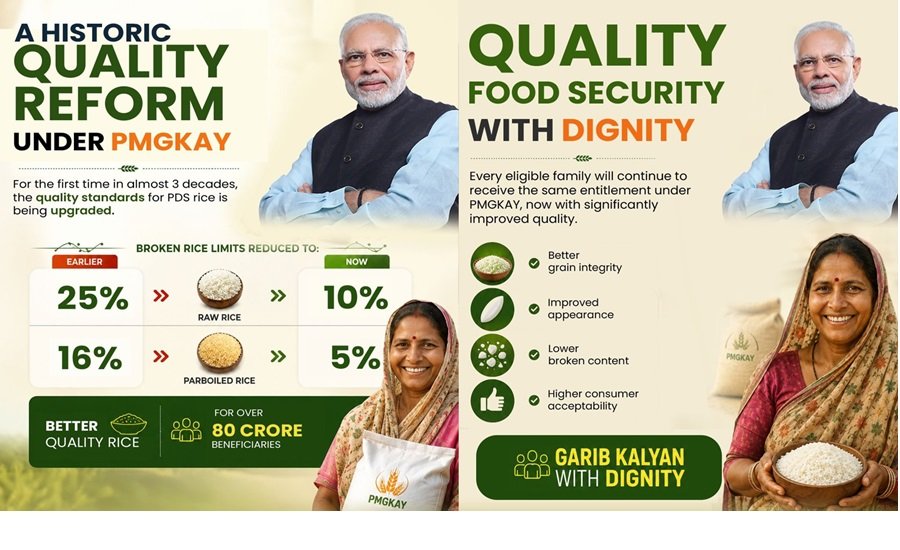
The permissible broken grain content in raw rice supplied through PMGKAY has been cut from 25% to 10%. For parboiled rice, the limit drops from 16% to 5%. Procurement under the new standards begins immediately, with phased rollout across procuring states by Kharif Marketing Season 2027–28. More than 80 crore beneficiaries receiving subsidised food grain under PMGKAY and other schemes are expected to receive better-quality rice with no reduction in their existing entitlements.
Where the broken rice goes, and what that saves
The tighter milling specifications mean a larger quantity of broken rice will be separated during processing. Rather than entering the welfare distribution chain, that broken rice will be diverted for other productive uses the mechanism by which higher-quality grain reaches beneficiaries. Broken rice will be auctioned directly from millers’ premises. Combined with lower transportation, storage, handling and packaging costs partly through a shift from jute to HDPE bags the reform is projected to generate annual savings of around ₹2,161 crore. Revenue from broken rice sales is also expected to ease the food subsidy burden.
Traceability through QR codes
Each rice bag will carry a QR code tag for end-to-end supply chain traceability, aimed at tightening inventory management, improving accountability and reducing leakages within the PDS. Pilot projects in Haryana, Andhra Pradesh, Punjab, Odisha, Telangana and Chhattisgarh have already demonstrated that producing and distributing improved-quality rice at scale is workable. The rice from those pilots will now go directly to PMGKAY beneficiaries.
Key takeaway: A three-decade-old standard gets its first overhaul with tighter broken grain limits, QR-based traceability, and ₹2,161 crore in projected annual savings. For the 80 crore-plus beneficiaries in the system, it means better rice at the same entitlement. For the government, it means less leakage and a smaller subsidy bill.
MCQ:
Question 1:
The recent revision of rice quality standards under PMGKAY reduces the permissible broken grain content in raw rice from:
A. 20% to 10%
B. 25% to 10%
C. 30% to 15%
D. 25% to 5%
Question 2:
The revised rice quality standards under PMGKAY will be implemented in phases beginning with:
A. Rabi Marketing Season 2026–27
B. Kharif Marketing Season 2026–27
C. Kharif Marketing Season 2027–28
D. Rabi Marketing Season 2027–28