
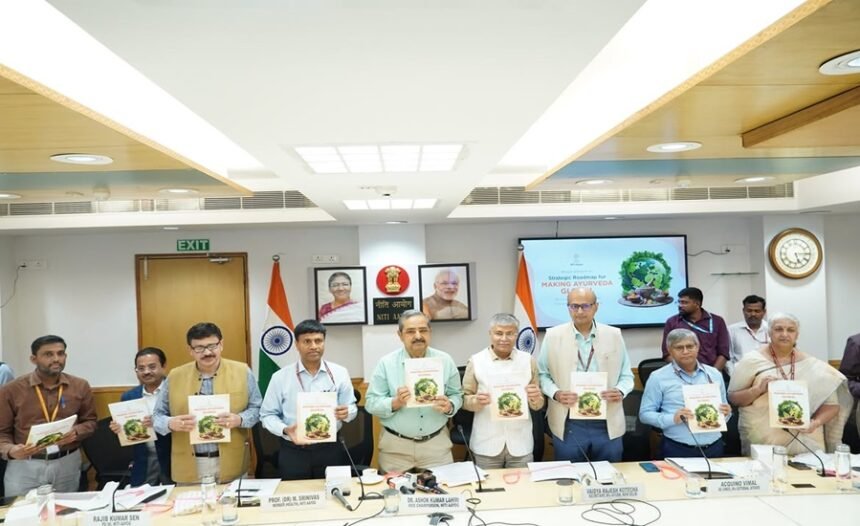
NITI Aayog has released a report titled “Strategic Roadmap for Making Ayurveda Global,” laying out both an assessment of where Ayurveda currently stands internationally and a strategy in phases to expand its reach. Launched on July 2, 2026, the report frames Ayurveda’s globalisation as part of India’s broader Viksit Bharat@2047 ambitions.
The launch was led by Dr. Ashok Kumar Lahiri, Vice Chairman of NITI Aayog, with Prof. (Dr.) M. Srinivas, Member, NITI Aayog, and Vaidya Rajesh Kotecha, Secretary, Ministry of Ayush, in attendance. Senior officials from the Ministry of External Affairs, research organisations, industry bodies and other stakeholders were also present.
The opportunity as NITI Aayog sees it
The report argues that taking Ayurveda global offers economic returns, exports, employment, revenue alongside a less tangible but equally stated goal: improving health outcomes worldwide by making evidence-based traditional healthcare more accessible. Officials at the launch were careful to frame this as something beyond market expansion, invoking the principle of “Sarve Bhavantu Sukhinah” may all be happy as the underlying intent.
The Ministry of Ayush noted that work on improving global recognition of Ayurveda has been underway for roughly a decade. The roadmap is meant to build on those efforts and push toward formal recognition of Ayurveda as a globally accepted healthcare system.
Three pillars
The report, prepared by NITI Aayog’s Health Division in collaboration with PricewaterhouseCoopers, is built on stakeholder consultations, international benchmarking, and evidence-based analysis. Its recommendations are structured around three pillars, each addressing a different dimension of what it would take to move Ayurveda from a niche or diaspora-linked practice into a globally recognised healthcare system.
Pillar one: Availability: This pillar is concerned with building out the infrastructure and human capital needed to actually deliver Ayurveda at scale outside India. It covers expanding the global Ayurveda workforce meaning more trained practitioners able to operate in international markets alongside growing exports and manufacturing capacity so that Ayurvedic products can reach those markets in sufficient volume. It also calls for strengthening international research and development, positioning Ayurveda within a more rigorous, evidence-generating framework rather than leaving it reliant on traditional knowledge alone. Rounding this out is a push for standardised education systems, ensuring that training and qualifications in Ayurveda carry consistent meaning and credibility wherever they are earned.
Pillar two: Regulatory compliance, collaboration, and adaptability: This includes navigating and meeting regulatory compliance requirements in individual international markets, which likely differ from one country to the next. It also emphasises academic and industrial collaborations, suggesting Ayurveda’s global growth depends on partnerships with universities and companies abroad rather than India acting alone. A further component is insurance coverage for Ayurvedic treatments; a practical necessity for Ayurveda to be treated as a legitimate, reimbursable healthcare option rather than an out-of-pocket alternative therapy. Finally, this pillar addresses cultural adaptability, recognising that Ayurveda’s practices, terminology, and delivery may need to be adjusted for acceptance across different cultural and regional contexts.
Pillar three: Propagation. This pillar is oriented toward visibility and perception. It covers strategic branding and international promotion, aimed at shaping how Ayurveda is understood and marketed on the world stage. It also highlights medical value travel essentially wellness and treatment-focused tourism as a channel through which people encounter Ayurveda directly. And it calls for greater representation in global organisations and forums, ensuring Ayurveda has a seat and a voice in the international bodies that set health policy and standards.
Key takeaway: The roadmap gives Ayurveda’s international ambitions a structured, long-term framework for the first time organised around three clear pillars and pegged to 2047. Whether the coordination across government departments that officials flagged as essential actually materialises will determine how much of it moves from paper to practice.
MCQ:
Question 1:
The report titled “Strategic Roadmap for Making Ayurveda Global” was released by:
A. Ministry of Health and Family Welfare
B. Ministry of External Affairs
C. NITI Aayog
D. Ministry of Commerce and Industry
Question 2:
The roadmap for making Ayurveda global has been aligned with which national vision?
A. Atmanirbhar Bharat 2030
B. India@2035
C. Viksit Bharat@2047
D. New India@2040