
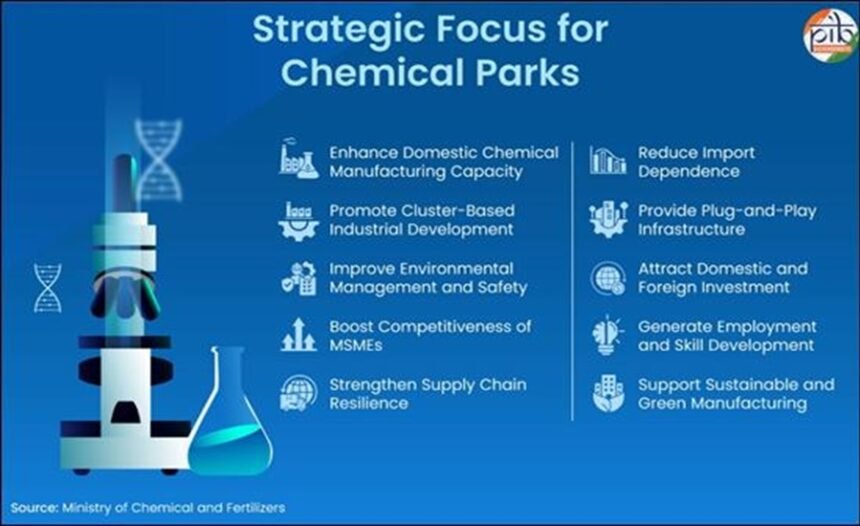
The Union Budget 2026-27 has announced a new scheme to help states build three dedicated Chemical Parks, chosen through a challenge-based selection process. These will run on a cluster model with shared infrastructure and common environmental facilities, backed by ₹600 crore in Budget Estimates for 2026-27. The idea is to strengthen domestic manufacturing, cut import dependence, and push India further up global chemical value chains. Alongside Chemical Parks, the Budget has set aside ₹20,000 crore over five years for Carbon Capture, Utilisation and Storage technologies.
Where India’s chemical industry stands
India is the sixth-largest chemical producer in the world and third-largest in Asia. The sector makes up around 7% of GDP and feeds essential inputs into agriculture, pharmaceuticals, textiles, automobiles, and construction.
More than 80,000 chemical products come out of Indian factories, everything from petrochemicals and polymers to agrochemicals, fertilizers, and specialty chemicals. Per the Economic Survey 2025-26, the sector accounted for 8.1% of manufacturing Gross Value Added in FY24. Production of major chemicals and petrochemicals grew from 45,638 thousand metric tonnes in FY16 to 58,617 thousand metric tonnes in FY25; a compound annual growth rate of 2.8%.
What the Budget is proposing
Three Chemical Parks, with ₹600 crore in central assistance for FY27. They’ll offer plug-and-play infrastructure, shared utilities and logistics, common environmental management systems, streamlined regulatory support, and integrated manufacturing setups. This is the first time chemical park infrastructure has gotten dedicated budgetary backing, and the goal is manufacturing clusters that can actually compete globally.
What a Chemical Park actually is
It’s a planned industrial zone built for chemical and petrochemical manufacturing, where several units share one ecosystem rather than each building everything from scratch. That shared setup usually includes effluent treatment, waste management, power and utility infrastructure, logistics and warehousing, and safety and emergency response systems. Clustering these functions cuts costs, improves efficiency, and tightens supply chain integration.
Why bother with this model
India already has some evidence and experience with Chemical Parks. Plastic Parks, Bulk Drug Parks, and Petroleum, Chemicals and Petrochemicals Investment Regions have all shown that shared infrastructure and coordinated planning pay off. The new Chemical Parks are meant to extend that logic across a wider slice of the value chain, covering bulk chemicals, specialty chemicals, and downstream manufacturing.
The expected payoff: shorter project timelines, lower capital and operating costs, better economies of scale, stronger industrial safety, tighter environmental compliance, and improved export competitiveness.
The models this builds on
Plastic Parks: Launched in 2013-14 to boost investment, production, exports, and jobs in plastics. The scheme covers up to 50% of project cost, capped at ₹40 crore per park, and has set up 13 Centres of Excellence for plastics and polymer research. Ten parks have been approved in nine states. They are Assam, Madhya Pradesh, Odisha, Jharkhand, Tamil Nadu, Uttarakhand, Chhattisgarh, Karnataka, and Uttar Pradesh.
Bulk Drug Parks: Launched in 2020 with a ₹3,000 crore outlay to strengthen pharmaceutical self-reliance. Three parks are supported, in Gujarat, Himachal Pradesh, and Andhra Pradesh, with shared infrastructure covering central effluent treatment, solvent recovery, warehousing and logistics, testing labs, emergency response centres, and dedicated power and water. The aim is lower manufacturing costs and better competitiveness in active pharmaceutical ingredients.
PCPIRs: Large integrated regions for domestic and export-oriented manufacturing, currently running in Visakhapatnam (Andhra Pradesh), Dahej (Gujarat), and Paradeep (Odisha). They combine production, logistics, utilities, and environmental infrastructure to drive industrial growth and exports.
The environmental piece
As chemical manufacturing scales up, so does the need for serious environmental management. That’s the thinking behind the ₹20,000 crore CCUS allocation over five years. CCUS technology captures carbon dioxide from industrial processes and either reuses it or stores it safely instead of letting it reach the atmosphere.
Key Takeaway: The proposed Chemical Parks are a real attempt to fix structural problems that have held back scale and competitiveness in Indian chemical manufacturing, by combining shared infrastructure, plug-and-play facilities, and integrated environmental systems. Paired with the CCUS investment, the plan is meant to draw in investment, strengthen supply chains, cut import dependence, create jobs, and move India closer to becoming a serious hub for global chemical manufacturing.
MCQ:
1. The Union Budget 2026-27 has announced financial assistance for establishing how many new Chemical Parks?
A. Two
B. Three
C. Five
D. Seven
2. In the Union Budget 2026-27, the Government allocated ₹20,000 crore over five years for which technology?
A. Green Hydrogen Mission
B. Carbon Capture, Utilisation and Storage (CCUS)
C. National Solar Mission
D. Biofuel Blending Programme
Read more: India Semiconductor Mission 2.0: Driving Growth in the Semiconductor Industry