
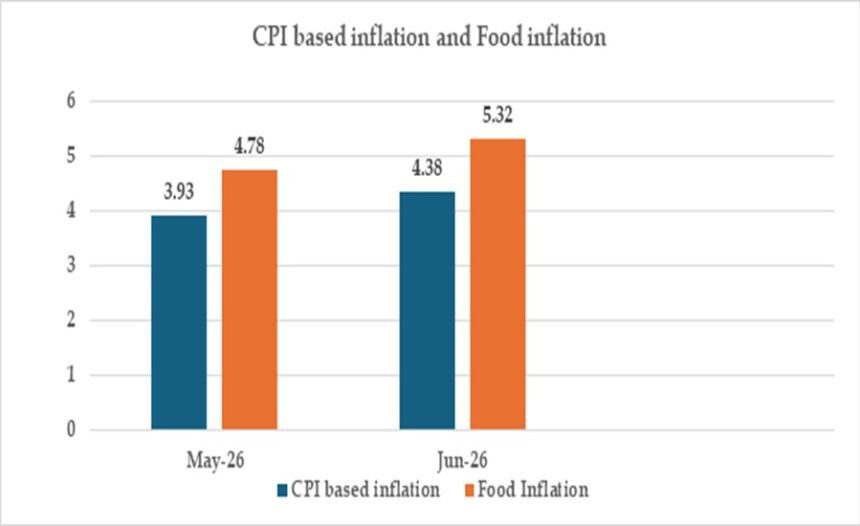
India’s retail inflation rose to 4.38% in June 2026, up from 3.93% in May, according to Ministry of Statistics and Programme Implementation (MoSPI) data using the new 2024=100 base year. Food prices and rising costs in personal care and services were the main drivers behind the increase, marking the fifth straight month of rising price pressure.
Food inflation, tracked through the Consumer Food Price Index, climbed to 5.32% in June from 4.78% the month before. Some key vegetables got cheaper during the month, but that wasn’t enough to offset sharp increases elsewhere, particularly in spices and precious metals. Households are once again seeing food costs outpace overall inflation, a pattern that tends to hit lower-income families hardest since food makes up a larger share of their spending.
Rural areas feel it more than urban ones
Rural CPI inflation hit 4.74%, well above the urban figure of 3.92%. Food inflation followed the same pattern: 5.45% in rural areas versus 5.09% in cities. This gap between rural and urban inflation has shown up consistently in recent months, and it suggests that price pressures on staples and everyday goods are landing harder in villages and smaller towns than in major cities.
What got more expensive
Food and beverages inflation stood at 5.05% nationally. Spices and vegetables saw some of the steepest jumps of any category. Silver jewellery climbed 133.21%, an extraordinary rise driven by global precious metal prices. Ginger rose 50.41%, and gold, diamond and platinum jewellery increased 36.82%. Tomatoes, a staple that swings wildly with weather and supply, jumped 31.92%, while raisins and monacca climbed 20.52%.
The rally in precious metals pushed the broader “personal effects” category past 50% inflation, making it one of the sharpest movers in the entire dataset for June.
What got cheaper
Not everything moved in one direction. Potatoes fell 20.34%, one of the steepest declines recorded this month, likely reflecting a strong harvest or oversupply in key growing regions. Peas dropped 9.67%. On the non-food side, motor cars and jeeps fell 6.89%, cumin (jeera) declined 3.75%, and motorcycles and scooters dropped 3.49%.
The continued fall in vehicle prices points to easing input costs for manufacturers and stiffer competition among automakers trying to win over price-sensitive buyers.
Services stay pricey
Among major expenditure categories, services inflation remained elevated. Restaurants and accommodation led the pack at 6.91%, followed by transport at 4.31%, education services at 3.34%, and clothing and footwear at 3.23%. Housing was the exception, holding at a modest 2.10%, offering some relief on one of the biggest line items in most household budgets.
Telangana tops the states
Among states with populations over 50 lakh, Telangana posted the highest inflation at 6.36%. Andhra Pradesh and Puducherry tied at 5.39%, followed by Tamil Nadu at 5.24% and Odisha at 5.15%. At the other end, Tripura, Mizoram, and Meghalaya recorded the lowest rates, at 1.65%, 1.63%, and 2.64% respectively, showing just how uneven inflation has been across the country.
Five months of steady climbs
CPI inflation has moved up every month this year: 2.74% in January, 3.21% in February, 3.40% in March, 3.48% in April, 3.93% in May, and 4.38% in June. Inflation still sits within the RBI’s 2-6% target band, but the steady climb since January, especially in food, points to mounting pressure that policymakers will likely keep watching closely.
Key Takeaway: MoSPI gathered prices from 1,407 urban markets, including online marketplaces, and 1,465 villages across all states and union territories, with a 100% response rate from both rural and urban sources.
MCQs:
- India’s retail inflation (CPI) in June 2026 stood at:
A) 3.48%
B) 3.93%
C) 4.38%
D) 5.32%
- Retail inflation in May 2026 was:
A) 2.74%
B) 3.48%
C) 3.93%
D) 4.38%
Read more: Pension Reforms through Digitalization – 12 Years of Digital Transformation