
The Government e-Marketplace (GeM) has changed how public procurement works in India, swapping out paperwork and fragmented approvals for a single digital platform. Launched on 9 August 2016, GeM now handles the entire procurement lifecycle online, and dedicated support for small enterprises, startups, women entrepreneurs and socially disadvantaged sellers has opened government markets to groups that struggled to access them before.
Building a transparent digital marketplace
Government agencies buy everything from medical equipment to classroom furniture to transport infrastructure, and the old process meant paperwork, multiple sign-offs and long tender cycles. GeM was built to replace that with one end-to-end platform, secure and paperless, that brings buyers and sellers together online. Its design drew on procurement systems in countries like the US and South Korea, and changes to the General Financial Rules gave government bodies the legal footing to actually use it.
Central and state ministries, PSUs, autonomous bodies, panchayats and cooperatives all buy through GeM, covering everything from seller registration to final payment. Buyers can choose direct purchase, comparison, e-bidding or reverse auctions depending on what they need, and digital records plus automated workflows cut down on the discretionary decisions that used to slow things down.
Data tools that shape buying decisions
GeM gives buyers tools like the Availability Report and Past Transaction Summary to check what’s on the platform and how it’s been priced before. Business analytics show last purchase price, price trends and departmental buying history, so decisions are grounded in data rather than guesswork. The platform also links to the Central Public Procurement Portal for a single view of tenders nationwide, and integration with the Railway and Defence procurement systems is underway to bring everything under one roof.
As of 6 August 2026, the Department of Military Affairs alone has crossed ₹1.35 lakh crore in cumulative purchases through GeM, making up nearly 15% of the platform’s total transaction value.
The scale GeM has reached
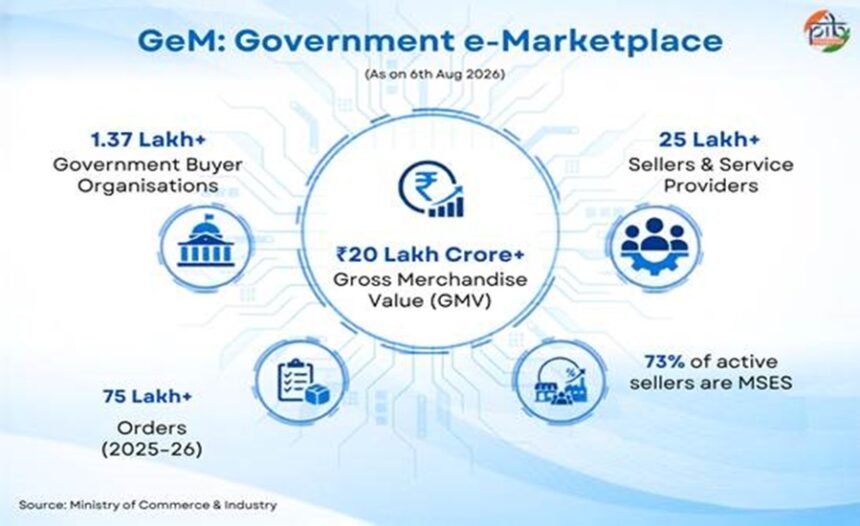
More than 1.37 lakh government buyer organisations and close to 25 lakh sellers now use the platform, with cumulative procurement past ₹20 lakh crore. It supports over 10,660 product categories and 350 service categories, spanning medical equipment, furniture, fire safety gear and handicrafts on one side, and transport, catering and HR services on the other. Recent reforms, including rate contracts for recurring purchases and dropping caution money requirements, have made selling on GeM simpler.
Partnerships extending the platform’s reach
GeM has teamed up with IN-SPACe on space-tech procurement and the Drone Federation India on drones. Its GeM Sahay partnership with Union Bank of India gives registered sellers access to collateral-free working capital without needing buyer approval. MoUs with institutions like AJNIFM, CareEdge Ratings, NCGG and IIPA support training and research, while a UN Women partnership backs women-led enterprises through the Womaniya initiative.
Widening access for underrepresented sellers
In June 2026, GeM partnered with CSC-SPV to set up 50 GeM Suvidha Kendras on a pilot basis, offering registration help, catalogue building and grievance support to MSEs, women, SC/ST entrepreneurs and artisans. During 2025-26, over 11 lakh registered MSEs completed more than 51 lakh orders worth over ₹2.36 lakh crore, women-led MSEs secured over ₹28,000 crore in business, SC/ST enterprise procurement grew nearly 28%, and startup procurement grew over 36%, crossing ₹19,000 crore.
Key Takeaway: Heading into its eleventh year, GeM is looking at artificial intelligence and broader participation to push transparency and efficiency further, while continuing to connect government demand with local enterprises across the country.
MCQ’s:
1. On which date was the Government e-Marketplace (GeM) launched?
A) 15 August 2015
B) 9 August 2016
C) 26 January 2017
D) 1 April 2017
2. Which of the following is NOT mentioned in the article as a procurement mechanism available to buyers on GeM?
A) Direct purchase
B) E-bidding
C) Reverse auction
D) Cryptocurrency auction
Read more: E20 Petrol Safe to Use: OMCs Debunk Contamination Rumours with Nationwide Clean Tests