

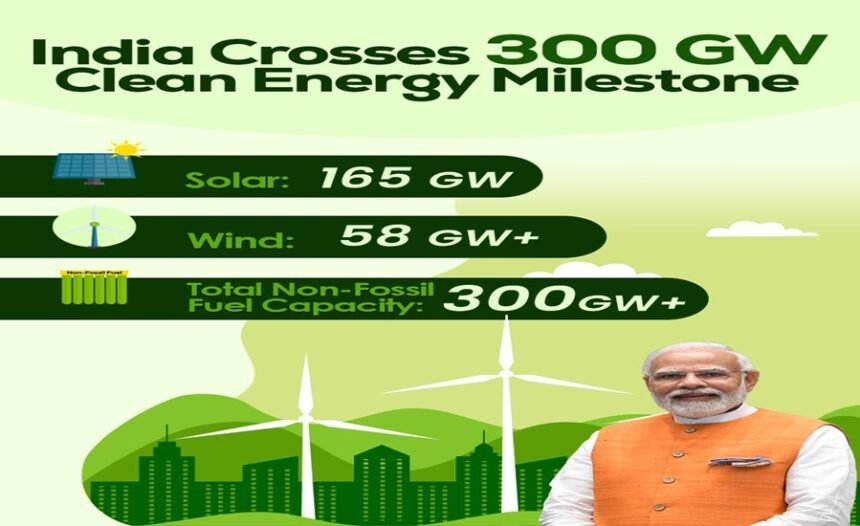
India’s clean energy build-out has crossed a major threshold. As of July 31, 2026, the country’s non-fossil fuel electricity capacity hit 300.50 GW, putting it past 60% of the 500 GW target set for 2030.
Where the capacity comes from
Solar leads by a wide margin, at 164.59 GW. Wind follows at 58.14 GW, then hydro power (large and small combined) at 57.24 GW, bio-power at 11.75 GW, and nuclear at 8.78 GW. Add these up and you get the 300.50 GW total.
Out of India’s overall installed capacity of roughly 552 GW, non-fossil sources now make up more than 54% of the mix. Government officials point to this as evidence of progress toward an energy system built on domestic strength, and toward hitting 500 GW of non-fossil capacity by the end of the decade.
Solar and wind have grown fast
Solar capacity sits around 165 GW today. In 2014, it was 2.8 GW. Wind has grown too, from 21 GW in 2014 to more than 58 GW now.
The 2025-26 fiscal year alone brought a record 55.29 GW of new non-fossil capacity, split between 44.6 GW of solar and 6 GW of wind. Renewable generation has climbed alongside that capacity, from 190.96 billion units in 2014-15 to 477.79 billion units in 2025-26.
Manufacturing is catching up too
Building this much capacity domestically requires a supply chain to match, and India has been working on that side as well. The Production Linked Incentive Scheme, aimed at high-efficiency solar modules made in India, has helped push capacity under the Approved List of Models and Manufacturers past 200 GW. In 2014, that figure was just 2.3 GW.
Beyond the climate commitment
Clean energy in India is no longer framed as a climate obligation. Officials increasingly describe it as a matter of industrial competitiveness, energy security, and economic resilience. The Ministry of New and Renewable Energy is also pushing industrial decarbonization, with an eye on making India a producer and exporter of green hydrogen and related products through the National Green Hydrogen Mission.
Key Takeaway: Reaching 300.50 GW puts India well on the way to its 500 GW target for 2030. Solar and wind keep growing, renewable generation is up sharply from a decade ago, and domestic manufacturing has scaled from a marginal presence to over 200 GW of module capacity. Together, these numbers point to a country building out its energy independence and industrial base at the same time it works toward its climate goals.
MCQ’s:
1. As of July 31, 2026, India’s non-fossil fuel electricity capacity stood at approximately:
A) 250.50 GW
B) 275.75 GW
C) 300.50 GW
D) 350.25 GW
2. What is India’s target for non-fossil fuel electricity capacity by 2030, as mentioned in the article?
A) 300 GW
B) 400 GW
C) 450 GW
D) 500 GW
Read more: Revolutionary Accountability: Government Fortifies OTT Code of Ethics with 3-Tier Grievance Checks