
Over the past decade, pension administration in India has gone through a real overhaul, with the Department of Pension and Pensioners‘ Welfare using technology to cut delays and clean up procedures for retired government employees. At the crux of it all sits Bhavishya, the government’s centralized platform which is designed to process pensions, and it has turned what used to be a slow, paper-heavy process into something far more streamlined for central government employees. The platform was introduced to bridge the gap with the delays, clerical mistakes, and procedural snags which were responsible for hampering pension processing. It’s since grown into a full digital system that makes the process more transparent and gets retirement benefits to people faster.
Bhavishya becomes the backbone of pension processing
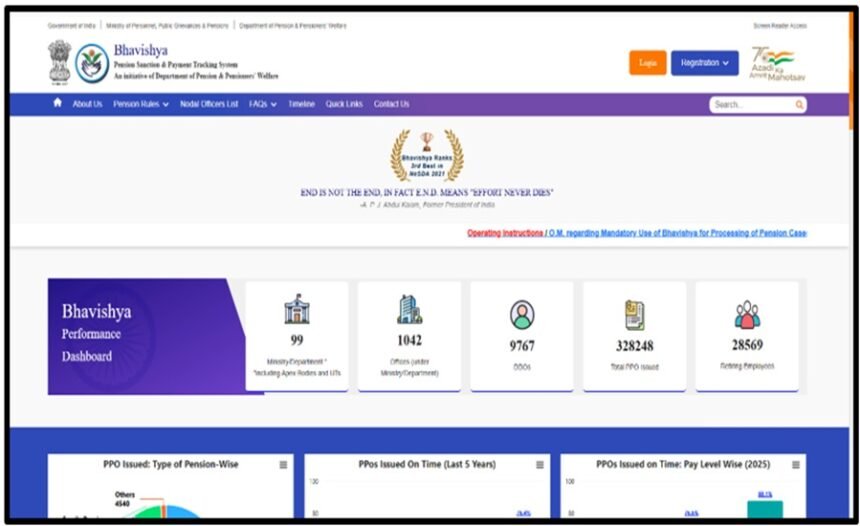
The platform became mandatory for all Central Government civil ministries and departments starting January 1, 2017. It has grown a lot since then. Today it covers 99 ministries and departments, 1,041 government offices, and 9,765 Drawing and Disbursing Officers. As of June 19, 2026, more than 3.28 lakh Pension Payment Orders have been issued through the system.
Faster processing, quicker PPOs
Digitising the process has paid off in some concrete ways. 73% of superannuation PPOs now go out on time. For family pensions tied to in-service deaths, 69% are issued within six months. And the average time to issue a PPO has dropped to 64 days. For someone about to retire, or a family dealing with a sudden loss, that kind of speed makes a real difference, taking away a lot of the uncertainty that used to hang over the process. The platform’s impact didn’t go unnoticed either: it came third in the National e-Governance Service Delivery Assessment for 2021.
One form instead of many: Form 6-A
In July 2024, the department rolled out Form 6-A, a single digital application that replaced the tangle of separate forms that used to exist. Since it’s built directly into Bhavishya, retiring employees can now finish their entire application with just one e-sign, cutting out a lot of the paperwork and back-and-forth that used to be routine. More than 64,000 employees have already used it to apply. It’s a small change on paper, but it moves the whole system closer to being fully digital.
Linked with banks and CGHS
The platform is now connected to banks and healthcare systems too. Through its link with the Central Government Health Scheme, retiring employees keep their medical coverage without any gap starting the day they retire. The platform is also tied into 11 pension-disbursing banks, which between them cover close to 92% of central government pensioners. Because of this, anyone can can pull up their slips, income tax certificates, due-and-drawn statements, and Digital Life Certificate status whenever they need to, all without extra paperwork.
Key Takeaway: Bhavishya is part of a much bigger shift toward digital, citizen-focused governance. Real-time tracking, electronic approvals, and better coordination between departments have made retirement a smoother experience for central government employees. As India keeps building out its digital infrastructure, this platform is a tangible realisation of what that can actually look like in practice: less friction, faster service, and a system that works better for the millions who depend on it.
MCQs:
MCQs:
1. The National e-Governance Service Delivery Assessment (NeSDA) is primarily associated with evaluating:
A. Defence preparedness
B. Digital governance and public service delivery
C. Agricultural productivity
D. Banking performance
2. Form 6-A, introduced in July 2024, was designed to:
A. Register new government employees
B. Replace multiple pension application forms with a single digital application
C. Apply for a Digital Life Certificate
D. Enrol under CGHS
Read more: Aadhaar App Downloads Exceed 31 Million-Digital ID Adoption Surge