
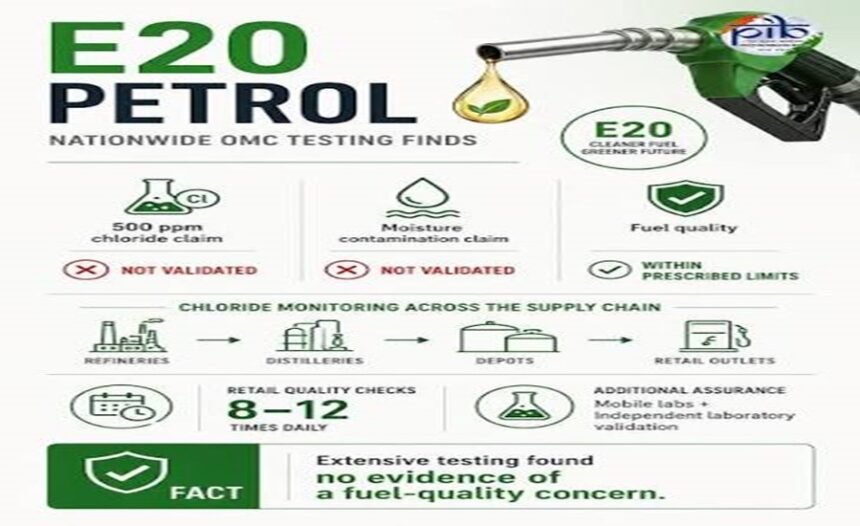
Oil marketing companies (OMCs) have expanded testing across the entire E20 petrol supply chain after media reports claimed the fuel contained moisture and high chloride levels. The results tell a different story: nationwide testing shows fuel quality staying within prescribed limits, and the random, scientifically designed sampling found nothing to suggest contamination is a real problem.
What the specification requires
The government has set strict chloride limits for ethanol used in petrol blending, backed by a monitoring system that checks quality at refineries, distilleries, depots, terminals, and retail outlets. That’s meant to catch problems anywhere along the distribution chain, not just at the point of sale.
OMCs have also added extra layers of surveillance on top of the existing protocols. Retail outlets now get water-ingress and density tests 8 to 12 times a day. Mobile testing labs have been deployed to various locations, and results are being cross-checked by independent fuel laboratories.
Refinery-level testing
More than 100 additional petrol samples, chosen at random from refineries across the country, were tested for chloride content by OMC’s. Every one came in at or below 1 ppm, well under the prescribed limit. That result reflects the quality checks already built into the refining and dispatch process.
Ethanol and blended fuel down the chain
Ethanol from distilleries is the main ingredient blended into E20 petrol, so its quality matters just as much as the petrol itself. A joint task force from OMCs and the Centre for High Technology tested samples from 80 distilleries over ten days. Chloride levels stayed under 3 ppm in every case.
Fuel tested by OMCs at depots and terminals showed the same pattern. More than 80 samples pulled from OMC terminals nationwide came in below 3 ppm, suggesting quality holds up as the fuel moves through storage and distribution.
Retail outlet results tell a different story than the reports
At the retail level, an intensified monitoring drive is underway across more than 1,000 outlets, with 160 test reports analyzed so far. Chloride levels ranged from 0 to 3 ppm, nowhere close to the several hundred ppm figures that circulated in media reports. Four outlets did show elevated chloride readings. Those were shut down right away, investigated for the root cause, and only reopened once the issue was fixed.
Checking for water in storage tanks
Around 90,000 retail outlets have started mandatory inspections of their underground storage tanks, with checks running 8 to 12 times daily. So far, none of that testing has turned up water ingress.
Ongoing transparency
A full breakdown of test results is posted on the Centre for High Technology’s website and gets updated as new data comes in.
Key Takeaway: OMCs maintain that fuel quality is their top priority and that surveillance runs continuously across the supply chain, with any deviation triggering immediate corrective action. Based on the testing done so far, there’s no support for the claims of 500 ppm chloride or widespread moisture contamination that prompted this round of scrutiny. The companies are telling consumers they can keep using E20 petrol with confidence, since fuel moving through the OMC network meets the required specifications at every stage, from refinery to pump.
MCQ’s:
1. In the context of India’s fuel policy, what does E20 petrol refer to?
A) Petrol containing 20% methanol
B) Petrol containing 20% ethanol
C) Petrol containing 20% biodiesel
D) Petrol containing 20% hydrogen
2. Which organization was mentioned in the article as participating in the testing of ethanol and fuel samples along with oil marketing companies (OMC’s)?
A) Central Electricity Authority
B) Centre for High Technology
C) Bureau of Indian Standards
D) Petroleum and Natural Gas Regulatory Board
Read more: Powering a Brighter Tomorrow: India Hits Historic 300 GW Non-Fossil Fuel Power Capacity