
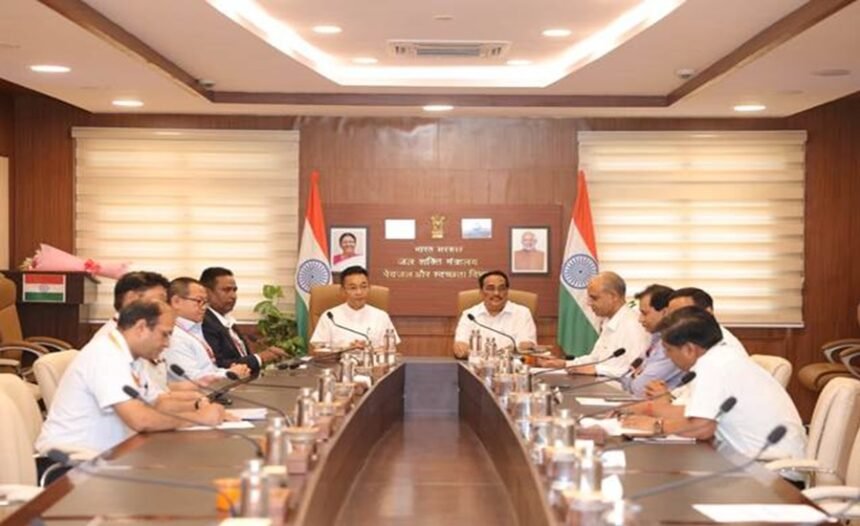
The Department of Drinking Water and Sanitation (DDWS), under the Ministry of Jal Shakti, has signed a reform-linked Memorandum of Understanding (MoU) with the Government of Sikkim as part of Jal Jeevan Mission (JJM) 2.0. The agreement is centred around service which is led by Gram Panchayat and focuses on a community-driven model to ensure rural water supply. All of this falls in line with the vision of Viksit Bharat @2047 of which the goal remains to ensure regular access to safe drinking water and water security in the long run.
Putting Gram Panchayats at the Centre
At its core, the MoU aims to make sure every rural household gets drinking water in adequate quantity and of prescribed quality. It leans heavily on community participation, or Jan Bhagidari, along with structural reforms and better operation and maintenance of rural water systems. Gram Panchayats and Village Water & Sanitation Committees (VWSCs) are placed at the centre of managing and running village-level water infrastructure, the idea being that local ownership improves both service delivery and accountability.
The MoU was signed in the presence of Union Minister of Jal Shakti C. R. Patil and Sikkim Chief Minister Prem Singh Tamang. Senior officials attended as well, including DDWS Secretary Ashok K. K. Meena, Additional Secretary and Mission Director of the National Jal Jeevan Mission Kamal Kishore Soan, and Joint Secretary D. Senthil Pandiyan. The agreement itself was exchanged between Senthil Pandiyan and Ashwini Kumar Chand, ADGP-cum-Principal Resident Commissioner for the Government of Sikkim.
What the Leaders Said
Speaking at the event, the Union Minister noted that Jal Jeevan Mission, launched under Prime Minister Narendra Modi, has expanded rural drinking water access significantly across the country, easing the burden of fetching water that has traditionally fallen on women and girls. Under JJM 2.0, the focus has shifted from building new infrastructure to sustaining it: keeping tap connections functional, improving water quality, protecting water sources, strengthening operation and maintenance, building community ownership, and tightening monitoring.
Patil also praised Sikkim’s progress under the Mission so far, and pushed the state to sharpen its district-level planning by preparing District Improvement Plans based on water service assessments done at the Gram Panchayat level. He asked for a comprehensive O&M policy covering all 19 essential service points, along with timely completion of Sujal Gram ID and Sujalam Bharat ID creation to support sustainable water delivery going forward.
Chief Minister Prem Singh Tamang, for his part, spoke about how transformative the Mission has been in a geographically difficult state like Sikkim. He reaffirmed the state’s commitment to expanding and sustaining rural drinking water infrastructure, pointing out that Sikkim has upgraded and modernised its rural water network despite tough terrain and high infrastructure costs. He also mentioned ongoing efforts to protect water sources through initiatives like the CAMPA project and VB-G RAM G, and said the MoU would help push functional household tap connections further into remote rural areas.
Key Takeaway: The agreement isn’t just about building infrastructure, it’s equally about ensuring services keep running through decentralised governance and community ownership. The role of District Water and Sanitation Mission (DWSM) meetings, Village Action Plans and Panchayat certification remain paramount in strengthening how rural water is managed, and ultimately ties it back to the Prime Minister’s vision of “Har Ghar Nirantar Nal Se Jal.”
MCQ’s:
1. Under Jal Jeevan Mission 2.0, which institutions have been placed at the centre of managing village-level rural drinking water systems?
A. District Collector and Zila Parishad only
B. Gram Panchayats and Village Water & Sanitation Committees (VWSCs)
C. State Water Boards only
D. NITI Aayog and State Planning Boards
2. Jal Jeevan Mission 2.0 primarily shifts its focus towards:
A. Construction of large irrigation dams
B. Expansion of urban water supply networks
C. Sustaining functional tap water services through operation, maintenance, water quality, and community ownership
D. River interlinking projects
Read more: Abundant Urea Availability in Punjab for Kharif 2026: Government Ensures Strong Supply