
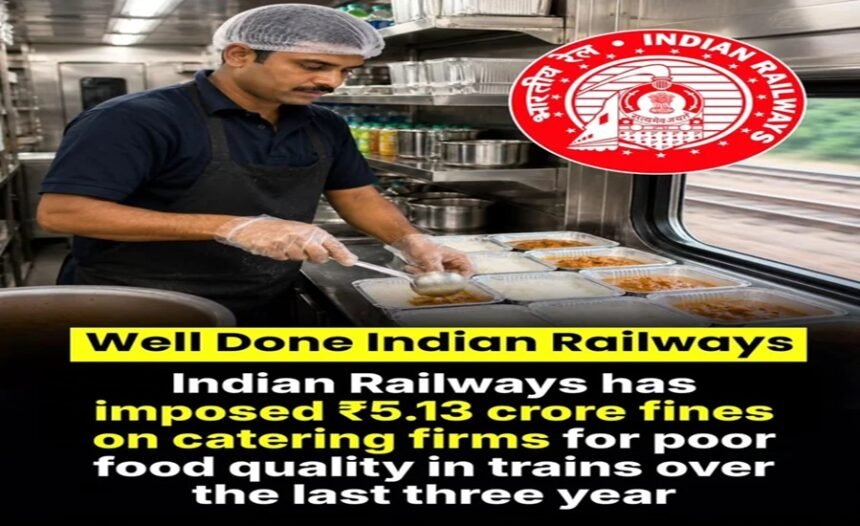
Indian Railways serves close to 58 crore meals every year. Against that scale, complaints about food quality work out to roughly 0.0008% of meals served, a small fraction, but IRCTC still tracks and acts on each one. Looking at complaints filed over the last three years, the Indian Railway Catering and Tourism Corporation (IRCTC) has imposed fines totalling ₹5.13 crore, issued 54 show-cause notices, terminated 6 contracts, and debarred licensees found violating standards. Names of debarred licensees are listed on the IRCTC website.
How the checks are carried out
Railway officials, IRCTC personnel and Food Safety Officers run both routine and surprise inspections to verify food quality, hygiene, safety and general compliance. These visits look at food safety practices, how staff are deployed, the condition of equipment, cleanliness, and whether prescribed standards are being followed. They’re also used to encourage better habits around handling, storing and preparing food, not just to catch problems after the fact.
What Indian Railways has changed
A number of measures now shape how food reaches passengers. Meals are supplied only from designated Base Kitchens, and modern versions of these kitchens have been commissioned at select locations. CCTV cameras installed in Base Kitchens allow real-time monitoring of food preparation. Raw materials are sourced from shortlisted, branded suppliers rather than left to individual discretion.
Food Safety Supervisors are posted at Base Kitchens specifically to watch over hygiene and safety practices, and IRCTC supervisors travel on board trains to keep an eye on service as it happens. Meal packets now carry QR codes showing the packing date, the licensee’s name and the FSSAI license number, giving passengers a way to check what they’re eating and who prepared it.
Base Kitchens and Pantry Cars undergo regular deep cleaning and periodic pest control. FSSAI certification is mandatory throughout, and food sampling is done regularly to check what’s actually going out on trains. IRCTC also runs ongoing training for catering staff, covering customer service, communication, courteous behaviour, grooming and hygiene. On top of this, third-party audits assess food quality and hygiene across Pantry Cars and Base Kitchens, and customer satisfaction surveys are used to gauge how passengers feel about the food and service they’re getting.
A system built on multiple layers
None of these checks work in isolation. Regular and surprise inspections by Railway and IRCTC officials, including Food Safety Officers, form one part of a broader, multi-layered setup meant to monitor food quality, hygiene and safety across the entire catering network. Where prevention isn’t enough, enforcement steps in.
Key Takeaway: Indian Railways is tightening food safety through stricter inspections, modern Base Kitchens, CCTV surveillance, QR-coded meal packets, mandatory FSSAI certification, food sampling and third-party audits. Alongside these preventive steps, financial penalties, show-cause notices, contract terminations and the debarment of defaulting licensees are being used to hold catering standards in place.
This information was shared by Union Minister for Railways, Information & Broadcasting, and Electronics & Information Technology Shri Ashwini Vaishnaw, in reply to a question in the Rajya Sabha.
MCQ’s:
1. Which organization is primarily responsible for catering services on Indian Railways?
A. Food Corporation of India (FCI)
B. Indian Railway Catering and Tourism Corporation (IRCTC)
C. Rail Vikas Nigam Limited (RVNL)
D. Dedicated Freight Corridor Corporation of India (DFCCIL)
2. Meal packets served on Indian Railways now carry QR codes primarily to provide:
A. Passenger reservation details
B. Information such as packing date, licensee name, and FSSAI licence number
C. Train speed and route information
D. Digital payment options only
Read more: Massive Success: PMAY-G Delivers 26.57 Lakh Homes in FY 2025-26