
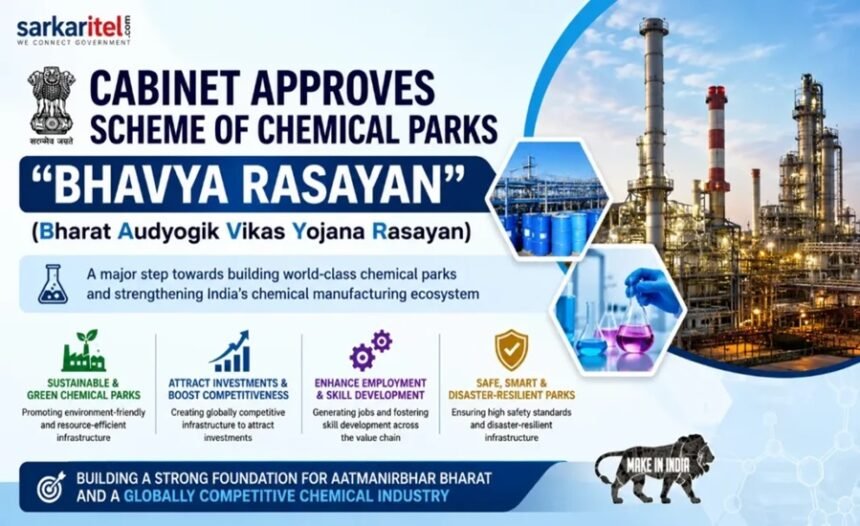
Three dedicated chemical parks in different parts of the country.will be set up as the Bharat Audyogik Vikas Yojana Rasayan (BHAVYA Rasayan) scheme, have been give the gree nlight by The Union Cabinet, led by Prime Minister Narendra Modi. The scheme was first announced in the Union Budget 2026–27, and its goal is straightforward: give India’s chemical manufacturing sector better infrastructure and a stronger footing to compete globally.
Funding and timeline
The scheme runs for five years, from FY 2026–27 through FY 2030–31, with ₹3,030 crore set aside for the whole effort. Most of that, ₹3,000 crore, goes toward building shared infrastructure and basic utilities at the parks. The remaining ₹30 crore covers administrative costs.
For each park, the Centre will chip in up to ₹1,000 crore, but only if the state government puts in at least ₹500 crore of its own. States will compete for the three park locations through a challenge-based selection process, and each site needs a minimum of 8 square kilometres, or roughly 2,000 acres, of contiguous land that’s free of any encumbrances.
What the parks will offer
These won’t be bare industrial plots. Each park is meant to come with plug-and-play infrastructure built specifically for chemical manufacturing: common effluent treatment plants, treatment, storage and disposal facilities, water supply systems, solvent recovery and distillation units, steam generation and distribution, connected pipeline networks, and logistics and warehousing space.
The idea is to let companies move in and start operating without having to build all this from scratch on their own, which is usually one of the bigger costs and delays in setting up a chemical plant.
Why the government is doing this
Beyond the physical infrastructure, the scheme has a few connected aims. It wants to support upstream, downstream and ancillary industries so they grow together rather than in isolation. Shared infrastructure should also cut logistics costs for companies operating in these zones and make better use of resources overall.
There’s an export angle too. Officials expect the parks to help Indian chemical manufacturers plug into global supply chains more easily, push exports higher, and cut down on imports of chemicals India currently buys from abroad. All of this is meant to sharpen the competitive edge of the domestic industry.
Environmental compliance gets attention as well. Centralised waste treatment and hazardous waste management facilities are built into the plan, which should make it easier for companies to meet environmental rules without each one setting up separate systems.
The bigger picture
Chemicals and petrochemicals feed into a long list of other industries: agriculture, pharmaceuticals, textiles, nutraceuticals, construction, automobiles, electronics. Because of that reach, the government is betting these parks will pull in both domestic and foreign investment, add manufacturing capacity, and create jobs, feeding into the broader Viksit Bharat 2047 goal.
Key Takeaway: BHAVYA Rasayan will build three integrated chemical parks with shared, modern infrastructure to give India’s chemical sector room to grow. Investment, sustainability, exports and competitiveness are the stated priorities, with the government framing it as a step toward long-term growth and greater self-reliance in chemicals manufacturing.
MCQ’s:
1. The BHAVYA Rasayan Scheme, approved by the Union Cabinet, primarily aims to:
A. Promote organic farming across India.
B. Establish integrated chemical parks with shared infrastructure.
C. Develop petroleum exploration blocks.
D. Set up semiconductor manufacturing units.
2. Under the BHAVYA Rasayan Scheme, the maximum Central assistance for each approved park is:
A. ₹500 crore
B. ₹750 crore
C. ₹1,000 crore
D. ₹1,500 crore
Read more: The Majestic Journey of White Gold: Celebrating India’s Cotton Story