
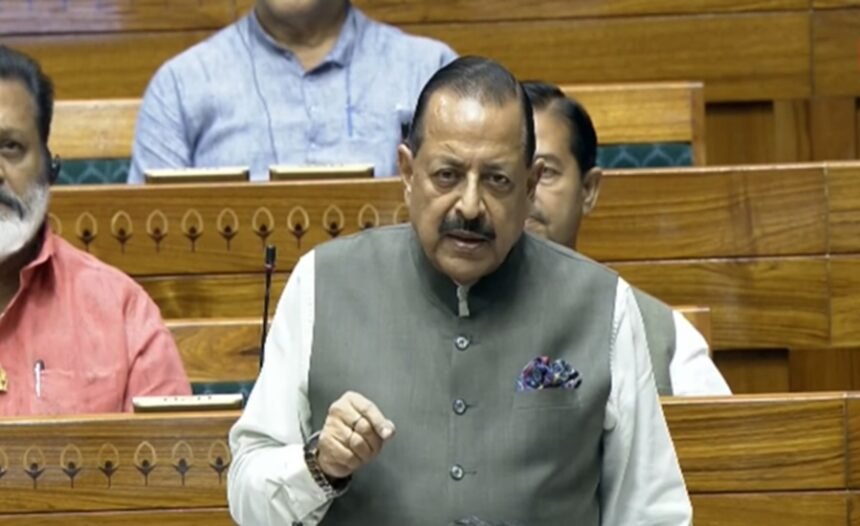
Dr. Jitendra Singh, who holds charge of the Ministry of Science & Technology, Earth Sciences, and also serves as Minister of State in the Prime Minister’s Office overseeing Personnel, Public Grievances and Pensions, Atomic Energy, and Space, told Parliament that the Public Examinations (Prevention of Unfair Means) Amendment Bill, 2026 marks a significant step toward tightening the legal net around examination-related malpractices and safeguarding the interests of students and youth nationwide.
Opening the discussion on the Bill in the Lok Sabha, he said the legislation reflects the Government’s ongoing commitment to protecting students’ futures and carries forward Prime Minister Shri Narendra Modi’s resolve that nobody should be allowed to compromise the aspirations of India’s youth. He called the Bill a milestone moment for the integrity of the country’s public examination system.
Why a National Framework Became Necessary
According to the Minister, question paper leaks and other exam-related malpractices have surfaced across various states over the years, and that pattern is exactly what made a comprehensive national legal framework necessary in the first place. He pointed out that the Government had already responded with the Public Examinations (Prevention of Unfair Means) Act, 2024, the country’s first comprehensive law targeting unfair means in public exams, and that the amendments now being proposed draw on lessons learned while implementing that Act, with the goal of making it more stringent and effective.
He also noted the scope of the existing Act, which covers examinations run by major recruitment bodies such as the Union Public Service Commission (UPSC), Staff Selection Commission (SSC), Railway Recruitment Boards (RRBs), and the Institute of Banking Personnel Selection (IBPS), as well as the National Testing Agency (NTA) for admissions to higher education. He reminded the House that the 2024 Act had already made offences under it cognizable, non-bailable, and non-compoundable, backed by strict penal provisions.
What the Amendment Bill Changes
Walking through the Bill’s key provisions, the Minister said punishment for individuals resorting to unfair means would rise from a range of three to five years’ imprisonment to five to ten years, while the maximum fine would jump from ₹10 lakh to ₹50 lakh. Service providers caught up in such offences would face a maximum fine increased from ₹1 crore to ₹5 crore, and their debarment period from conducting public examinations would extend from four years to eight years.
Directors and senior management at these service providers would also see their punishment enhanced, from a three-to-ten-year imprisonment range to five to ten years, with the maximum fine similarly rising from ₹1 crore to ₹5 crore. For organised crime tied to exam malpractice, the Bill proposes raising the punishment from five-to-ten years to seven to ten years’ imprisonment, and lifting the maximum fine from ₹1 crore to ₹10 crore.
Building in Speed: Fast Track Courts and Time-Bound Trials
Speedy justice was another point Dr. Jitendra Singh stressed. The Amendment Bill proposes setting up Special Fast Track Courts specifically to handle offences related to public examinations. Under the Bill’s framework, investigations would need to wrap up within two months, and trials would need to conclude within three months of the charge sheet being filed, keeping such cases from dragging on.
The Bill would also give the Central Government the power to hand over investigation of offences under the Act to a Special Task Force set up for that purpose, allowing for quicker, more coordinated action against organised examination-related crime.
Progress Already Underway
The Minister told the House that the Government has already begun setting up Special Fast Track Courts in several locations to speed up case disposal. He also referenced the Prime Minister’s earlier announcement of a high-level task force made up of eminent experts, tasked with making the public examination system “leak-proof,” and said meaningful progress has already been made in acting on the recommendations of the committee formed to strengthen the examination ecosystem.
The broader objective, he said, is to make sure students are rewarded for their genuine effort, while boosting the credibility, transparency, and fairness of public examinations overall.
Wrapping up his remarks, Dr. Jitendra Singh said the proposed amendments would strengthen deterrence against organised examination-related crime, deliver faster justice, and further build public confidence in the integrity, transparency, and fairness of India’s public examination system.
Key Takeway: The proposed Public Examinations (Prevention of Unfair Means) Amendment Bill, 2026 seeks to further strengthen India’s legal framework against examination malpractices by making penalties stricter, ensuring faster investigation and trial, and improving accountability among individuals and service providers involved in unfair practices.
Building upon the Public Examinations (Prevention of Unfair Means) Act, 2024, which brought major recruitment and examination bodies such as the UPSC, SSC, Railway Recruitment Boards, IBPS, and NTA under a common legal framework, the amendments propose higher punishments, increased fines, longer debarment periods for service providers, and tougher action against organised exam-related crimes.
The Bill also introduces provisions for Special Fast Track Courts, time-bound investigations and trials, and the possibility of investigation by specialised task forces to ensure swift action. These measures aim to protect the credibility of India’s public examination system, uphold transparency and fairness in recruitment and admissions, and ensure that merit and genuine effort remain the foundation for opportunities in government services and higher education.
M.C.Q.
Question 1: The Public Examinations (Prevention of Unfair Means) Amendment Bill, 2026 proposes to increase the maximum fine on individuals resorting to unfair means from ₹10 lakh to what amount?
- A) ₹20 lakh
- B) ₹50 lakh
- C) ₹1 crore
- D) ₹5 crore
Question 2: Under the Amendment Bill, 2026, trials in cases related to public examination malpractice must conclude within how many months of the charge sheet being filed?
- A) One month
- B) Two months
- C) Three months
- D) Six months
Read More: Para Powerlifter’s Powerful, Inspiring Medal Winning Story