
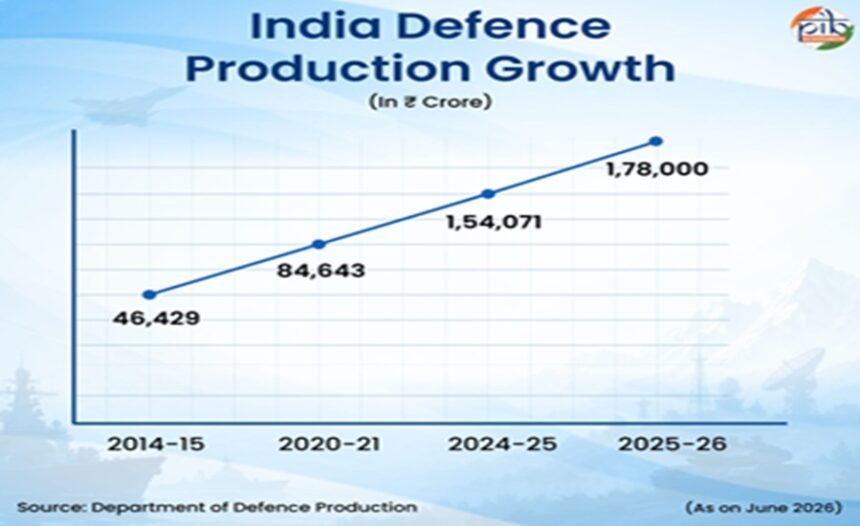
India’s defence sector looks fairly different today than it did in 2014, and the numbers make the case on their own. The budget went from ₹2.53 lakh crore in 2013–14 to ₹7.85 lakh crore in 2026–27. Indigenous production climbed from ₹46,429 crore to ₹1.78 lakh crore over the same stretch, and exports, which were a modest ₹686 crore back then, hit a record ₹38,424 crore, now reaching more than 80 countries. Reforms like DAP 2020, the Positive Indigenisation Lists, the Technology Development Fund, iDEX, and SRIJAN are behind a lot of that shift, pushing domestic manufacturing, innovation, and private-sector involvement further than they’d gone before.
Where the capability build-out is coming from
Capital expenditure rose from ₹94,587.95 crore in 2014–15 to ₹2.19 lakh crore in 2026–27, funding newer platforms and military infrastructure. Defence research spending more than doubled, from ₹13,716.14 crore to ₹29,100.25 crore, and a quarter of that R&D budget is now open to industry, startups, and academic institutions rather than staying locked inside government labs.
Innovation programmes have picked up real traction. By March 2026, iDEX had worked with 676 startups, MSMEs, and individual innovators, and signed 551 design and development contracts. The ADITI Scheme, backed by ₹750 crore, runs alongside it to push more advanced defence tech. DRDO, meanwhile, has leaned into its Development-cum-Production Partner model, now with 134 production partners, 2,180 technology transfer agreements, and over 2,780 intellectual property rights handed to Indian industry. Under the Technology Development Fund, 80 projects worth ₹334 crore were in progress as of June 2026.
Procurement itself got simpler too. DPP 2016, DAP 2020, DPM 2025, and the draft DAP 2026 each chipped away at acquisition red tape while raising indigenous content requirements. Some of the bigger approvals to come out of this: 97 Tejas Mk-1A fighters, 156 Prachand Light Combat Helicopters, and a handful of other indigenous platforms.
The manufacturing base has grown alongside it
Production hit ₹1.78 lakh crore in 2025–26, a 15.6% jump year-on-year and more than double what it was in 2020–21. Public sector units still do most of the heavy lifting, 76% of production, with the private sector making up the remaining 24%.
The industrial base itself now runs to 16 DPSUs, roughly 500 licensed defence companies, and close to 17,000 MSMEs. Licences issued grew from 258 in 2015 to 834 by March 2026, and 145 firms are now exporting. A few structural changes underpin this: the 2021 corporatisation of the Ordnance Factory Board, the SRIJAN and SRIJAN DEEP portals, FDI liberalised to 74% via the automatic route and 100% through government approval, and an overhauled export system.
Regional manufacturing corridors in Uttar Pradesh and Tamil Nadu have pulled in over ₹74,000 crore in investment commitments between them, building out supply chains, testing infrastructure, and local jobs.
On the operational side
A string of milestones marks the period: Mission Shakti in 2019, Mission Divyastra in 2024, indigenous systems deployed during Operation Sindoor, and advanced air defence testing through 2025. Platforms like the Tejas fighter, the Arjun Mk-IA tank, and various AI-enabled systems have added real combat capability. More recently, DRDO completed a long-duration scramjet combustor test in January 2026, and a new Hypersonic Wind Tunnel is now supporting research into next-generation missile tech.
On the people side, the Agnipath Scheme, launched 15 June 2022, is aimed at building a younger, more technically trained force through structured military training and certifications that carry recognition beyond the armed forces.
Partnerships have expanded too
India’s kept building out strategic ties without giving up much on autonomy. With the US, cooperation has deepened through LEMOA, COMCASA, BECA, and a ten-year defence partnership framework signed in 2025, plus work under iCET and TRUST. Russia, France, Japan, Australia, the EU, and the UAE have all become partners in joint production, tech transfer, and industrial collaboration in various forms. India’s also more active in the Quad, SCO, and ADMM-Plus, pushing maritime security and a rules-based Indo-Pacific through the SAGAR and MAHASAGAR frameworks.
Key Takeaway: Over roughly a decade, the sector has moved from being heavily import-dependent to something closer to a self-sustaining ecosystem, more R&D, more domestic manufacturing, more exports, and a wider set of international partnerships to go with it. Whether that momentum holds through Vision 2047 will come down to whether the self-reliance push, the tech investment, and the diplomatic relationships keep reinforcing each other the way they have over the last decade.
MCQs:
1. India’s defence budget increased from ₹2.53 lakh crore in 2013–14 to approximately how much in 2026–27?
A) ₹5.85 lakh crore
B) ₹6.75 lakh crore
C) ₹7.85 lakh crore
D) ₹8.50 lakh crore
2. India’s indigenous defence production reached what level in 2025–26?
A) ₹1.18 lakh crore
B) ₹1.38 lakh crore
C) ₹1.58 lakh crore
D) ₹1.78 lakh crore
Read more: Kisan Sarathi: India’s Integrated Digital Agro-Advisory Platform Transforming Agricultural Extension