

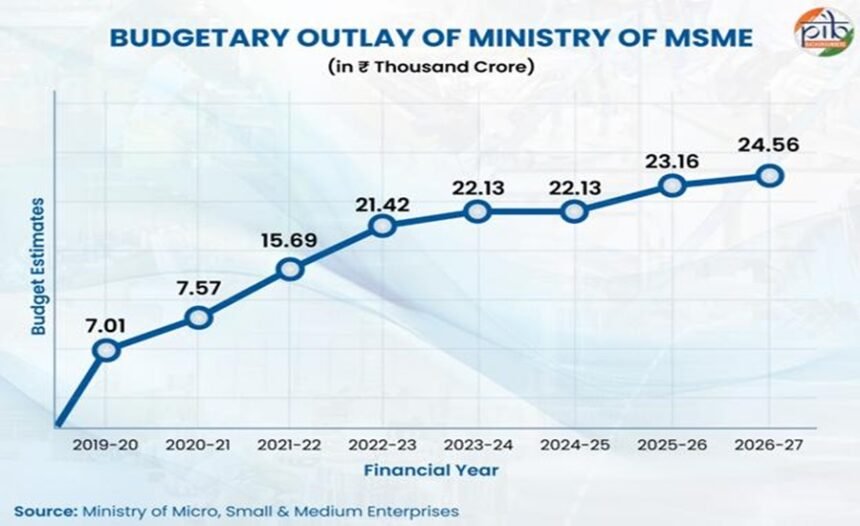
Micro, small and medium enterprises (MSMEs) are one of the more consistent forces in India’s economy they drive jobs, manufacturing, exports, and entrepreneurship all at once. The Union Budget 2026-27 puts them front and centre, with a push toward scale, competitiveness, and better integration into global supply chains.
Just how big is the MSME sector?
Over 7.47 crore enterprises, employing more than 32.82 crore people. That makes MSMEs India’s second-largest source of employment after agriculture. They account for around 35.4% of manufacturing output, about 48.58% of exports, and nearly 31.1% of GDP.
They also do something the raw numbers don’t capture: pushing industrialisation into rural and backward regions, which helps even out regional development and income gaps. That’s part of why the Budget treats MSMEs as central to inclusive growth, not just an economic afterthought.
Three pillars
Equity: A new ₹10,000 crore SME Growth Fund is meant to help promising businesses scale up. The existing Self-Reliant India (SRI) Fund, running since 2021, gets another ₹2,000 crore. So far it’s backed 682 MSMEs with ₹15,442 crore in investment, as of November 30, 2025.
Liquidity: The Trade Receivables Discounting System (TReDS) has already unlocked more than ₹7 lakh crore in working capital. The Budget wants to push that further: Central Public Sector Enterprises will now be required to settle all MSME purchases through TReDS, CGTMSE will offer credit guarantee support for invoice discounting on the platform, GeM will be integrated with TReDS so buyers and financiers share information more smoothly, and TReDS receivables will become asset-backed securities to deepen the secondary market. In plain terms, TReDS lets MSMEs borrow against money they’re owed by corporates, government departments, and public enterprises.
Professional support: ICAI, ICSI, and ICMAI will build short modular courses to train up a network of accredited “Corporate Mitras” mostly in Tier-II and Tier-III cities who’ll help smaller businesses handle compliance without hiring expensive consultants.
Opening up export markets
The Budget scraps the ₹10 lakh value cap per consignment on courier exports entirely. That should cut friction for small exporters, artisans, start-ups, and e-commerce sellers trying to sell across borders, and it comes paired with better tech for tracking rejected or returned shipments.
Getting MSMEs into the formal system
The Udyam Registration Portal (2020) and the Udyam Assist Platform (January 2023) exist to bring informal businesses into the formal economy and open up access to government schemes and priority lending. Between July 2020 and December 2025, more than 7.30 crore enterprises registered through Udyam (4.37 crore), and Udyam Assist (2.92 crore).
Where employment support stands
The Prime Minister’s Employment Generation Programme has, since FY 2008-09, supported over 10.71 lakh micro enterprises, disbursed ₹29,249.43 crore in margin money subsidy, and generated an estimated 87 lakh jobs; figures current through December 2025.
The MSME Champions Scheme, built around three components (ZED for sustainability, LEAN for competitiveness, and MSME Innovative), has seen 2,71,373 MSMEs register for ZED certification with 1,92,689 actually certified, and 32,077 register for LEAN with 31,987 taking the Lean pledge. The scheme also covers quality manufacturing, process efficiency, innovation, incubation, design support, and IP protection.
Digital commerce and dispute resolution
ONDC and the TEAM Initiative are expanding e-commerce access for MSMEs, with TEAM targeting 5 lakh enterprises onboarded. Separately, the government launched an MSME Online Dispute Resolution Portal on June 27, 2025 (MSME Day) to encourage settlement talks before disputes escalate under the MSMED Act, 2006; the goal being faster payment recovery without wrecking business relationships in the process.
Credit access
The Credit Guarantee Scheme for Micro and Small Enterprises just crossed one crore guarantees since it launched in August 2000, marking 25 years in 2025. Between January and November 2025 alone, it approved 29.03 lakh guarantees worth ₹3.77 lakh crore. The guarantee coverage limit has gone up from ₹5 crore to ₹10 crore, and transgender entrepreneurs now get a 10% concession on guarantee fees plus 85% coverage.
PM Vishwakarma: supporting artisans
Launched in September 2023, this scheme supports artisans across 18 traditional trades. As of December 1, 2025: over 30 lakh beneficiaries registered, 23.09 lakh trained, and more than 20 lakh receiving both training and banking support. 7.7 lakh completed basic skill training in 2025 alone. The scheme has sanctioned ₹2,257 crore in collateral-free loans to 2.62 lakh beneficiaries, digitally enabled 6.7 lakh artisans, and onboarded more than 30,000 beneficiaries onto GeM.
Labour reforms
Ongoing labour code changes aim to simplify compliance, formalise employment, and strengthen social security and workplace safety mostly by cutting procedural steps and pushing more of the process online, which should lower compliance costs for MSMEs.
Key Takeaway: MSMEs have become one of the more dependable parts of India’s growth story over the past several decades. The 2026-27 Budget builds on that with targeted moves on capital, liquidity, digitalisation, market access, and skills, betting that as manufacturing expands and supply chains shift globally, Indian MSMEs are positioned to grow bigger, more innovative, and more export-focused.
MCQ :
1. The Trade Receivables Discounting System (TReDS) is primarily designed to:
A. Provide crop insurance to farmers
B. Facilitate invoice financing for MSMEs
C. Finance infrastructure projects
D. Promote foreign direct investment
2. The PM Vishwakarma Scheme, launched in September 2023, primarily aims to support:
A. Large manufacturing industries
B. IT startups
C. Traditional artisans and craftspeople
D. Export promotion councils
Read more: The Impact of Union Budget FY 2026-2027 on Chemical Parks