
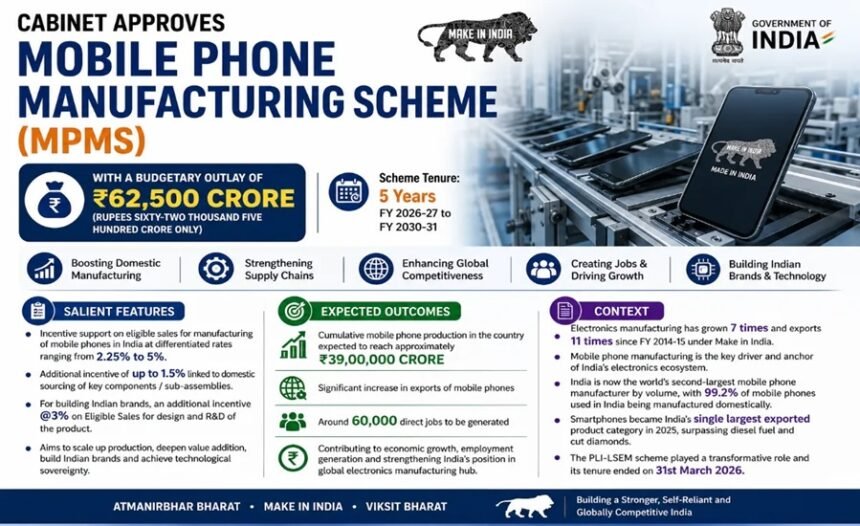
The Mobile Phone Manufacturing Scheme (MPMS) has been approved by The Union Cabinet, chaired by Prime Minister Narendra Modi, backed by a budgetary outlay of ₹62,500 crore. The scheme is meant to expand mobile phone production, lift domestic value addition, strengthen supply chains and sharpen India’s competitiveness in global electronics manufacturing. It also emphasizes and puts weight behind indigenous brands and innovation.
Mobile Phone Manufacturing Scheme to Strengthen India’s Electronics Ecosystem
MPMS has come in to accelerate India’s mobile phone manufacturing industry, encouraging higher production, deeper localisation of components and a supply chain that can hold up under pressure. This positions the scheme as a natural successor to earlier manufacturing incentive efforts, aiming to push the sector beyond assembly-level operations and into a more self-reliant, resilient ecosystem capable of weathering global disruptions.
The MPMS stays active for five years, from FY 2026-27 to FY 2030-31, giving manufacturers a reasonably long runway to plan investments, scale up facilities and align their production strategies with the incentive structure on offer. It offers incentives between 2.25 per cent and 5 per cent on eligible sales of phones manufactured in India, a tiered structure designed to reward higher output and better performance across participating companies.
There’s more on offered by the MPMS: manufacturers can pick up an additional incentive of up to 1.5 per cent for sourcing more key components and sub-assemblies domestically, a provision clearly aimed at deepening the domestic value chain rather than simply incentivising final assembly. And for Indian brands specifically, there’s a further 3 per cent incentive on eligible sales tied to investment in design and R&D, a targeted push to help homegrown companies move up the value chain and compete on innovation, not just cost.
The government is banking on this to expand mobile manufacturing capacity in a big way, viewing the scheme as a lever for both scale and sophistication within the sector. Cumulative production during the scheme’s run is projected to hit around ₹39 lakh crore, with exports climbing alongside it, signalling an intent to position India as a serious player in global mobile phone trade rather than just a domestic assembly base. Around 60,000 direct jobs are expected to come out of it as well, feeding into employment, economic growth and India’s ambition to be a global electronics manufacturing hub, with the ripple effects likely extending to ancillary industries, component suppliers and skill development across the manufacturing ecosystem
Building on India’s Mobile Manufacturing Success
India’s electronics manufacturing has come a long way under Make in India. Production is up seven-fold and exports up eleven-fold since FY 2014-15. Along the way, the sector has become a serious employer, particularly for younger workers. Some plants now employ more than 5,000 people at a single location.
Mobile phones have blazed the trial and are leading that charge. India is now the world’s second-largest mobile phone manufacturer by volume today, and 99.2 per cent of phones used in the country are made right here. In 2025, smartphones overtook diesel fuel and cut diamonds to become India’s largest export product, a shift that’s helped India dig in deeper across global value chains.
Much of this owes to the Production Linked Incentive Scheme for Large Scale Electronics Manufacturing (PLI-LSEM), which closed out on March 31, 2026, after playing a central role in getting India’s mobile manufacturing and exports this far. MPMS steps in now to carry that forward.
Key Takeaway: MPMS is built around financial incentives, stronger domestic value addition and dedicated support for Indian brands, all aimed at accelerating the country’s mobile manufacturing industry. With ₹62,500 crore behind it, the scheme is set to push production, exports, employment and innovation forward, while reinforcing India’s spot as a top global hub for mobile phone manufacturing.
MCQ’s:
1. Under MPMS, manufacturers are eligible for incentives ranging between:
A. 1%–3%
B. 2.25%–5%
C. 5%–8%
D. 4%–6%
2. Manufacturers can receive an additional incentive of up to ______ for sourcing more key components and sub-assemblies domestically.
A. 0.5%
B. 1%
C. 1.5%
D. 2%