
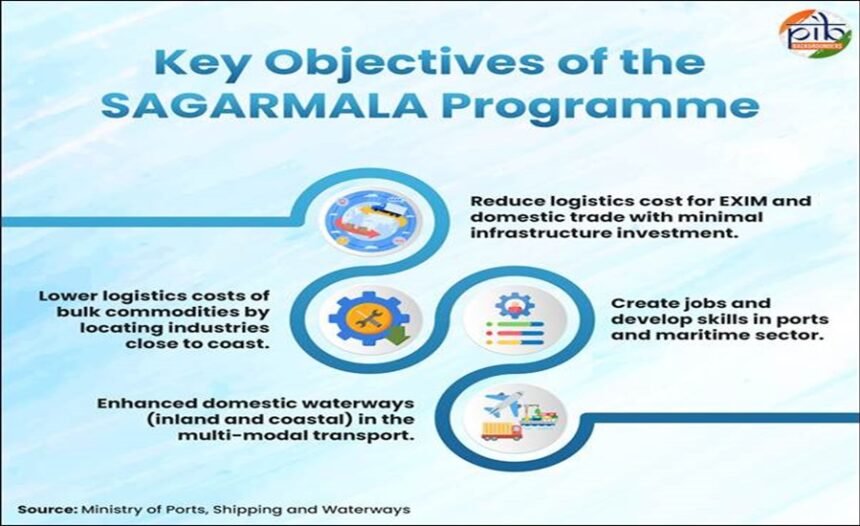
The government launched the Sagarmala Programme in March 2015 to build on modernising ports, improving logistics, cutting transportation costs, and pushing more freight onto coastal shipping and inland waterways.
India’s coastline runs over 11,099 kilometres, and its navigable waterways stretch nearly 14,500 kilometres more. Together they carry about 95% of the country’s trade by volume and 70% by value numbers that explain why the maritime sector has become so central to how India moves goods.
Where the infrastructure stands
India runs 12 major ports and more than 200 non-major ones, moving everything from crude oil and coal to containers, fertilizers, and farm produce. Sagarmala has identified 845 projects under this umbrella, worth ₹6.06 lakh crore combined. As of March 24, 2026, 315 of them (₹1.57 lakh crore) are finished, 210 are being built, and 320 are still in planning.
The programme rests on five pillars: modernising and building ports, improving port connectivity, driving port-led industrialisation, developing coastal communities, and expanding coastal shipping and inland waterways transport.
Capacity and connectivity gains
Seven coastal berth projects, worth ₹494 crore, are complete and have added 9.84 million tonnes per annum of cargo capacity. Eleven fishing harbour projects worth ₹1,057 crore are also done, reaching more than 30,000 fishermen. Malpe in Karnataka is one example of a harbour that’s been expanded and modernised. Work is also underway at Mumbai Port’s Pir Pau Terminal and the historic Bascule Bridge at Kolkata’s Syama Prasad Mookerjee Port.
Port performance
Major ports handled 915.17 million tonnes of cargo in FY 2025-26, beating the 904 million tonne target, with year-on-year traffic growth of 7.06%. Average vessel turnaround time has fallen from 96 hours in 2014 to 49.5 hours in 2025. Nine Indian ports now rank among the world’s top 100.
Inland waterway cargo has grown even faster: from 18.10 MTPA in FY 2013-14 to 145.50 MTPA in FY 2024-25, roughly a sevenfold increase.
Moving people, not just cargo
Sagarmala has also funded Ro-Pax and ferry services. Twenty-nine such projects, worth ₹1,233 crore, have been undertaken, and 17 of them (₹706 crore) are already running. More than 35 lakh passengers have used these routes.
The Ghogha-Hazira Ro-Pax service is a good illustration of what that means in practice: a road trip of nearly 10 hours becomes a sea crossing of about 4, and the route has carried over 36,000 trucks, 61,000 cars, and close to 4 lakh passengers. The Mumbai-Mandwa ferry does something similar, swapping a 109-kilometre road journey for an 18.5-kilometre sea route.
Jobs and coastal communities
Skill-building is folded into the programme through the Deen Dayal Upadhyaya Grameen Kaushalya Yojana. More than 7,600 candidates have been trained so far, and over 3,100 have found jobs in maritime and related sectors. Sagarmala’s own projections put total employment potential at around 1 crore jobs of which 40 lakh would be direct and 60 lakh would be indirect.
How it’s run
Four bodies oversee implementation: the National Sagarmala Apex Committee sets policy, the Maritime States Development Council handles Centre-State coordination, State Sagarmala Committees identify and implement projects locally, and the Sagarmala Finance Corporation Limited handles financing. SMFCL formerly the Sagarmala Development Company Limited became India’s first maritime-focused NBFC in 2025 and approved about ₹4,300 crore in loan sanctions that December, its first move into maritime lending.
Key Takeaway: The government has proposed Sagarmala 2.0, a wider push aligned with Maritime India Vision 2030 and Maritime Amrit Kaal Vision 2047. It covers port modernisation, coastal and hinterland connectivity, inland waterway expansion, coastal shipping, maritime research, and island and coastal community development, backed by ₹85,482 crore in budgetary support and a target of ₹3.6 lakh crore in total investment. A decade in, Sagarmala has added real port capacity, cut turnaround times, and pushed more cargo and passengers onto water. Sagarmala 2.0 is meant to build on that, with more investment aimed at ports, logistics, inland waterways, and maritime services.
MCQ :
1. The Sagarmala Programme was launched by the Government of India in:
A. 2013
B. 2014
C. 2015
D. 2016
2. Which of the following is NOT one of the five pillars of the Sagarmala Programme?
A. Port-led Industrialisation
B. Coastal Community Development
C. Inland Waterways and Coastal Shipping
D. Universal Health Coverage
Read more: Union Budget 2026-27: Empowering MSMEs for a Global India