
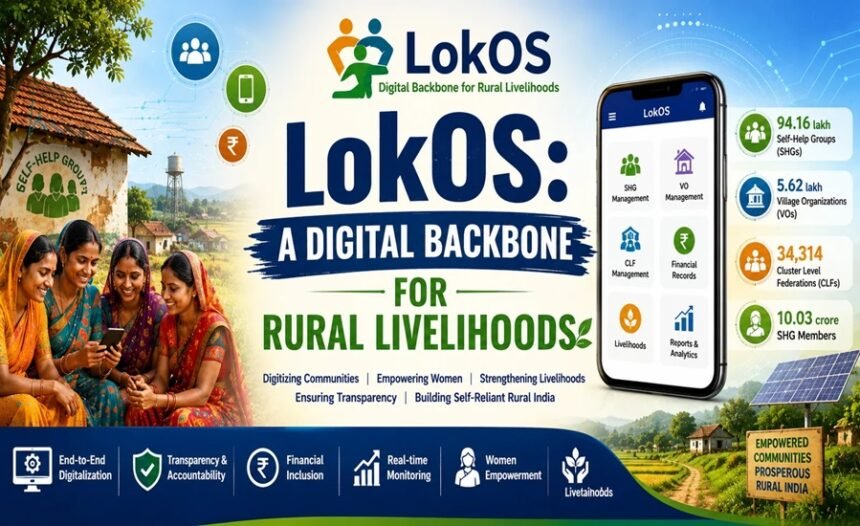
Under DAY-NRLM, the government built a digital platform called LokOS to bring India’s Self-Help Groups out of paper ledgers and onto a single system, and the numbers behind it are enormous.
What it actually does
LokOS stands for Lok Operating System, and it runs as both a web portal and a mobile app. Its job is to manage the day-to-day mechanics of Self-Help Groups and their federations: member records, savings, loans, repayments, livelihoods, and the financial transactions that tie all of it together. Before this, most of that record-keeping happened by hand, in registers kept at the village level, which made things slow to update and hard to audit. LokOS replaces that with real-time digital records, and the effect shows up in the scale of what it now tracks: close to ₹2 lakh crore in annual financial transactions across the SHG network.
The two versions of the platform serve different people in the chain. Administrators and e-bookkeepers use the web portal to create and approve SHGs, Village Organisations (VOs), and Cluster Level Federations (CLFs), along with the member records underneath them. Field-level workers, the people actually out in villages, use the mobile app to log community activities and transactions as they happen rather than writing them down and entering them later. Beyond record-keeping, the system also issues Aadhaar- and bank-linked digital identities, collects livelihood data so it can be cross-referenced against other government schemes, handles role-based approvals so different users can only act within their remit, and feeds real-time dashboards for people monitoring the programme from above.
The scale of the rollout
LokOS is now live in 34 states and union territories. Broken down further, that’s 762 districts, 7,241 blocks, 2.57 lakh Gram Panchayats, and 5.92 lakh villages, which gives some sense of how far into rural India this system now reaches. On the institutional side, it has digitally onboarded 34,314 Cluster Level Federations, 5.62 lakh Village Organisations, 94.16 lakh Self-Help Groups, and more than 10.03 crore SHG members. That last figure alone is larger than the population of most countries.
The financial tracking goes deeper than transaction volume. LokOS monitors ₹9,718.41 crore disbursed under the Revolving Fund, ₹64,607.66 crore through the Community Investment Fund, and ₹38.34 crore under the Community Enterprise Fund. These aren’t small pilot numbers; they represent the bulk of DAY-NRLM’s financial support architecture now running through one digital system instead of scattered across separate ones.
The platform has also become the backbone for the Lakhpati Didi initiative, which aims to help rural women reach an annual household income of at least one lakh rupees. LokOS is currently monitoring 3.87 crore Potential Lakhpati Didis, and that effort is backed by 6,611 Master Trainers, 4.09 lakh Community Resource Persons, and 18.50 crore Digital Aajeevika Registers, which are used for livelihood planning and tracking implementation on the ground.
More recently, a separate platform called SHE-LEAPS, short for Self-Help Entrepreneur-Livelihoods and Enterprise Application for Prosperity and Sustainability, was folded into LokOS. Its focus is women-led rural enterprises specifically. Rather than running as a standalone tool, it now gives users one unified system for creating an enterprise, managing the business day to day, and tracking performance over time, covering both farm and non-farm livelihood activities.
Key Takeaway: Taken together, the SHG digitisation, the fund tracking, and the Lakhpati Didi and SHE-LEAPS integrations add up to something bigger than a records system. LokOS has effectively become the infrastructure DAY-NRLM runs on: the layer where transparency, financial inclusion, and rural livelihood support all get implemented and measured, at a scale that touches tens of millions of households across the country.
MCQ:
Question 1:
LokOS, recently seen in the news, has been developed under which of the following schemes?
A. National Rural Livelihood Mission
B. DAY-NRLM
C. PM SVANidhi
D. Deendayal Upadhyaya Grameen Kaushalya Yojana
Question 2:
LokOS stands for:
A. Local Organisation System
B. Livelihood Operations Software
C. Lok Operating System
D. Local Opportunity Scheme
Read more: India’s Ethanol Blending Drive: Policy Milestones & Clearing the Air on E20 Concerns