
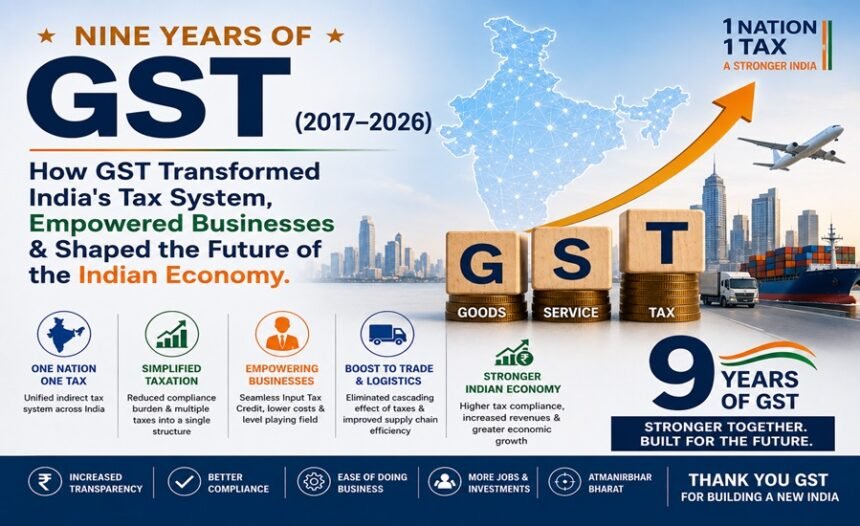
GST turned nine on 1 July 2026, and looking back, it’s held up as one of the bigger economic reforms India has attempted. When it launched in 2017, the idea was to collapse a maze of central and state indirect taxes into one framework, “One Nation, One Tax” was the slogan, and nine years on, the system has kept evolving through policy tweaks, digital tools, and closer coordination between the Centre and states.
The taxpayer base tells part of the story: 66.5 lakh registered in 2017, now 1.65 crore as of May 2026. That’s a lot more of the economy showing up on the books. The more recent chapter is GST 2.0, rolled out in September 2025, which simplified rates, eased compliance, widened exemptions, and cut down procedural headaches for households, MSMEs, farmers, and exporters.
What existed before GST
Before 2017, India ran on a patchwork: excise duty, service tax, VAT, entry tax, purchase tax, assorted cesses, each state setting its own rates. That meant compliance headaches, higher logistics costs, and the classic problem of tax being charged on top of tax. GST folded 17 taxes and 13 cesses into one system covering most goods and services, and in doing so created something closer to a genuine national market, since interstate trade no longer had to navigate different tax regimes at every border.
The base has kept growing
Beyond the taxpayer count, collections have climbed steadily: about ₹7.4 lakh crore in 2017–18, up to ₹13.76 lakh crore by 2021–22, and roughly ₹22.27 lakh crore in 2025–26. April–May 2026 alone brought in nearly ₹4.37 lakh crore. The growth tracks a few things at once: more economic activity, more taxpayers participating, digital reporting catching more transactions, and tighter compliance monitoring.
How the system is actually structured
A few design choices set GST apart from what came before. It taxes supply rather than taxing manufacture, sale, and service separately, which was the old fragmented approach. It’s destination-based, so revenue goes to the state where something is consumed, not where it’s made. Coverage is broad, though alcohol for human consumption stays outside GST, and five petroleum products remain outside for now unless the GST Council decides otherwise.
The tax itself runs on a dual structure: CGST collected by the Centre, SGST collected by states on transactions within a state, and IGST for anything crossing state lines. That split lets both levels of government retain some fiscal authority while still sharing revenue.
Overseeing all of this is the GST Council, which brings the Union and state governments together to set rates, decide exemptions, and work through procedural changes. It meets regularly, which has let the system adapt reasonably quickly to new problems as they come up, and it’s often pointed to as a working example of cooperative federalism, national tax goals balanced against state interests, rather than one overriding the other.
Running it digitally
The Goods and Services Tax Network, GSTN, is the technical backbone, jointly owned by the Centre and states. It handles registration, return filing, payments, refunds, and compliance tracking through one online platform. E-invoicing, automated filing, invoice matching, and digital validation have cut down paperwork considerably, and pre-filled returns plus automated Input Tax Credit reconciliation mean less manual work on both sides.
GST 2.0’s changes
The 56th GST Council Meeting signed off on this next phase, which took effect 22 September 2025. The main thrust was simplification: rates were rationalised down to essentially two slabs, 5% and 18%, cutting out a lot of the classification disputes businesses used to get stuck in.
A separate 40% rate now applies to luxury and sin goods, tobacco, lottery and online gaming, aerated drinks, high-end cars, yachts, private aircraft, meant to hold revenue steady even as other rates came down. Registration got simpler too, refunds move faster, and compliance costs dropped, with MSMEs and startups feeling this most directly.
Who’s benefited
Consumers have seen lower rates and wider exemptions bring costs down on various goods and services; exemptions on insurance and essential medicines in particular have made healthcare and financial protection more affordable. MSMEs got relief through lower rates on inputs like cement and handicrafts, fewer classification disputes, and fixes to inverted duty structures that had been discouraging domestic manufacturing and exports.
Small taxpayers specifically have picked up several breaks over the years. The registration threshold for goods suppliers rose from ₹20 lakh to ₹40 lakh back in April 2019, and the Composition Scheme’s turnover cap went from ₹75 lakh to ₹1.5 crore in most states, letting small businesses pay at fixed rates with lighter documentation. The QRMP scheme lets businesses turning over up to ₹5 crore file quarterly while still paying monthly, and businesses with no activity can file NIL returns by SMS. Since October 2023, small sellers doing intra-state business through e-commerce platforms haven’t needed mandatory GST registration under certain conditions, and low-risk applicants can now get registered within three working days.
On disputes, pre-deposit requirements for filing appeals have been reduced, and interest and penalty waivers are available for certain demand notices tied to 2017–18 through 2019–20, subject to conditions.
Where technology fits in
GST enforcement increasingly leans on AI, machine learning, and data analytics to flag high-risk taxpayers, catch evasion patterns, and sharpen registration scrutiny. The upside is that authorities can concentrate on the cases that actually look suspicious rather than treating every taxpayer the same, which in theory lightens the load for people who are just filing honestly. It’s also made revenue more predictable and improved fiscal transparency generally.
Key Takeaway: Nine years in, GST has reshaped how India collects indirect tax, a more unified market, more transparency, more of the economy formalised, and a functioning model of Centre-state cooperation on tax policy. GST 2.0 builds on that base with simpler rates and faster, more digital compliance, and it’s positioned as central to where India wants its tax system to go next.
MCQ :
Question 1:
The Goods and Services Tax (GST) was launched in India on:
A. 1 April 2016
B. 1 July 2017
C. 1 April 2018
D. 1 July 2018
Question 2:
GST in India is best described as:
A. Origin-based tax on manufacturing
B. Destination-based tax on supply
C. Direct tax on income
D. Turnover tax on production
Read more: LokOS App: A Digital Backbone for Rural Livelihoods & Governance