
India’s toy sector is going through a real change. Manufacturing know-how, fresh policy support, and craftsmanship built up over centuries are combining to turn what used to be an import-heavy market into one that now sells more abroad than it buys.
Roots that run deep
People have been making toys in India for close to 5,000 years. Clay carts from the Indus Valley Civilization, wooden figures carved by hand, dolls based on characters from the epics, region-specific styles handed down through families, this isn’t a new industry pretending to have history. It’s an old craft that’s finally getting modern tools.
Artisans in rural pockets of the country have kept these traditions running for generations, often as much a livelihood as a cultural practice. What’s changing now is how that craft connects with design, technology, and business.
Buyers are changing too
With a population past 1.4 billion and a large chunk of it under 25, India has no shortage of potential buyers, and rising incomes plus more people moving to cities are pushing demand up further. But what parents want has shifted, educational and STEM toys are increasingly the default rather than the exception. AI, AR, and VR are also opening a lane for smart, interactive experience that simply didn’t exist in this market a few years back. E-commerce has made all of this easier to reach, letting small manufacturers and individual artisans sell well beyond their local markets.
The export numbers back it up
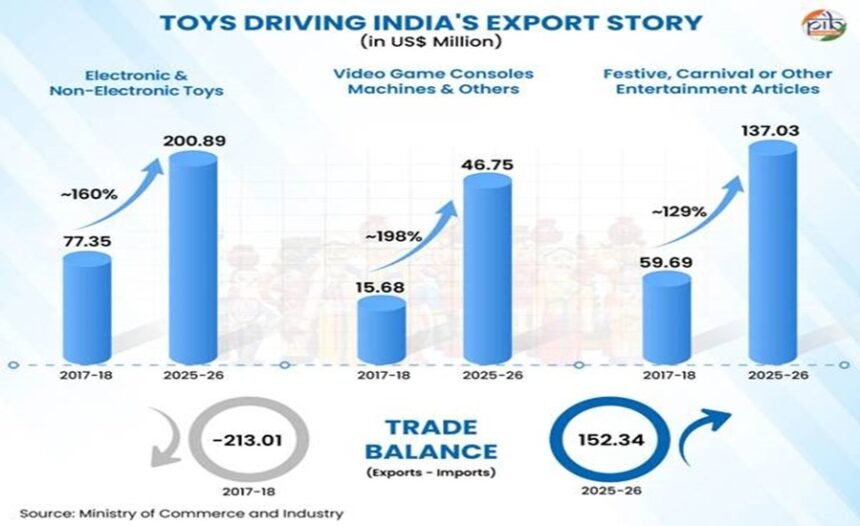
Exports across the main categories (HSN 9503, 9504, 9505) went from US$152.7 million in 2017–18 to US$384.7 million in 2025–26, a jump of more than 151.9%. Electronic and non-electronic toys alone nearly tripled, from US$77.35 million to US$200.89 million, with the US buying more than anyone else, followed by the UK, Germany, Poland, and the Netherlands.
Video game consoles and other recreational products climbed from US$15.68 million to US$46.75 million in the same period, and festive and entertainment products grew from US$59.69 million to US$137.03 million.
On the flip side, imports of traditional and educational toys fell 66%, which says a lot about how much domestic manufacturing has caught up. The net result: a trade surplus of US$152 million in 2025–26, compared to a US$213 million deficit back in 2017–18.
Jobs followed the growth
The sector now touches artisans, MSMEs, traders, and entrepreneurs across both cities and villages, and it’s opened up work for women and socially diverse communities too. Employment under NIC Code 324 went from 8,685 workers in 2018–19 to 17,693 in 2023–24 roughly double.
Policy did a lot of the work
The National Action Plan, rolled out in 2020, backed toys grounded in Indian culture while pushing local manufacturing and educational products. Its Quality Control Order made BIS certification compulsory for any product sold in India. As of May 2026, BIS had handed out 1,786 licences to Indian manufacturers and 56 to foreign ones.
Tariffs moved sharply too: the MFN rate went from 20% to 60% in 2020, then up to 70% in 2023, giving local producers more breathing room to compete and invest.
Toycathon, launched in 2021, gets students and startups building toys inspired by Indian heritage. The e-Toycathon came in 2025 with a focus on electronic toys made in India, and MeitY’s e-Toys Lab at C-DAC Noida now backs training and prototyping in that space.
Traditional crafts have their own support too. The One District One Product scheme helps district-based toy clusters with branding, packaging, and export access, while GI protection for Channapatna Toys, the Leather Toys of Indore, and the Thanjavur Doll safeguards artisan identity and opens doors to new buyers.
GST dropped from 12% to 5%, making them cheaper and encouraging more people to buy educational ones.
Key Takeaway: Trade deals with the UAE, Australia, the UK, and EFTA countries have widened export access, and the Districts as Export Hubs initiative has already flagged more than 10 districts with strong export potential.
Put together, India’s toy industry is stitching old craftsmanship into a modern manufacturing base, and the numbers suggest that approach is paying off.
MCQs:
1. India’s toy-making tradition dates back approximately how many years?
A. 1,000 years
B. 2,500 years
C. 5,000 years
D. 7,000 years
2. India’s toy exports across major toy categories increased from US$152.7 million in 2017–18 to approximately how much in 2025–26?
A. US$250 million
B. US$300 million
C. US$384.7 million
D. US$450 million
Read more: India’s Defence Transformation: A Deep Dive Into the Historic Surge in Exports and Budget