
The protocol, called General Concurrence Percolation (GCP), offers a way to establish long-distance quantum links while needing far less initial entanglement than current methods demand. Scientists at the Bose Institute, an autonomous body under the Department of Science and Technology, have worked out a new theoretical framework that could make future quantum communication networks both more efficient and easier to build.
Why quantum networks are hard to build
Quantum networks depend on strong entanglement between distant stations to move quantum information securely. Getting that entanglement, though, is genuinely hard in practice. Environmental noise chips away at quantum links over time, and the longer the distance, the more that noise erodes the connection.
Physicists have tried to work around this using percolation theory, a set of ideas borrowed from statistical physics that describes how connectivity emerges across a network. Most existing approaches strengthen a network by cutting out intermediate stations to forge stronger direct links. It works, but it comes at a cost: those methods burn through network resources and reshape the network’s original layout in the process.
How GCP works differently
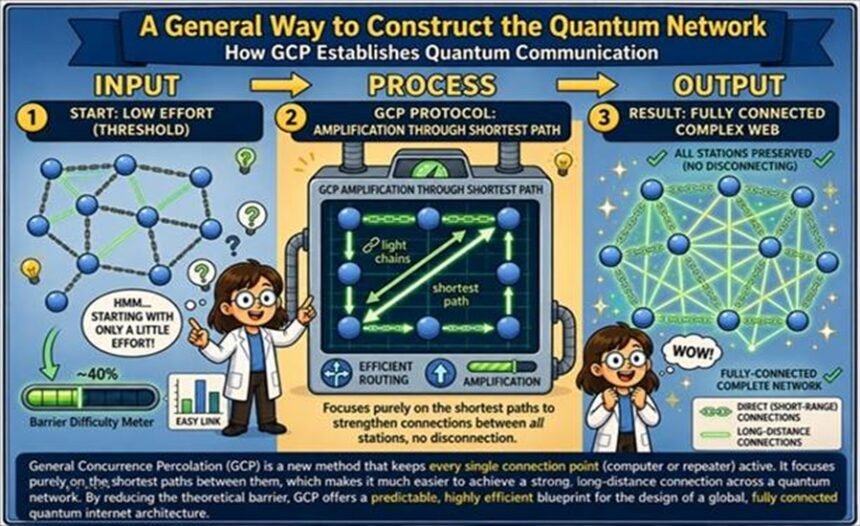
The new study, led by Dr. Deep Nath and Prof. Soumen Roy at the Bose Institute and published in Physical Review A, takes a different route. Rather than stripping stations out, GCP boosts entanglement by directing it along the shortest paths available between nodes. The physical network stays intact. What changes is how efficiently entanglement moves through it, turning a sparse, thinly connected setup into something denser and considerably more robust.
The payoff, according to the researchers, is that GCP lowers the amount of initial entanglement needed to achieve long-distance quantum communication. That’s a meaningful shift, since the entanglement threshold has been one of the main bottlenecks holding back practical quantum networks.
Simulations back up the theory
To test the idea, the team ran computer simulations rather than relying on theory alone. The results backed up the core claim: routing entanglement along shortest paths did bring down the minimum threshold required for the whole network to stay connected, without needing to sacrifice any intermediate stations along the way.
There’s a second finding buried in the paper that matters just as much for the field going forward. The simulations showed that GCP falls into what’s known as the percolation universality class, a well-studied category in statistical physics that describes how certain systems behave as they cross a connectivity threshold. That might sound like a technical footnote, but it’s not. It means GCP isn’t some one-off trick that happens to work; it fits within a mathematical framework physicists already understand deeply, which makes its behavior far more predictable as networks scale up.
Key Takeaway: Put together, the two results point toward something practically useful: a way to build quantum networks that don’t need to sacrifice their physical layout, don’t burn through scarce entangled resources, and still manage to connect distant nodes reliably. For a field where every bit of entanglement is hard-won and easily lost to noise, that combination is rare.
The researchers frame GCP as a step toward more reliable and scalable quantum communication systems, though it remains a theoretical and simulation-based result at this stage rather than something demonstrated on physical hardware. Even so, by showing that a sparse network can behave like a dense one without altering its structure, the work gives network designers a new tool for thinking about how to build the quantum internet of the future, one that doesn’t have to fight its own topology to get information where it needs to go.
MCQ’s:
1. The General Concurrence Percolation (GCP) protocol, recently developed by scientists at the Bose Institute, is primarily associated with:
A. Improving quantum communication networks by reducing the entanglement required for long-distance communication
B. Enhancing satellite navigation accuracy using quantum sensors
C. Developing room-temperature superconductors
D. Improving classical optical fibre communication through AI
2. Which of the following statements about the General Concurrence Percolation (GCP) protocol is correct?
A. It strengthens quantum networks by removing intermediate nodes from the network.
B. It has already been successfully deployed in India’s quantum communication infrastructure.
C. It preserves the original network topology by routing entanglement through the shortest available paths.
D. It eliminates the need for quantum entanglement in quantum communication.
Read more: India’s New IT Rules Defeat Deepfakes: Securing the Digital Space