
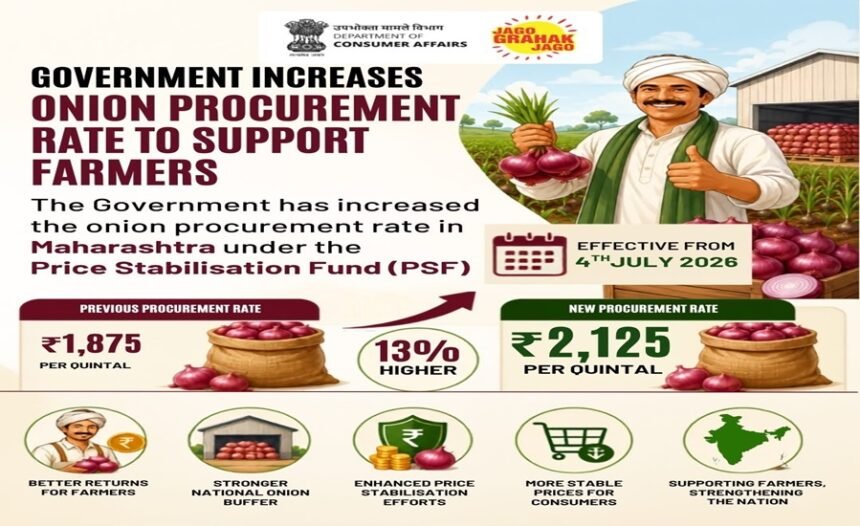
The Government has raised the procurement price of onions under the Price Stabilisation Buffer by 13%, from ₹1,875 per quintal to ₹2,125 per quintal, effective 4 July 2026. The higher price should give farmers better returns and put the country’s buffer stock system on firmer footing.
Procurement operations are currently being carried out through the National Agricultural Cooperative Marketing Federation of India (NAFED) and the National Cooperative Consumers’ Federation of India (NCCF) as part of the Government’s market intervention strategy aimed at stabilising onion prices during periods of volatility.
Production holding steady
The Department of Agriculture and Farmers’ Welfare’s Second Advance Estimates put India’s 2025-26 onion production at 307.37 lakh metric tonnes (LMT), close to last year’s 307.67 LMT. Given these numbers, the Government isn’t expecting major availability issues, though prices could tick up seasonally once supply gets tighter.
Stocks holding up in key states
Maharashtra, Madhya Pradesh and Gujarat all report adequate stock levels, with no sign of shortages so far. Wholesale arrivals nationwide are running above 50,000 MT a day, and Maharashtra alone is bringing in more than 30,000 MT daily, with modal prices around ₹18 per kilogram. Better-quality stored onions are still waiting to enter the market during the lean season, which should help keep prices in check. The all-India average retail price is currently about ₹31 per kilogram.
Weather worries fueling some speculation
A delayed monsoon and below-normal rain in parts of the country have pushed some traders into speculative buying. That said, the Government says actual demand at current prices hasn’t picked up much in major consumption centres. What’s happening in Nashik and parts of Madhya Pradesh looks more like traders betting on future price rises than any real jump in demand.
Exports ticking along normally
Exports stayed steady in June 2026, at roughly 1.50 lakh metric tonnes. Exporters do expect things to slow a bit going forward, though, as fresh supplies from Pakistan and China start competing on price in markets like the Gulf, Sri Lanka and the Far East.
Kharif sowing: a mixed picture
Weather has thrown off sowing schedules unevenly. Nashik is running about 15 days behind because of the late monsoon, while Chitradurga and Challakere in Karnataka have reached around 60% of normal sowing levels.
Key Takeaway: The increase in procurement prices reflects the Government’s effort to balance farmer welfare with consumer interests by ensuring remunerative prices for producers while maintaining adequate buffer stocks for market intervention whenever required.
The enhanced procurement price is expected to support farmer incomes, strengthen the Price Stabilisation Buffer and improve the Government’s ability to respond effectively to future price fluctuations in the onion market.
MCQ:
1.Which two agencies procure onions for the Government under the Price Stabilisation Buffer?
A. FCI and CWC
B. NAFED and NCCF
C. APEDA and FSSAI
D. NABARD and SFAC
2. The Government increased the onion procurement price under the Price Stabilisation Buffer, effective 4 July 2026, to:
A. ₹1,875 per quintal
B. ₹2,000 per quintal
C. ₹2,125 per quintal
D. ₹2,250 per quintal
Read more: TReDS Platform for MSMEs – Government Mandate for Faster Invoice Settlement