
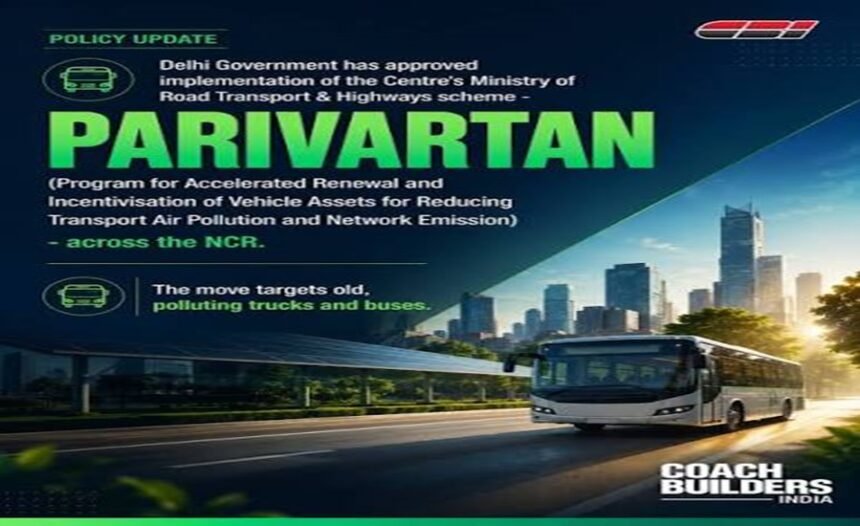
The government has rolled out the PARIVARTAN Scheme (Programme for Accelerated Renewal and Incentivization of Vehicle Assets for Reducing Transport Air Pollution and Network Emissions) to swap out old commercial trucks and buses in the Delhi-NCR region for cleaner BS-VI vehicles and EVs. The Union Cabinet approved it on June 3, 2026, with the goal of cutting vehicle emissions, improving air quality, and pushing the region toward cleaner transport through financial incentives and coordinated rollout.
The Parivartan scheme carries a total outlay of ₹9,585 crore, with ₹5,041 crore coming from the Central Government. The Ministry of Road Transport and Highways (MoRTH) will run it, and funds will flow through the National Capital Region Planning Board (NCRPB) under the Ministry of Housing and Urban Affairs.
Over 2 lakh commercial vehicles set for replacement
The Parivartan Scheme coverage extends across the National Capital Territory of Delhi and the NCR districts of Haryana, Rajasthan, and Uttar Pradesh. It targets BS-IV and older trucks and buses, going all the way back to Pre-BS, BS-I, BS-II, and BS-III vehicles.
More than 1.9 lakh trucks and over 16,000 buses are expected to qualify, making this one of the largest fleet modernization efforts India has attempted. Swapping in cleaner vehicles should cut down significantly on particulate matter, nitrogen oxides, and other pollutants, while also making transport safer and more fuel-efficient.
Incentives to encourage the switch
Anyone buying a new BS-VI diesel/CNG vehicle or an electric commercial vehicle gets access to a set of incentives:
- Full waiver on Motor Vehicle Tax
- Full waiver on registration fees
- 5% interest subvention on vehicle loans
- Up to 8% discount from participating manufacturers
- Monthly fuel vouchers for BS-VI diesel and CNG vehicles
- A one-time payout for EVs equal to what future fuel vouchers would have been worth
Buyers of eligible used BS-VI vehicles get tax concessions, interest subvention, and fuel incentives too, which should make cleaner options easier to afford.
A bigger push for EVs
Zero-emission vehicles get extra support. EV buyers receive a one-time payment between ₹64,000 and ₹2.56 lakh, which brings down the upfront cost of going electric. BS-VI diesel and CNG buyers, meanwhile, get monthly fuel vouchers of ₹1,200 to ₹4,800 for five years, with the amount depending on vehicle category.
Owners also have some flexibility in how they participate. They can scrap old vehicles at Registered Vehicle Scrapping Facilities, sell eligible BS-IV vehicles outside NCR in cities not covered by the National Clean Air Programme, or trade their Certificate of Deposit if they’d rather skip buying a replacement altogether.
Rules by region, and a digital platform to run it all
Delhi has its own requirement: every replacement Light Goods Vehicle there must be electric. In the NCR districts of Haryana, Uttar Pradesh, and Rajasthan, owners can pick either BS-VI vehicles or EVs, giving them more room to decide what works for their operations.
The scheme runs through the Parivahan PARIVARTAN Portal, where vehicle owners can check eligibility, register, apply for incentives, and track their applications in one place.
MoRTH has also signed MoUs with 11 major vehicle manufacturers, among them Ashok Leyland, Tata Motors, Mahindra & Mahindra, Daimler India Commercial Vehicles, Eicher Trucks and Buses, Force Motors, Olectra Greentech, Montra Electric, Switch Mobility, SML Mahindra, and Pinnacle Mobility Solutions. These companies together cover more than 95% of India’s domestic truck and bus market.
An Empowered Committee under the Cabinet Secretary will oversee the scheme, and District Collectors and Magistrates will handle monitoring at the district level.
Key Takeaway: With a ₹9,585 crore investment, PARIVARTAN aims to modernize commercial transport across Delhi-NCR by retiring more than 2 lakh old trucks and buses in favor of BS-VI and electric alternatives, cutting pollution and moving the region closer to a cleaner transport system.
MCQ’s :
1. The PARIVARTAN Scheme has primarily been launched to:
A. Promote ethanol blending in transport fuel
B. Replace ageing commercial vehicles with cleaner BS-VI and electric vehicles in Delhi-NCR
C. Expand metro rail connectivity across NCR
D. Subsidise private passenger cars
2. Which ministry is responsible for implementing the PARIVARTAN Scheme?
A. Ministry of Environment, Forest and Climate Change
B. Ministry of Heavy Industries
C. Ministry of Road Transport and Highways
D. Ministry of Housing and Urban Affairs
Read more: India Leads the World: 24 Nations Join Forces for Digital Public Infrastructure