
Cotton continues to be one of India’s most important agricultural and industrial commodities. It supports millions of farmers and drives the country’s textile and apparel industry. India is the only country growing all four recognised cotton species, holds the top spot globally in cotton acreage, and ranks second in the world for both production and consumption.
Provisional numbers put cotton production at 290.91 lakh bales in 2025–26, against domestic consumption of 328 lakh bales. The sector makes up close to 19% of global fibre production. Government efforts lately have leaned on productivity, better quality, digital procurement, traceability and value addition. Through the Minimum Support Price, the Mission for Cotton Productivity and Kasturi Cotton Bharat, the Government is aiming to lift production to 498 lakh bales by 2031 and make Indian cotton more competitive globally.
A crop that carries millions of livelihoods
It runs through the entire textile value chain, linking agriculture, manufacturing and global trade. Close to 60 lakh farmers depend on it directly, and another 4–5 crore people work in ginning, spinning, weaving, processing, trading and garment making because of it. The exports it generates bring in serious foreign exchange too, which is part of why it has picked up the nickname “White Gold.”
Centuries in the making
India has been growing cotton for thousands of years and was once among the world’s top producers of textiles. Its fabrics made their way across Asia, the Middle East and Europe, and was even used as a form of currency in ancient times.
Things picked up in the 19th century, when mills opened in Kolkata, Mumbai and Ahmedabad, the last of which came to be called the “Manchester of India.” The Swadeshi movement gave domestic textile production another push, setting the stage for the industry as it exists now.
Four species, one country
India is unique in growing all four recognised cotton species: Gossypium arboreum, Gossypium herbaceum, Gossypium barbadense (Egyptian cotton), and Gossypium hirsutum (American upland cotton). G. hirsutum alone makes up nearly 90% of India’s hybrid cotton, including every Bt cotton hybrid grown commercially.
Bt cotton has been around since 2002. It carries genes from Bacillus thuringiensis that make it resistant to bollworms, which has cut down pest damage, reduced how much insecticide farmers need, and lifted productivity.
It also gets sorted by staple, or fibre length. That runs from short staple at up to 20 mm, through medium and medium long, up to long staple and finally extra long staple at 32.5 mm and beyond.
Where it’s grown
Three agro-climatic zones handle most of India’s cotton cultivation. The Northern Zone covers Punjab, Haryana and Rajasthan. The Central Zone covers Gujarat, Maharashtra and Madhya Pradesh. The Southern Zone covers Telangana, Andhra Pradesh and Karnataka. Odisha and Tamil Nadu grow the crop as well.
India’s standing in the world market
India cultivates the crop across 114.84 lakh hectares, roughly 38% of all cotton acreage worldwide. Most of it, around 62%, relies on rainfall, while the rest is irrigated.
Production reached 297.24 lakh bales, or 5.06 million tonnes, in 2024–25, before easing slightly to a provisional 290.91 lakh bales, or 4.95 million tonnes, in 2025–26. Consumption that year hit 328 lakh bales, or 5.58 million tonnes, across both textile and non-textile uses.
On exports, India sent out about 18 lakh bales, or 0.31 million metric tonnes, in 2024–25, a 3.37% share of global cotton exports worth US$11.49 billion. The US bought the most, at 26.35%, followed by Bangladesh at 19.81% and Sri Lanka at 5.11%, with the UK and UAE also among the buyers.
What the Government is doing for farmers
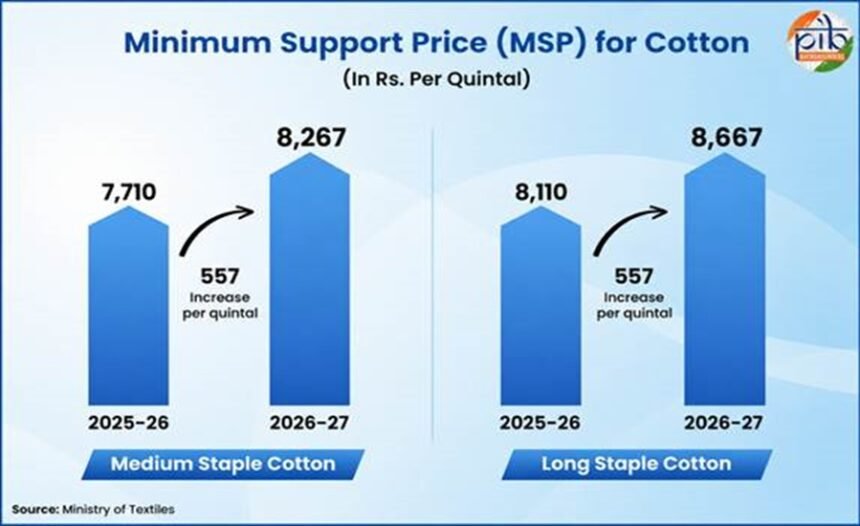
MSP exists to protect farmers when market prices fall below what the Government has set. For 2025–26, that was ₹7,710 per quintal for medium staple cotton and ₹8,110 for long staple. Both went up for 2026–27, to ₹8,267 and ₹8,667 per quintal respectively.
The Cotton Corporation of India handles MSP procurement through a growing network of centres. In the 2025–26 season, it bought 105.09 lakh bales worth ₹41,530 crore across 24 lakh farmer transactions.
A five-year Mission for Productivity got underway in 2025–26, backed by ₹5,659.22 crore. It’s built around climate-resilient varieties, pest-resistant hybrids, high-yielding, extra long staple and biotech-driven breeding, and is meant to reach 24 lakh hectares across 140 districts in 14 states, benefiting close to 32 lakh farmers, with the ultimate goal of taking production from 297 lakh bales to 498 lakh bales by 2031.
There’s also the Special Project, running under the National Food Security Mission since 2023–24, which pushes High Density Planting Systems, closer spacing, and extra long staple technologies. It’s shown yield gains of about 40% under HDPS and over 32% under closer spacing, strong enough results that the project got extended into 2025–26.
How it’s being done
To make MSP procurement less of a hassle, the Government also built the Kapas Kisan app, where farmers can register, book procurement slots, get Aadhaar-linked payments, track their status and get SMS updates. Over 41 lakh farmers have signed up already, and the process has become faster and paperless as a result.
Kasturi Cotton Bharat is a separate push to turn Indian cotton into a recognised premium brand worldwide, using QR-code certification, blockchain traceability, NABL-accredited testing and a digital registration system, with a particular focus on certifying long staple and extra long staple cotton. As of 30 June 2026, 116 units had registered, and 3.29 lakh certified bales had been produced.
More than just fabric
The crop’s usefulness goes well past textiles. It’s seed gets turned into edible oil, animal feed, fish feed and poultry feed. The rest of the plant yields linters, hulls, and biomass fuel from the stalks. Fibres too short for spinning end up as surgical and absorbent cotton, making the crop relevant to healthcare too.
Key takeaway: India’s cotton sector sits at the crossing point of old farming traditions and newer technology and policy support. Better seed varieties, digital procurement, higher MSPs, branding pushes and productivity programmes are all aimed at the same thing: raising farmer incomes while making India more competitive in global textile markets. With the Mission for Cotton Productivity, Kasturi Cotton Bharat and digital procurement all still expanding, cotton looks likely to keep mattering a great deal for rural livelihoods, industry and India’s textile economy going forward.
MCQ’s:
1. India is unique among producing countries because it:
A. Cultivates only two recognised species.
B. Is the only country cultivating all four recognised species.
C. Produces only extra-long staple varieties.
D. Has the highest productivity in the world.
2. Bt varieties derive their resistance to bollworms from genes obtained from:
A. Rhizobium leguminosarum
B. Azotobacter chroococcum
C. Bacillus thuringiensis
D. Nitrosomonas europaea
Read more: Powering Prosperity: Coal Production and Self-Reliance through Energy Independence Strategy