
All operating Central Public Sector Enterprises (CPSEs) must now settle invoices from Micro, Small and Medium Enterprises (MSMEs) through the Trade Receivables Discounting System (TReDS) platform. This isn’t optional anymore as per the notification which came out on 30 June 2026. The notification carries the weight of a commitment made in the Union Budget 2026-27. And the goal is straightforward: fix the liquidity crunch and payment delays that have dogged the MSME sector for years.
For the lakhs of MSME suppliers who deal with CPSEs, this should mean faster access to working capital and fewer months spent chasing overdue invoices.
What’s actually changing
Every operating CPSE now has to process and settle invoices for goods and services bought from MSMEs through RBI-authorised TReDS platforms. That’s the core rule.
Alongside it, the government added a few transparency requirements. CPSEs must:
- Disclose details of MSME invoices routed through TReDS, per RBI guidelines
- Report invoice settlement details on a regular basis
- Get a statutory auditor’s certificate each year confirming they’re registered on TReDS and complying with the rules
- The idea is that CPSEs start acting as the model for how corporate India should pay its small suppliers, on time and without the runaround.
Why this matters
Late payments are one of the biggest headaches Indian MSMEs face. Money tied up in unpaid receivables means less cash for production, slower growth, and businesses stuck in a holding pattern.
There are over 8.70 crore enterprises registered on the Udyam Registration Portal and Udyam Assist Platform right now, employing more than 38 crore people between them. Get payments right for this group and you’re touching a huge share of India’s workforce.
Once an invoice is approved through CPSE procurement, mandatory TReDS routing means it becomes automatically eligible for financing by banks and financial institutions. MSMEs can pull in funds well before the actual due date rather than waiting it out.
What MSMEs get out of it
Suppliers can now convert an approved invoice into working capital immediately, no need to sit around until the payment cycle wraps up.
A few concrete benefits:
- No collateral required to access financing
- No recourse to the seller if something goes wrong, which lowers the financial risk on the MSME’s end
- Financiers bid against each other, which tends to push financing costs down
- Cash comes in faster, which helps with day-to-day liquidity and keeping the business running
- For small businesses that live and die by their receivables, this could meaningfully change their cash position.
How TReDS works
TReDS is an RBI-regulated electronic platform built for discounting trade receivables that MSMEs are owed by corporates, government departments and public sector undertakings.
Banks and NBFCs compete on the platform to finance approved invoices, so MSMEs generally get quicker funding at rates set by market competition rather than a single lender’s terms.
Five RBI-authorised TReDS platforms are currently running:
- RXIL
- M1xchange
- Invoicemart
- C2treds
- DTX
How we got here
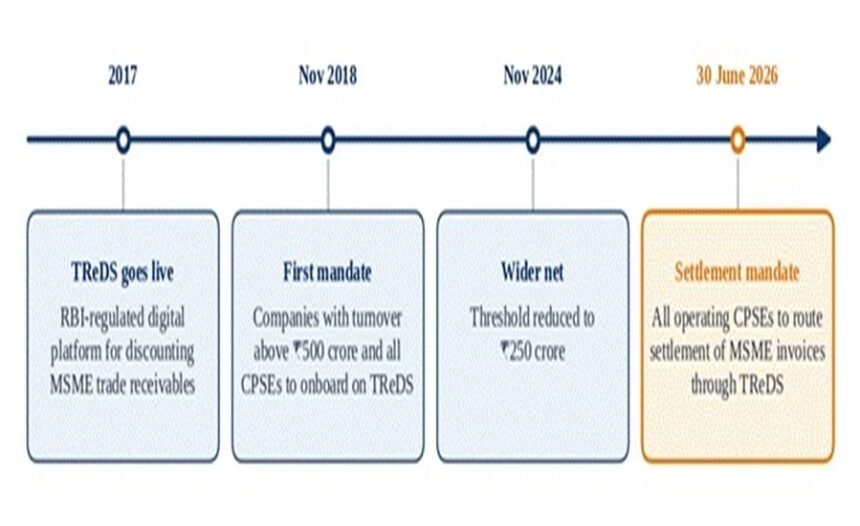
TReDS didn’t appear overnight. Here’s the timeline:
2017: TReDS launches as an RBI-regulated platform for MSME invoice discounting
November 2018: Mandatory onboarding kicks in for companies with turnover above ₹500 crore, plus all CPSEs
November 2024: The turnover threshold for mandatory onboarding drops to ₹250 crore
30 June 2026: All CPSE purchases from MSMEs must now be settled through TReDS
Key Takeaway: Invoice discounting through TReDS has grown fast. In FY 2021-22, the platform discounted around ₹40,000 crore worth of invoices. By FY 2025-26, that number hit ₹3.47 lakh crore.
Making TReDS mandatory for CPSE procurement is a real shift toward better payment discipline and freeing up working capital for MSMEs. No collateral, faster cash, and a system pushing India’s small businesses toward stronger footing while cleaning up how procurement gets paid for.
MCQ:
1. The Trade Receivables Discounting System (TReDS) is regulated by which institution?
A. Securities and Exchange Board of India (SEBI)
B. Ministry of Finance
C. Reserve Bank of India (RBI)
D. Small Industries Development Bank of India (SIDBI)
2. As per the notification issued on 30 June 2026, all operating Central Public Sector Enterprises (CPSEs) are required to settle MSME invoices through:
A. Government e-Marketplace (GeM)
B. Unified Payments Interface (UPI)
C. Trade Receivables Discounting System (TReDS)
D. National Automated Clearing House (NACH)
Read more: Ministry of Jal Shakti Launches 7th National Water Awards