
India and the Nordic Countries Take Their Partnership Up a Notch. Leaders from India and five Nordic countries met in Oslo on 19 May 2026 for the third India-Nordic Summit. It’s been a slow build since the first one in 2018, but the relationship has moved well past standard diplomatic exchanges into territory like green tech, clean energy, and innovation.
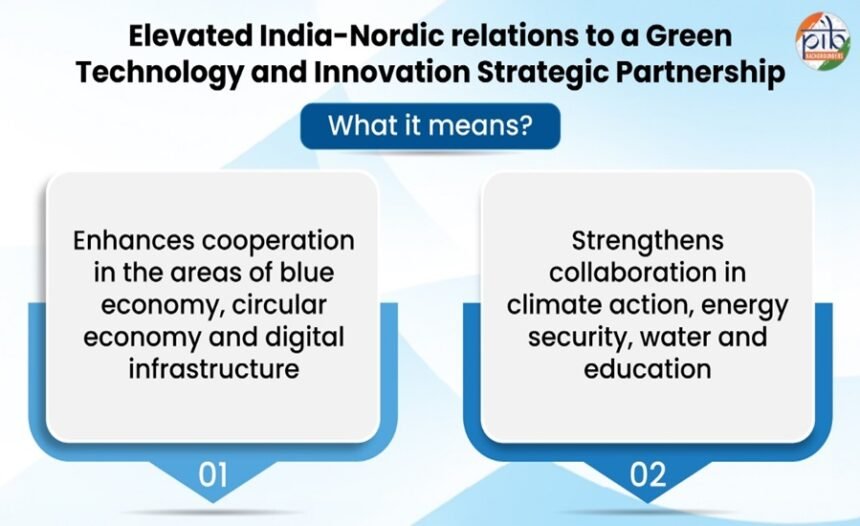
The big outcome from Oslo: both sides agreed to upgrade the relationship into what they’re calling a Green Technology and Innovation Strategic Partnership, covering everything from trade and investment to maritime cooperation, defence, and research.
The Arctic angle
There’s a reason India cares so much about the Arctic, and it’s not abstract. Ice melt and other changes up north have real effects on India’s monsoons, food security, water supply, and coastal areas.
India’s Arctic Policy officially “India and the Arctic: Building a Partnership for Sustainable Development” is built around six areas: scientific research, environmental protection, economic and human development, connectivity, governance, and capacity building. Nordic cooperation feeds directly into that, giving India a stronger scientific and strategic presence in the region.
How things stand with each country
Denmark did USD 2.05 billion in goods trade with India in 2025 split roughly USD 1.06 billion in Indian exports and USD 0.98 billion in imports plus USD 4.25 billion in services trade. Indian firms have put around USD 560 million into Denmark, and Danish investment into India reached USD 1.413 billion by 2024. About 40 Indian companies work in Denmark; nearly 200 Danish companies have set up in India, mostly in renewables, shipping, agriculture, food processing, and urban development. Roughly 21,000 Indians live in Denmark.
Finland’s goods trade with India came to USD 1.017 billion in 2024-25 (USD 356.37 million in exports, USD 660.70 million in imports), with services trade at USD 1.9 billion. Indian investment there has passed USD 2 billion, and Finnish investment in India is now around USD 4 billion. Over 100 Finnish firms operate in India, and Finland’s Indian community about 33,000 people, including 2,400 students plays a notable role in the country’s tech sector.
Iceland is the smallest of the five by trade volume: USD 77.06 million in 2024-25, mostly Indian exports (USD 66.01 million versus USD 11.05 million in imports). The two countries are now talking about geothermal energy, fisheries, tourism, and Arctic research. About 600 Indians live there.
Norway did USD 1.05 billion in bilateral trade in 2024-25 (USD 630 million in exports, USD 420 million in imports), with services trade close to USD 1 billion. More striking is Norway’s sovereign wealth fund the Government Pension Fund Global which had roughly USD 28 billion sitting in Indian markets as of December 2025. Direct Norwegian investment into India totalled USD 764 million between 2000 and September 2025. Around 30,000 Indians live in Norway, with more than 40 Indian associations active there.
Sweden remains the biggest of the bunch economically. Trade hit USD 6.96 billion in 2024, and Swedish FDI into India has reached USD 2.596 billion since 2000. About 280 Swedish companies operate in India, 75 Indian companies operate in Sweden, and the Indian community in Sweden numbers around 88,000.
What’s driving the shift
Trade between India and the Nordics has quadrupled over the last ten years, and investment flows are up nearly 200%. That growth is what’s pushing both sides toward a formal Green Technology and Innovation Strategic Partnership, with priorities including renewable energy and green hydrogen, digital innovation, sustainable manufacturing, climate resilience, the blue economy, defence manufacturing, cybersecurity, telecom, and Arctic research.
India also has country-specific goals: geothermal and fisheries work with Iceland, blue economy and Arctic cooperation with Norway, and broader maritime work across the region.
Concrete outcomes
The green tech partnership is meant to speed up clean tech adoption, improve resource use, and strengthen digital governance along with creating jobs and drawing in investment.
Separately, the India-EFTA Trade and Economic Partnership Agreement, signed recently, should lower trade barriers and improve market access, adding more momentum to the economic relationship.
Both sides also reaffirmed how much Arctic research matters for understanding India’s monsoon systems and farming conditions, and agreed to expand cooperation in STEM, advanced manufacturing, and next-gen telecom including 6G.
On the ocean side, cooperation will focus on sustainable use of marine resources and maritime connectivity, with a stated interest in stability across the Indo-Pacific. There’s also a push to make it easier for students, researchers, and skilled workers to move between India and the Nordic countries, plus expanded defence cooperation in manufacturing and technology transfer that’s meant to support India’s own defence production.
Key Takeaway: The relationship now runs on a combination of climate goals, strategic trust, and straightforward economic interest. Nordic countries bring expertise in green technology and manufacturing; India brings scale and a large talent pool. As the two sides keep expanding cooperation across energy, digital tech, research, and maritime security, this partnership looks like it’s becoming a working example of how sustainable, tech-focused development can happen between regions that don’t share a border but share a lot of interests.
MCQs:
1. The Third India–Nordic Summit was held in which city on 19 May 2026?
A) Stockholm
B) Copenhagen
C) Oslo
D) Helsinki
2. India and the Nordic countries agreed to upgrade their relationship into which strategic partnership?
A) Indo-Pacific Security Partnership
B) Green Technology and Innovation Strategic Partnership
C) Arctic Development Partnership
D) Digital Economy Partnership
Read more: Tourism and Architecture of Growth Budget 2026-27 – Strategic Infrastructure Development