
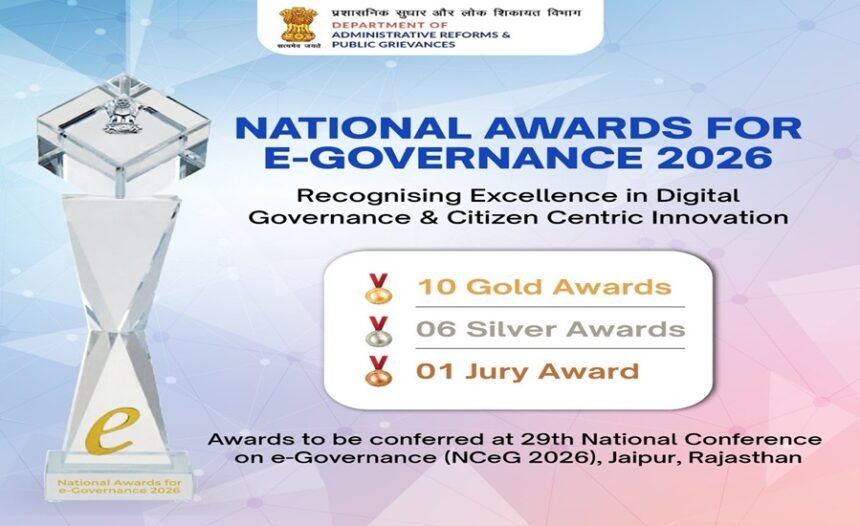
The government has announced the winners of the National Awards for e-Governance (NAeG) 2026, recognising 17 projects and initiatives for excellence in digital governance and public service delivery.
The list includes 10 Gold Awards, 6 Silver Awards and one Jury Award spread across seven categories, covering everything from artificial intelligence and cybersecurity to grassroots governance and citizen-facing services. This is the 29th edition of the national awards, and it includes a dedicated category for Gram Panchayats, recognising how digital tools are reshaping public service delivery at the village level.
Who Won Gold and Silver in the National Awards
The winning projects span central ministries, state governments, local bodies, public institutions and financial organisations.
On the central government side, Agri Stack from the Ministry of Agriculture & Farmers Welfare and e-Jagriti from the Ministry of Consumer Affairs both made the cut, along with the Ministry of Health and Family Welfare’s AI-enabled Clinical Decision Support System built into eSanjeevani, and the Panchayat Advancement Index from the Ministry of Panchayati Raj.
States and their institutions picked up several national awards too. Uttar Pradesh’s Prayagraj Mela Authority was recognised for Mahakumbh 2025, while Kerala saw two wins: the Blood Bag Traceability and Citizen Interaction Portal from K-DISC, and the District Court Case Management System from the High Court of Kerala. Madhya Pradesh’s Urban Development and Housing Department was honoured for E Nagar Palika with Cyber Security.
Maharashtra had a strong showing, with E-Aarogya Dhamni from the Zilla Parishad Nandurbar Health Department, Pune 360 from the Pune Municipal Corporation, and two Gram Panchayats, Kadepur in Sangli district and Bijoy Nagar in West Tripura’s Tripura district, both recognised for grassroots digital work.
Other winners include ICMR-MINDS from the Indian Council of Medical Research, a threat intelligence and DNS filtering security product developed by ISRO’s Space Applications Centre in Ahmedabad, an Integrated Cyber Security Framework for Digital Banking from Bank of Baroda, and the TRINETRA AI-based video surveillance system used by the Mahakaleshwar Temple Trust in Ujjain.
The Jury Award
This year’s Jury Award went to the Survey of India for its Real Time Precise Positioning Services, delivered through the CORS network.
What the Categories Cover
The seven national awards categories are built to capture innovation across different levels of government. They include government process re-engineering through technology, AI and emerging technologies for citizen-centric services, cybersecurity innovation and e-governance best practices, district-level e-governance initiatives, digital service delivery by Gram Panchayats and local bodies, replication and scaling of already-recognised e-governance projects, and data analytics-driven digital transformation carried out by central ministries, states and Union Territories.
Key Takeaway: Along with a trophy and a certificate, Gold Award winners receive a cash incentive of ₹10 lakh, while Silver Award winners get ₹5 lakh. Ministries, departments, state governments, organisations and Gram Panchayats are expected to put this money toward strengthening their projects further or covering resource gaps in related public welfare work. The awards will be handed out at the 29th National Conference on e-Governance, set to take place in Jaipur, Rajasthan.
MCQ:
1. The Jury Award under the National Awards for e-Governance (NAeG) 2026 was conferred on which organisation?
A. National Informatics Centre (NIC)
B. Survey of India
C. ISRO
D. Centre for Development of Advanced Computing (C-DAC)
2. How many Gold Awards were announced for the National Awards for e-Governance (NAeG) 2026?
A. 8
B. 10
C. 12
D. 17
Read more: Transforming Madhya Pradesh: Cabinet Approves Massive NH-347B Upgradation