
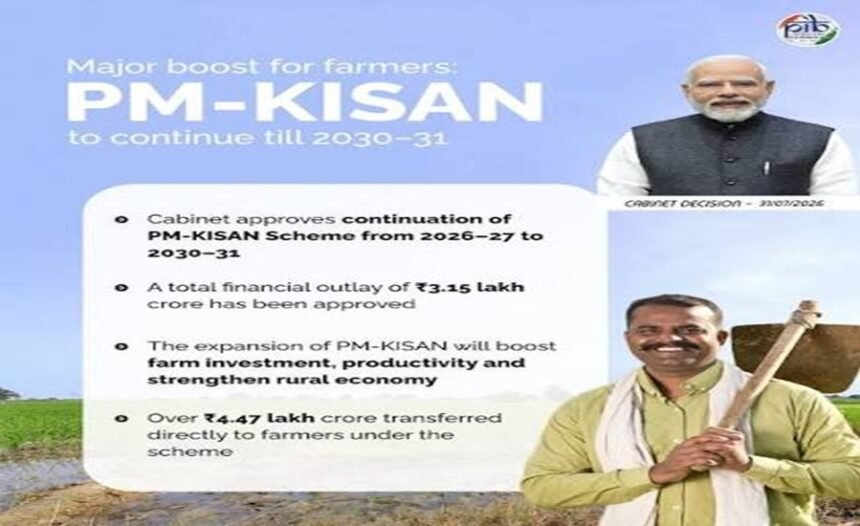
The government has given the green light to keep the PM-KISAN scheme running for another five years, from 2026-27 through 2030-31, with Rs.3.15 lakh crore set aside for it. The Union Cabinet, led by Prime Minister Narendra Modi, cleared the extension on July 31.
The idea behind the decision is straightforward: farmers who are doing well are good for the country as a whole. PM-KISAN moves money straight into farmers’ bank accounts through direct benefit transfer, so there’s no middleman and, in theory, no leakage.
How the scheme works
PM-KISAN started back in February 2019. Farmers who own land get Rs.6,000 a year, paid out in three installments, with Aadhaar checks and digital verification built in to keep the process clean.
The numbers so far
Since it launched, the scheme has put more than Rs.4.47 lakh crore into farmers’ accounts across 23 installments. The most recent one alone reached over 9.49 crore farmers and released more than Rs.18,984 crore. During COVID, when many rural households were struggling, the scheme disbursed over Rs.1.71 lakh crore. Women farmers have gotten more than Rs.1.06 lakh crore of that total, and roughly one in four beneficiaries is a woman.
Where the money actually goes
Mostly back into farming itself. Seeds, fertilizer, irrigation, equipment. Farmers use the cash to cover costs they’d otherwise have to borrow for, often from informal lenders charging steep interest. That’s the argument, anyway, and it’s one the government backs up with outside data.
NITI Aayog’s Development Monitoring and Evaluation Office looked into how the payments were actually used. More than 92% of beneficiaries said they spent the money on farming activities and investment. About 85% said their agricultural income had gone up and their reliance on informal credit had gone down.
What the bigger picture shows
The larger numbers tell a similar story. Between 2020-21 and 2025-26, the area under cultivation grew by about 9.65%, productivity rose roughly 10.53%, and total foodgrain production climbed close to 21.18%. Whether PM-KISAN deserves all the credit is a separate question, but the government is pointing to these figures as evidence the scheme is working alongside other support for agriculture.
The digital angle
There’s also a tech piece worth noting. PM-KISAN relies entirely on Aadhaar authentication and digital verification to confirm who gets paid, which the government holds up as proof that Digital India can deliver welfare directly and without much friction. Beyond the cash itself, officials frame the scheme as something that gives farmers more confidence to invest in their own land rather than just scraping by.
Key Takeaway: Looking ahead, the government’s pitch is that continuing the scheme will let farmers keep investing, push productivity higher, cut down on some of the risk that comes with farming, and generally give the rural economy a boost.
PM-KISAN sits alongside a handful of other farmer-focused programs the government has rolled out, and it’s being positioned as one piece of a larger push, one the government calls Viksit Bharat, aimed at strengthening the position of India’s farmers as the country’s food producers.
MCQ’s:
1. The Pradhan Mantri Kisan Samman Nidhi (PM-KISAN) scheme provides eligible farmer families with financial assistance of:
A. ₹4,000 per year in two instalments
B. ₹5,000 per year in one instalment
C. ₹6,000 per year in three equal instalments
D. ₹10,000 per year in four instalments
2. The PM-KISAN scheme was launched in:
A. 2016
B. 2017
C. 2018
D. 2019
Read more: Stricter Platform Accountability: Deepfakes effectively tackled by Government’s Legal Rules