
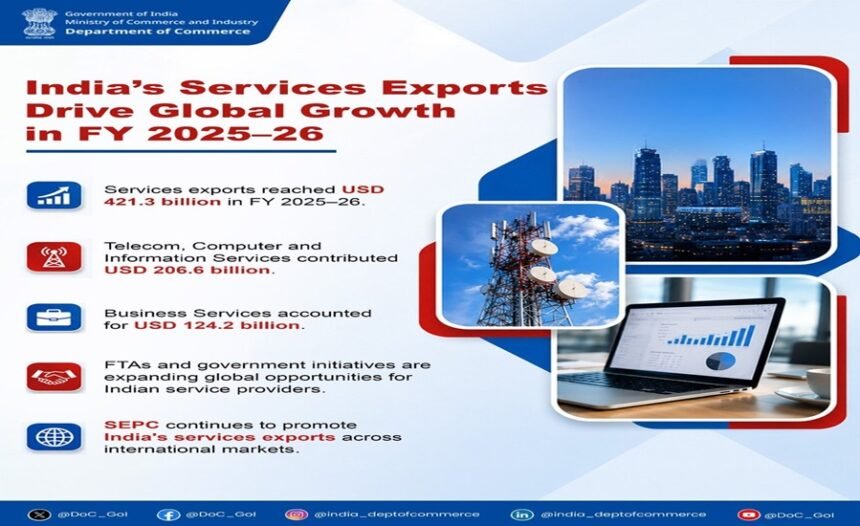
Services exports from India climbed to an all-time high of USD 421.3 billion in FY 2025–26, with telecommunications, computer and information services, along with business services, doing much of the heavy lifting. The figures come from the Ministry of Commerce and Industry.
The government says it’s working to open up more of the world to Indian service providers, using Free Trade Agreements, trade promotion efforts, and steps to sharpen competitiveness in key service sectors.
Five years of steady growth
The upward trend hasn’t let up for half a decade now. Services exports stood at USD 254.5 billion in 2021–22, then climbed to USD 325.3 billion the following year, USD 341.1 billion in 2023–24, USD 387.5 billion in 2024–25, and now USD 421.3 billion in 2025–26.
FTAs open doors for service providers
According to the government, its approach involves zeroing in on priority markets, working through domestic sectoral roadblocks, and pushing for better terms in trade negotiations.
Recent Free Trade Agreements give Indian service suppliers improved access and equal treatment across several delivery channels, whether that’s digital services crossing borders, setting up commercial operations abroad, or sending professionals overseas temporarily.
These agreements also push for regulatory approvals that are clearer, more predictable, and bound by set timelines, which should ease some of the friction Indian firms run into when operating in other countries.
Making it easier for professionals to work abroad
Several FTAs now include provisions to help skilled Indian professionals move and work overseas more easily, partly through Mutual Recognition Agreements that give Indian qualifications more standing abroad. The aim is to cut down on repeat licensing, extra training, and drawn-out certification processes that professionals often face in partner countries.
Other gains from recent trade deals include frameworks that support Indian students in Australia and New Zealand, and Social Security Agreements with countries including Oman, New Zealand, the UK, and the EU, which prevent Indian workers from paying into two social security systems at once. One such agreement, tied to the India–UK CETA, was signed on 10 February 2026.
There’s also specific support for traditional medicine written into agreements with Oman and the EU, and the India–Australia Economic Cooperation and Trade Agreement tackles double taxation issues affecting India’s IT services sector.
Promoting Indian services on the world stage
The Services Export Promotion Council keeps working on behalf of Indian exporters, whether that’s through market development, policy advocacy, connecting buyers with sellers, training programmes, or showing up at international trade events, with funding support from the government’s Export Promotion Mission.
Recently, SEPC backed the second Medical Value Tourism Summit in Tamil Nadu and set up Indian pavilions at events like the Arabian Travel Market, GETEX Dubai, MIPCOM Paris, the Malaysia Health & Pharma Expo, Tokyo Game Show, and Gamescom Germany. It also ran national conferences covering logistics, higher education and skilling, legal-fintech innovation, and school education.
Minister of State for Commerce and Industry Jitin Prasada shared these details in a written reply in the Rajya Sabha.
Key Takeaway: RBI data shows telecommunications, computer and information services alone brought in USD 206.6 billion, just under half of all services exports at 49.03%. Business services added another USD 124.2 billion, or 29.5% of the total. Between these two segments, India covered nearly four-fifths of its entire services export revenue for the year.
MCQ’s :
1. India’s services exports reached a record level of approximately:
A. USD 341.1 billion
B. USD 387.5 billion
C. USD 421.3 billion
D. USD 450.0 billion
2. Which sector contributed the largest share to India’s services exports in FY 2025–26?
A. Tourism Services
B. Financial Services
C. Telecommunications, Computer and Information Services
D. Transport Services
Read more: Nutritional Outcomes Surging: How Mission Poshan 2.0 Battles Malnutrition Real-Time