
After Prime Minister Narendra Modi urged citizens to save every drop of rainwater during the 135th episode of Mann Ki Baat on 28 June 2026, Odisha ramped up its work under the Catch the Rain 2026 campaign. The effort centers on rainwater harvesting, recharging groundwater, bringing old water bodies back to life, and getting communities more involved in securing water supplies for the long run.
Rather than relying on infrastructure alone, the campaign mixes public awareness, changes in everyday behavior, cooperation across institutions, and new water conservation structures on the ground.
Getting the message out
Odisha ran 968 Information, Education and Communication (IEC) activities across the state as part of the campaign. Street plays, folk performances, and community events made up much of this outreach, all built around teaching people why rainwater harvesting and groundwater conservation matter.
Khordha led all districts with 230 such activities, followed by Angul at 124. Cuttack, Kendrapara, Jajpur, Sundargarh, Jharsuguda, Nabarangpur and Subarnapur each held 62, Mayurbhanj ran 60, Nayagarh and Puri had 50 apiece, and Ganjam organized 20.
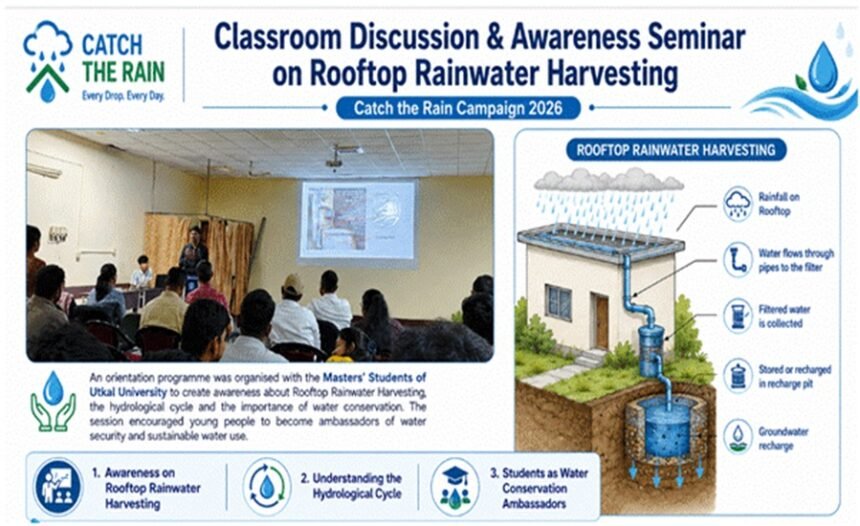
Schools and colleges pitched in too, running awareness sessions, induction programs, and technical talks so students could learn about groundwater science, how rainfall moves through the landscape, and how harvesting systems actually work. The idea is to plant this knowledge early, so it sticks with the next generation.
Building the infrastructure to catch rain
On the ground, the campaign has delivered 905 rainwater harvesting and groundwater recharge structures so far. That includes 849 Rooftop Rainwater Harvesting (RRWH) setups, split between 21 on government buildings and 828 on private ones, plus 56 recharge shafts built specifically to help groundwater replenish faster.
Ganjam leads the districts with 330 RRWH structures, ahead of Khordha (121), Mayurbhanj (94), Cuttack (62), Sambalpur (54), Sundargarh (53), Kendrapara (48), Jharsuguda (25), Bargarh (16), Puri (13), Nayagarh (12), Angul (10), Nabarangpur (7), and Balangir (4). Jajpur added 45 recharge shafts on top of that, Kendrapara built 10, and Sundargarh added one.
Put simply, these structures turn rain that would otherwise run off or evaporate into water that sticks around, feeding into irrigation and topping up groundwater levels that communities depend on through the dry months.
Bringing old tanks back to life
Beyond new construction, Odisha has restored 98 tanks spread across all 30 districts, working through the State Plan’s Improvement to Tanks and Minor Irrigation Projects Scheme. Desilting and renovating these tanks should let them hold more water, capture more of the monsoon runoff instead of losing it, support irrigation nearby, and help recharge groundwater in the surrounding area.
The state has also planted trees around irrigation sites, groundwater offices, and other water infrastructure. This isn’t just cosmetic: tree cover helps stabilize soil, cuts down on erosion, lets more rainwater soak into the ground instead of running off, and gives local ecosystems a better shot at staying healthy over time.
Key Takeaway: Taken together, the awareness drives, new harvesting structures, and tank restorations reflect an attempt to tackle water security from several angles at once rather than betting on one fix. Whether Odisha sustains this pace will likely depend on continued funding and community buy-in, but the numbers so far suggest a campaign that’s reaching well beyond a handful of pilot districts.
MCQ’s:
1. The Catch the Rain 2026 Campaign in Odisha primarily focuses on:
(A) River interlinking projects
(B) Rainwater harvesting and groundwater recharge
(C) Construction of large hydroelectric dams
(D) Desalination of seawater
2. Under Odisha’s Catch the Rain 2026 Campaign, how many Rooftop Rainwater Harvesting (RRWH) structures had been created?
(A) 905
(B) 849
(C) 968
(D) 98
Read more: Record-Breaking Growth: Indian Railways Freight Loading Surges 9%