
The government’s latest GST rationalisation is meant to cut costs, fix some long-standing structural distortions, and make India’s textile and logistics sectors more competitive. Both industries are among the country’s biggest employers, and both matter a lot for manufacturing, exports, and growth more broadly.
By bringing tax rates across the value chain closer together, the reforms should make goods cheaper for consumers, help labour-intensive industries, and back up India’s push to be a global manufacturing hub under Make in India.
Support for the textile industry
The GST changes build on a few other efforts already underway. The Production Linked Incentive (PLI) Scheme for Textiles launched in September 2021 with a ₹10,683 crore outlay, aimed at scaling up manufacturing in Man-Made Fibre (MMF) fabrics, MMF apparel, and technical textiles.
Export competitiveness gets help from schemes like RoSCTL (Rebate of State and Central Taxes and Levies) and RoDTEP (Remission of Duties and Taxes on Exported Products), which refund embedded taxes and duties on exports mostly for apparel and made-ups. On top of that, the government is putting money into PM-MITRA Textile Parks, and pushing innovation and skills through the National Technical Textiles Mission and the SAMARTH programme.
Cheaper readymade garments
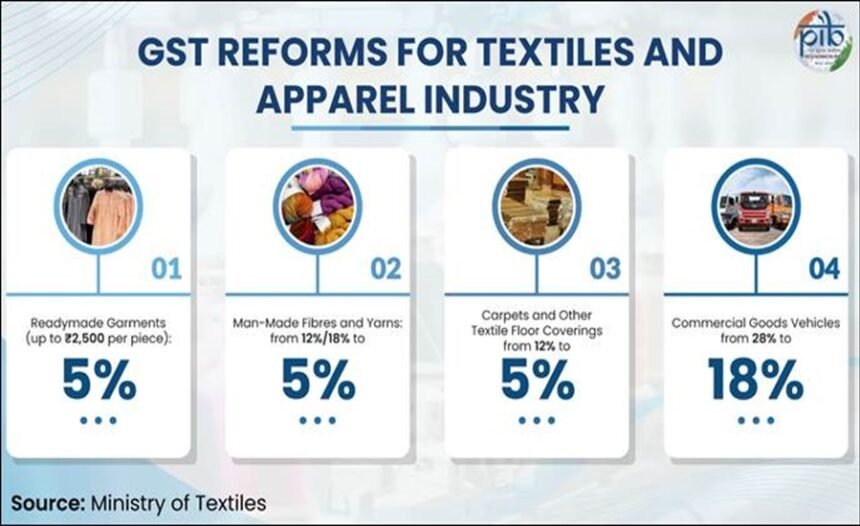
GST on readymade garments priced up to ₹2,500 a piece has come down to 5%, up from the earlier ₹1,000 threshold.
That wider lower-tax bracket should help middle- and lower-income buyers, making clothes more affordable especially in smaller towns and rural areas, where people tend to be more price-sensitive. And since garment manufacturing is one of India’s biggest labour-intensive industries, more demand should mean more jobs, particularly for women workers. It should also help domestic manufacturers and brands compete better against cheap imports in the mass market.
Relief for man-made fibre and yarn producers
GST on man-made fibres dropped from 18% to 5%, and on man-made yarns from 12% to 5%.
This fixes a problem that’s been around a while: an inverted duty structure where inputs were taxed more heavily than the finished product, which tied up more working capital than it should have. Lower taxes here mean better cash flow and lower production costs, especially for the small and medium enterprises that make up a big chunk of India’s MMF manufacturing. It should also make Indian synthetic textiles more competitive abroad, cut import dependence, and support exports, all of which feeds into India’s goal of becoming a major global supplier of MMF-based garments and textiles.
A lift for carpets and floor coverings
GST on carpets and other textile floor coverings fell from 12% to 5%. That makes them cheaper at home and more competitive abroad which is good news given how export-oriented this sector is, and how much of it rests on traditional craftsmanship. Manufacturers and artisans should both benefit.
Lower logistics costs
GST on commercial goods vehicles like trucks, delivery vans dropped from 28% to 18%. Since these vehicles carry roughly 65-70% of all freight in India, this should bring logistics costs down across the board, especially in textiles, FMCG, and e-commerce.
Cheaper freight means lower cost per tonne-kilometre, which helps supply chains run more efficiently and eases cost pressure generally. It also makes exporting easier, since it’s cheaper to move goods to ports and on to international markets. And lower transport costs tend to ripple through the economy, helping keep a lid on inflation.
Key Takeaway: Taken together, these GST changes target tax distortions that have been sitting there for years, while making things more affordable and easier to do business in. Consumers get lower prices, manufacturers get lower costs and better cash flow, and exporters get a stronger footing to compete internationally all pieces of India’s bid to become a genuinely competitive global textile and manufacturing hub.
MCQs:
1. The latest GST rationalisation aims primarily to improve the competitiveness of which two sectors?
A) Agriculture and Mining
B) Pharmaceuticals and IT
C) Textiles and Logistics
D) Banking and Insurance
2. The Production Linked Incentive (PLI) Scheme for Textiles was launched in:
A) July 2020
B) September 2021
C) January 2022
D) April 2023
Read more: India Steel Sector Self-Reliance: Domestic Value Chain Advancement