
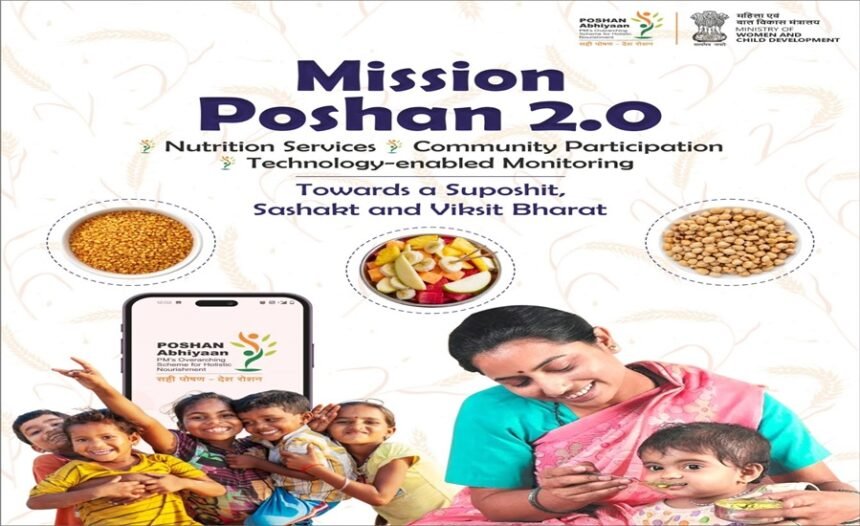
Poshan 2.0 pulls together three earlier efforts, Anganwadi Services, Poshan Abhiyaan, and the Scheme for Adolescent Girls, into a single framework. Improving nutrition for children, pregnant women, new mothers, and adolescent girls has been the focus of a set of measures the Ministry of Women and Child Development has put in place under Mission Saksham Anganwadi and Poshan 2.0. The mission runs across every state and Union Territory, with ₹21,960 crore set aside for it in FY 2025–26.
The adolescent girls’ component covers those aged 14 to 18 in Aspirational Districts and the North Eastern Region. Together, these pieces are meant to fight malnutrition through direct nutrition support, awareness drives, and monitoring powered by technology.
Watching nutrition data as it comes in
At the centre of this monitoring is the Poshan Tracker, a digital system that follows what’s happening at Anganwadi Centres, tracks the workers staffing them, and keeps records on the people they serve.
It also flags cases of stunting, wasting, and being underweight in children under five as the numbers shift, so states can respond quickly rather than waiting for annual data. Anyone can check state-level figures through the Poshan Tracker’s public dashboard.
One clarification from the government: malnutrition doesn’t appear as a direct cause of death in the Sample Registration System–Registrar General of India’s Cause of Death Report for 2021–23. But it does make children more vulnerable to illness and death by weakening their immune systems.
The core interventions
A few measures form the backbone of the mission. Children between 6 months and 6 years old, pregnant women, lactating mothers, and adolescent girls all receive supplementary nutrition, following the National Food Security Act, 2013. Children marked as Severely Acute Malnourished get an added boost through Take-Home Ration.
Twice-yearly awareness pushes, Poshan Pakhwada and Poshan Maah, are held to nudge people toward healthier eating and better nutrition practices generally.
To catch severe cases early, MoWCD has worked with the Ministry of Health & Family Welfare on a joint Protocol for Management of Malnutrition in Children, which lays out how such cases should be identified and treated.
At the local level, Anganwadi Centres have started setting up Poshan Vatikas, small nutrition gardens meant to get more variety into people’s diets using food that’s grown right there.
Where the Health Ministry steps in
Alongside all this, the Ministry of Health and Family Welfare runs its own set of programmes under the National Health Mission, organised around the RMNCAH+N strategy, which stands for reproductive, maternal, newborn, child, adolescent health and nutrition.
Anemia Mukt Bharat is one such programme, built around a 7x7x7 approach to reducing anaemia. Nutrition Rehabilitation Centres handle children under five who have moderate or severe acute malnutrition along with complications, giving them both medical and nutritional care.
Breastfeeding support comes through the Mothers’ Absolute Affection Programme, and Lactation Management Centres provide pasteurised donor human milk to newborns who are preterm, underweight, or critically ill.
Key Takeaway: Two more efforts round things out: National Deworming Day, when albendazole tablets go out to reduce worm infections spread through soil, and Village Health, Sanitation and Nutrition Days, which bring maternal and child healthcare, plus nutrition awareness, directly to villages.
Minister of State for Women and Child Development Savitri Thakur shared all of this in a written reply to the Lok Sabha.
MCQ’s:
1. Poshan 2.0 integrates which of the following government programmes?
A. Poshan Abhiyaan, Anganwadi Services and Scheme for Adolescent Girls
B. Ayushman Bharat, PMMVY and ICDS
C. Mid-Day Meal Scheme and PM POSHAN only
D. National Health Mission and PM-KISAN
2. The Poshan Tracker is primarily used to:
A. Monitor agricultural production.
B. Track nutrition indicators and beneficiaries at Anganwadi Centres.
C. Monitor school attendance.
D. Provide direct cash transfers to beneficiaries.
Read more: Product Boom: DPIIT Empowers Artisans with 1,244 Unique Items Across 773 Districts