
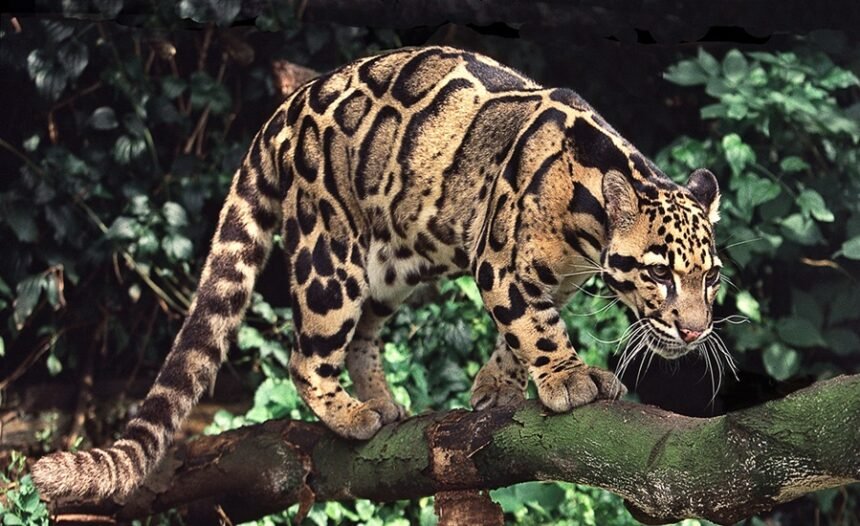
To mark International Clouded Leopard Day, India rolled out a fresh Clouded Leopard Conservation Action Plan (CAP), signalling renewed commitment to protecting one of Asia’s most secretive wild cats. Put together jointly by the Government of India, GEF and UNDP, the plan made its debut at the 91st Standing Committee meeting of the National Board of Wild Life in Coimbatore, held in the second week of July 2026.
What the CAP essentially does is bring together several strands into one framework: protecting habitats, reconnecting fragmented forests, tightening up scientific tracking of the species, and giving local communities a real role in conservation.
Northeast India takes centre stage
The Northeast is where this plan puts its full weight, treating the region as the frontline for the Clouded Leopard’s long-term survival. Rather than working site by site, the approach thinks in terms of whole landscapes, backed by solid science, active local involvement and tools like camera traps and satellite tracking.
Fourteen priority landscapes across Northeast India have already been flagged for conservation focus, with work planned on restoring habitat at scale and rebuilding corridors that reconnect isolated forest patches. On paper, the species now also sits under the Species Recovery Programme of the Integrated Development of Wildlife Habitats (IDWH) scheme, which gives it a more formal institutional home within existing conservation machinery.
Sharper science, tougher enforcement
Tracking the species will now follow a standardised method: camera traps, occupancy surveys, genetic sampling and environmental DNA (eDNA) work, all feeding into a much better picture of where the cats actually live and what conditions they need. Cracking down on poaching and wildlife crime sits right alongside this as a priority.
Frontline forest staff are getting trained up too, with the M-STrIPES smart application brought in as a tool to make field-level monitoring and enforcement more effective.
People, borders and a changing climate
Local communities aren’t a side note here, they’re built into the plan’s foundation, with community-led conservation paired with support for sustainable livelihoods so protection and local wellbeing move together. The CAP also looks outward, calling for closer cooperation with neighbouring countries that share the Clouded Leopard’s range, since a species doesn’t respect national borders.
Climate change gets factored in as well, with adaptive management written into the plan so that conservation strategies can bend and adjust as conditions on the ground shift over time.
The bigger picture for the region’s forests
None of this works in isolation. Protecting the Clouded Leopard means protecting Northeast India’s forests and natural heritage as a whole, the two are inseparable. With the CAP, India is stitching together habitat protection, scientific tracking, landscape restoration, technology, community effort and cross-border cooperation into a single coordinated push to give this rare wild cat a real shot at a secure future.
Key Takeaway: The Clouded Leopard Conservation Action Plan provides a comprehensive roadmap for securing the future of one of India’s most elusive wild cat species through an integrated approach that combines habitat conservation, landscape restoration, scientific monitoring, stronger wildlife protection, and community participation.
With a special focus on the biodiversity-rich landscapes of Northeast India, the plan prioritises restoring ecological corridors, adopting advanced technologies such as camera traps, eDNA analysis and M-STrIPES for monitoring, strengthening anti-poaching measures, and promoting cross-border cooperation and climate-resilient conservation. By bringing the species under the Integrated Development of Wildlife Habitats (IDWH) scheme’s Species Recovery Programme, the initiative reinforces India’s long-term commitment to biodiversity conservation and sustainable ecosystem management.
M.C.Q.
Question 1: The Clouded Leopard Conservation Action Plan (CAP) has been brought under which Government of India scheme’s Species Recovery Programme?
- A. Project Tiger
- B. Project Elephant
- C. Integrated Development of Wildlife Habitats (IDWH)
- D. National Afforestation Programme
Question 2: Which of the following technologies is specifically mentioned in the Clouded Leopard Conservation Action Plan for strengthening field monitoring by frontline forest staff?
- A. Bhuvan Portal
- B. M-STrIPES
- C. DigiYatra
- D. eNAM