
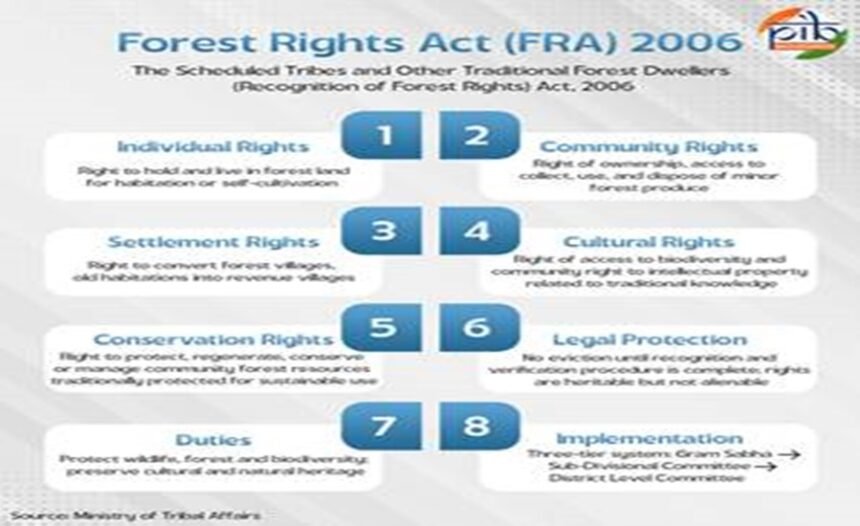
Union Minister of State for Tribal Affairs Shri Durgadas Uikey told the Rajya Sabha that (Recognition of Forest Rights) Act, 2006 or also called the Scheduled Tribes and Other Traditional Forest Dwellers is a job which is to be carried out by State Governments and Union Territory administrations, not the Centre. The Ministry of Tribal Affairs (MoTA) tracks how things are going by pulling together Monthly Progress Reports that states and UTs send in.
Where claims stand right now
Looking at data states and UTs reported between April 1, 2023 and March 31, 2026 (covering FY 2023-24 through FY 2025-26), the numbers break down like this:
- 8,56,159 claims were filed in total: 8,21,908 from individuals and 34,251 from communities.
- 2,34,352 claims got approved and titles went out, split between 2,18,899 individual claims and 15,453 community claims.
- 14,462 claims were turned down, with 13,756 individual and 706 community claims among them.
Anyone wanting a state-by-state breakdown can find it on the Ministry of Tribal Affairs website.
No deadline exists for clearing claims
The government was clear on one point: neither the Act itself nor the rules under it set any deadline for deciding a claim. The Ministry of Tribal Affairs (MoTA) also said it doesn’t keep centralised records tracking how long claims actually take to resolve, so there’s no single figure the Ministry can point to on turnaround time.
Why claims get rejected
Drawing on what some state governments have reported, a few reasons come up again and again when claims are denied:
- The land wasn’t occupied before December 13, 2005.
- The same plot shows up in more than one claim.
- The land in question isn’t forest land at all.
- There isn’t enough evidence to back the claim.
Key Takeaway: States and UTs still carry the load when it comes to actually running the Forest Rights Act, while the Centre’s role stays limited to gathering monthly updates on progress. Over the three years from FY 2023-24 to FY 2025-26, more than 8.56 lakh claims came in, and it was state and UT authorities, not the central government, who decided which ones got approved, which got rejected, and how each case was handled.
MCQ’s:
1. Under the Scheduled Tribes and Other Traditional Forest Dwellers (Recognition of Forest Rights) Act, 2006, the responsibility for implementing the Act primarily lies with:
A. Ministry of Environment, Forest and Climate Change
B. Ministry of Tribal Affairs
C. State Governments and Union Territory Administrations
D. National Commission for Scheduled Tribes
2. Which of the following statements regarding the Forest Rights Act, 2006 is correct?
A. The Act mandates that all claims must be disposed of within six months.
B. The Ministry of Tribal Affairs maintains a centralized database of claim disposal timelines.
C. The Act and its Rules do not prescribe any time limit for disposal of claims.
D. Only individual forest rights claims can be filed under the Act.
Read more: Breaking All Records: Dipka Open Cast Project Achieves Highest-Ever Coal Output for FY 2025–26