
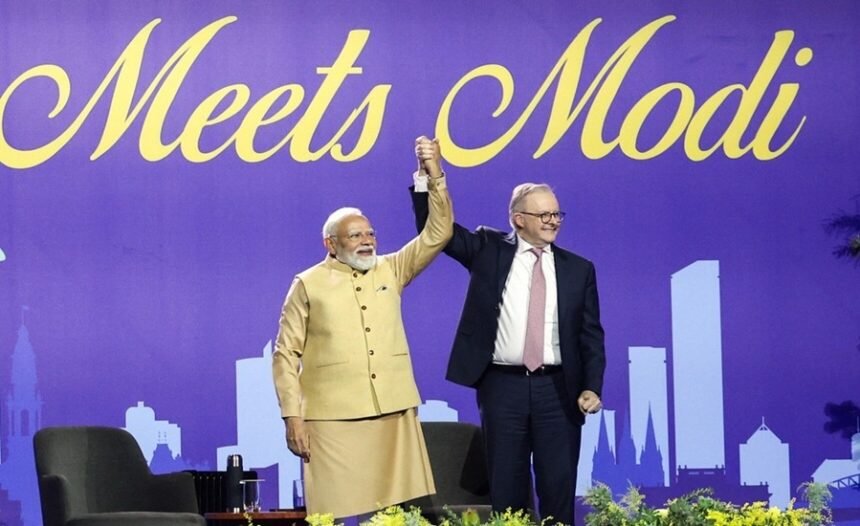
India and Australia used their Third Annual Summit, held in Melbourne on 9 July 2026, to reaffirm their Comprehensive Strategic Partnership and lock in progress across several fronts, maritime security, energy security, cyber cooperation, critical technologies, skill development and entrepreneurship. But the standout result was on the nuclear side: the two countries finalised the Administrative Arrangement under their Civil Nuclear Cooperation Agreement, clearing the way for long-term exports of Australian uranium to India for peaceful purposes, under IAEA safeguards.
The timing matters. Australia sits on the world’s largest uranium reserves, holding more than a third of the global total, so a reliable pipeline of Australian uranium gives India a much sturdier fuel base as its nuclear power programme grows.
Fitting Into India’s Bigger Nuclear Ambitions
This isn’t a standalone deal, it slots directly into India’s broader nuclear strategy. It supports the Nuclear Energy Mission’s target of reaching 100 GW of nuclear capacity by 2047, and it strengthens the SHANTI Act (Sustainable Harnessing and Advancement of Nuclear Energy for Transforming India), which became law in December 2025 and opened the door for private Indian companies and joint ventures to build, own and run nuclear power plants.
A secured, long-term uranium supply gives developers and investors more confidence to actually commit to projects and get them built on schedule. Together, the SHANTI Act and this new Arrangement give India both the policy framework and the fuel security it needs to grow nuclear power as part of its energy security and economic growth strategy.
Where India’s Nuclear Programme Stands Today
India currently runs 24 nuclear reactors spread across seven sites, with a combined installed capacity of 8.78 GW. Ten more reactors, adding up to 8,000 MW, are already under construction, and pre-project work has begun on ten additional units beyond that. The reactor fleet is a mix of Pressurised Heavy Water Reactors (PHWRs), Boiling Water Reactors (BWRs) and Light Water Reactors (LWRs), with PHWRs, which run mainly on natural uranium and produce plutonium as a byproduct, forming the backbone. The uranium coming in from Australia will help keep this fleet steadily fuelled.
Looking further ahead, India is banking on its large thorium reserves, concentrated in the coastal sands of Kerala, Tamil Nadu, Andhra Pradesh and Odisha, as the long-term fuel source. Thorium isn’t naturally fissile though; it first has to absorb neutrons inside a reactor to become usable. That’s where Fast Breeder Reactors (FBRs) come in: India is developing these to make use of plutonium and act as a bridge toward thorium-based power.
On the smaller-scale front, the Union Budget 2025-26 set aside ₹20,000 crore for researching, designing, developing and deploying indigenous Small Modular Reactors (SMRs). These typically produce up to 300 MWe each, and because they’re compact and modular, they can be built in factories rather than on-site, which means faster construction, better quality control and the option to deploy them in phases. The government’s target is to have at least five of these indigenous SMRs operational by 2033. Between the reactor fleet, the thorium roadmap and the SMR push, nuclear energy is shaping up to be a solid pillar of India’s future energy mix.
The Nuclear Partnership With Australia: How It Got Here
India and Australia’s civil nuclear relationship isn’t brand new. It rests on the Civil Nuclear Cooperation Agreement, signed back in September 2014 and in force since November 2015. What changed on 9 July 2026 is that the two countries finalised the Administrative Arrangement that actually puts that Agreement into practice, setting out the procedures both governments and industry will follow, and giving the partnership a stable, long-term structure.
Australian policy only allows uranium exports to countries with a civil nuclear cooperation agreement in place, and every shipment to India will stay under IAEA safeguards. Beyond the fuel supply itself, Australia used the occasion to reaffirm its support for India’s bid to join the Nuclear Suppliers Group (NSG). Officials describe the Arrangement as a trust-building step that broadens the strategic reach of the India-Australia partnership and helps India diversify and secure its energy supply.
Why This Matters for India
There are several layers to why this deal counts as significant for India:
- Energy security. It locks in fuel supply for a growing reactor fleet. Nuclear power runs continuously as baseload generation, which stabilises the grid in a way that complements the more variable output from solar and wind.
- Clean energy. As a low-carbon source, nuclear adds firm capacity to India’s non-fossil energy mix, and it can gradually take over demand that coal currently serves, while also meeting the rising energy needs of industry, data centres and the digital economy.
- Climate commitments. India has pledged to hit net-zero emissions by 2070 and has kept raising its climate targets, including pushing for a larger share of non-fossil capacity in its energy mix. A dependable uranium supply makes it easier to expand clean, reliable power generation in line with those goals.
- International standing. Australia’s willingness to supply uranium is itself a signal, it reflects trust in India’s non-proliferation record and its responsible handling of nuclear technology.
Taken together, the Arrangement adds a substantial energy dimension to the India-Australia Comprehensive Strategic Partnership, a partnership that already spans trade, defence, critical minerals, technology and the broader Indo-Pacific relationship.
Key Takeaway: The finalisation of the Administrative Arrangement under the India-Australia Civil Nuclear Cooperation Agreement marks a significant step in strengthening India’s long-term energy security by ensuring a reliable supply of Australian uranium for its civilian nuclear programme under IAEA safeguards.
Supporting India’s goal of achieving 100 GW of nuclear power capacity by 2047, the agreement complements recent reforms such as the SHANTI Act, the expansion of indigenous reactor capacity, and the development of Small Modular Reactors and thorium-based technologies. Beyond securing fuel for clean and reliable baseload power, the partnership reinforces the India-Australia Comprehensive Strategic Partnership, advances India’s climate and energy transition objectives, and underscores growing international confidence in India’s responsible use of nuclear technology.
M.C.Q.
Question 1: Australia exports uranium to India under the Civil Nuclear Cooperation Agreement subject to safeguards administered by which international organisation?
- A. Nuclear Suppliers Group (NSG)
- B. International Atomic Energy Agency (IAEA)
- C. Comprehensive Nuclear-Test-Ban Treaty Organization (CTBTO)
- D. International Renewable Energy Agency (IRENA)
Question 2: India’s long-term Three-Stage Nuclear Power Programme ultimately aims to utilise which of the following as its principal nuclear fuel?
- A. Uranium-235
- B. Plutonium-239
- C. Thorium-232
- D. Enriched Uranium