
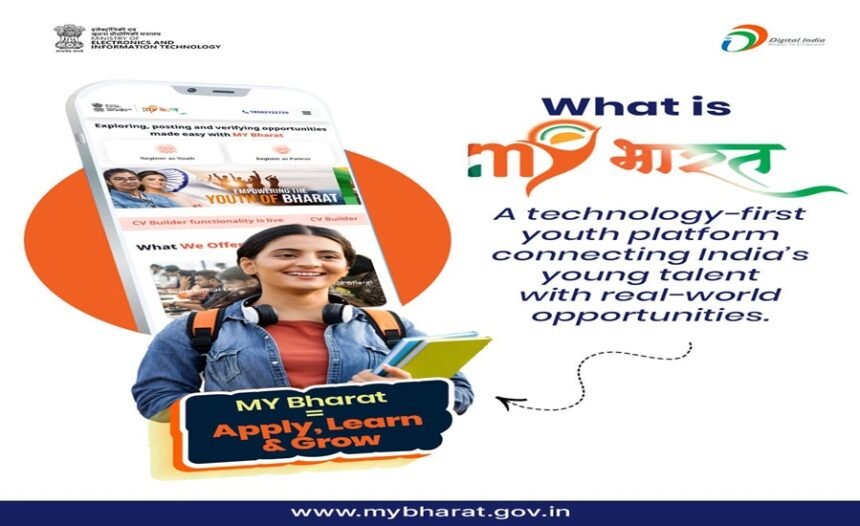
The Ministry of Youth Affairs & Sports is scaling up youth empowerment through the MY Bharat platform, pairing AI-enabled digital services with hands-on learning opportunities and outreach that stretches into the country’s smallest towns. Since launch, over 2.46 crore youth have signed up, and more than 1.22 lakh of them have gone on to enroll in nearly 25,000 Experiential Learning Programmes (ELPs). Behind the scenes, AI tools and a wide network of District Youth Offices and Common Service Centres (CSCs) are what make volunteering, skill development, internships, and leadership opportunities reachable for young people who might otherwise never find them.
AI tools built into the platform
MY Bharat has rolled out a handful of AI-powered features to smooth out digital service delivery, among them an AI-enabled CV Builder built with Bhashini. AI is also quietly at work behind the scenes: helping with software development, documentation, knowledge management, and keeping track of how programmes are performing.
On the learning side, the platform runs Experiential Learning Programmes in partnership with government departments, public institutions, educational institutions, and other partner organisations. The list is wide-ranging:
- India Post ELP
- Jan Aushadhi ELP
- Seva Se Seekhen ELP
- Public Distribution System (PDS) ELP
- Sadak Suraksha Mitra ELP
- Radio Production and Presentation ELP
- Farmer Producer Organisation (FPO) ELP
- Youth Engagement with Senior Citizens at Care Homes ELP
- Semiconductor Training Programme
Each programme runs somewhere between 20 and 360 hours of structured, hands-on learning, and participants walk away with a digitally validated certificate issued through the MY Bharat portal once they finish.
Feeding into the Prime Minister Internship Scheme
The Ministry of Corporate Affairs has also plugged into MY Bharat, using it to steer youth toward the Prime Minister Internship Scheme (PMIS) through a dedicated volunteer opportunity on the platform. As of 16 July 2026, 98,632 youth had been redirected from MY Bharat to the PMIS portal to register and apply.
Reaching beyond the cities
Much of the platform’s expansion is happening in rural areas, smaller towns, and Aspirational Districts, through what the government calls a phygital, or physical-plus-digital, approach. That reach is built on more than 780 District Youth Offices spread across the country, along with an integration with the CSC network that lets Village Level Entrepreneurs help youth in remote areas register and take part.
The platform has also built partnerships with youth clubs, educational institutions, National Service Scheme units, government departments, NGOs, and businesses, and it now supports location-based opportunities down to the district, block, panchayat, and village level, so young people can find programmes close to home instead of having to travel for them.
Key Takeaway: Nationally, the platform has logged 2,46,52,142 youth registrations across states and union territories. Uttar Pradesh leads by a wide margin with 25,06,907 registrations, followed by Rajasthan at 20,39,230. Maharashtra and Tamil Nadu are close behind, at 15,18,436 and 15,02,286 respectively, while Madhya Pradesh rounds out the top five with 14,32,089.
Taken together, the numbers suggest MY Bharat has become one of the government’s more substantial digital touchpoints with young people, one that’s leaning on AI and grassroots infrastructure alike to widen access to skills, internships, and leadership opportunities across the country.
MCQ’s:
1. The MY Bharat (Mera Yuva Bharat) platform has been launched under which Ministry?
A. Ministry of Education
B. Ministry of Skill Development and Entrepreneurship
C. Ministry of Youth Affairs & Sports
D. Ministry of Social Justice and Empowerment
2. Which of the following statements regarding the MY Bharat platform is correct?
A. It provides AI-enabled services, including a CV Builder developed using Bhashini, and offers Experiential Learning Programmes (ELPs).
B. It is implemented exclusively through urban employment exchanges.
C. It is managed by the Ministry of Corporate Affairs.
D. It is designed only for graduates seeking government employment.
Read more: Major Breakthrough: New Protocol Revolutionizes Quantum Networks