
The Union Cabinet, led by Prime Minister Narendra Modi, has cleared GOBARdhan, or Galvanising Organic Bio-Agro Resources Dhan, as India’s National Circular Bioenergy Scheme. The scheme comes with an outlay of ₹23,731 crore and will stretch from FY 2026-27 to FY 2035-36. At its heart is a simple idea: turn agricultural residue, cattle dung, municipal organic waste, press mud, and other biomass into Compressed Biogas (CBG), organic manure, and income for rural India, and in doing so, give CBG a real place in the country’s energy mix.
To get there, the scheme knits together assured offtake, stable pricing, capital assistance, pipeline connectivity, credit support, and technology development, all in service of Atmanirbhar Bharat, energy security, and a functioning circular bioeconomy.
Not starting from zero
This isn’t a new idea launched in isolation. GOBARdhan draws on several schemes already in motion, including SATAT (Sustainable Alternative Towards Affordable Transportation), the Market Development Assistance Scheme for organic manure, the Biomass Aggregation Machinery Scheme, the Development of Pipeline Infrastructure Scheme, and Central Financial Assistance under the National Bioenergy Programme. Those efforts have already gotten over 200 Compressed Biogas plants up and running, along with functioning production, offtake, and manure value chains. GOBARdhan folds all of it into a single framework, run by the Ministry of Petroleum and Natural Gas.
The six pieces of the puzzle
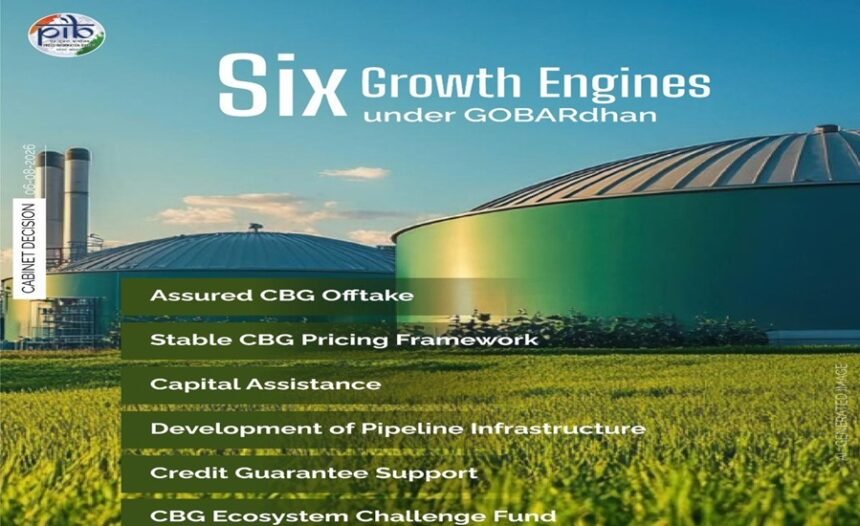
The GOBARdhan scheme is built around six components meant to cover the CBG value chain end to end.
On demand, a dedicated Offtake Assurance Framework requires City Gas Distribution entities to buy CBG against notified blending targets: 3% in FY 2026-27, climbing to 4% the following year, and settling at 5% from FY 2028-29 onward. Guaranteed buyers make projects easier to finance and should draw in private capital willing to commit for the long haul.
Pricing is fixed too, at ₹2,110 per MMBTU under a government-backed mechanism, so producers know what they’ll earn without the government losing sight of affordability.
For capital, eligible greenfield projects can get assistance of up to ₹2 crore per tonne per day of installed capacity, with further support for feedstock aggregation, manure processing, value addition, and brownfield expansions, which should lower the entry barrier for MSMEs, cooperatives, and rural entrepreneurs.
Pipeline funding covers both cluster and standalone infrastructure linking plants to trunk lines and City Gas Distribution networks, cutting transport costs and opening up markets that were previously hard to reach.
A credit guarantee mechanism is designed to make lenders more comfortable financing MSME-based CBG projects, easing collateral demands and lowering the risk on the lender’s side.
And a CBG Ecosystem Challenge Fund backs the groundwork of GOBARdhan at the district level: mapping feedstock, building aggregation infrastructure, planning, adopting new technology, adding value to manure, building capacity, and raising awareness among stakeholders.
Key Takeaway: The government is projecting a nearly ten-fold jump in domestic CBG production as a result of the scheme. That would chip away at India’s dependence on imported fossil fuels and strengthen energy security more broadly. Stable pricing paired with guaranteed demand is expected to pull in large-scale private investment, while farmers, cooperatives, feedstock aggregators, MSMEs, and rural entrepreneurs get new ways to earn.
There’s an environmental angle too: better management of agricultural and municipal waste, lower greenhouse gas emissions from wider use of renewable gaseous fuel, and a bigger organic manure economy built around Fermented Organic Manure and its liquid counterpart. A single national framework with digital governance is meant to cut through the red tape that’s usually slowed projects like this down.
MCQ’s:
1. The GOBARdhan (Galvanising Organic Bio-Agro Resources Dhan) Scheme primarily aims to:
A. Promote organic farming through direct fertilizer subsidies only.
B. Convert organic biomass and agricultural waste into Compressed Biogas (CBG) and organic manure under a circular bioeconomy framework.
C. Establish ethanol production units in every district.
D. Increase coal-based energy generation using agricultural residues.
2. Under the GOBARdhan National Circular Bioenergy Scheme, the mandatory Compressed Biogas (CBG) blending target for City Gas Distribution (CGD) entities from FY 2028-29 onwards is:
A. 2%
B. 3%
C. 4%
D. 5%
Read more: Empowering Young India: MY Bharat Celebrates 2.46 Crore Youth Registrations