
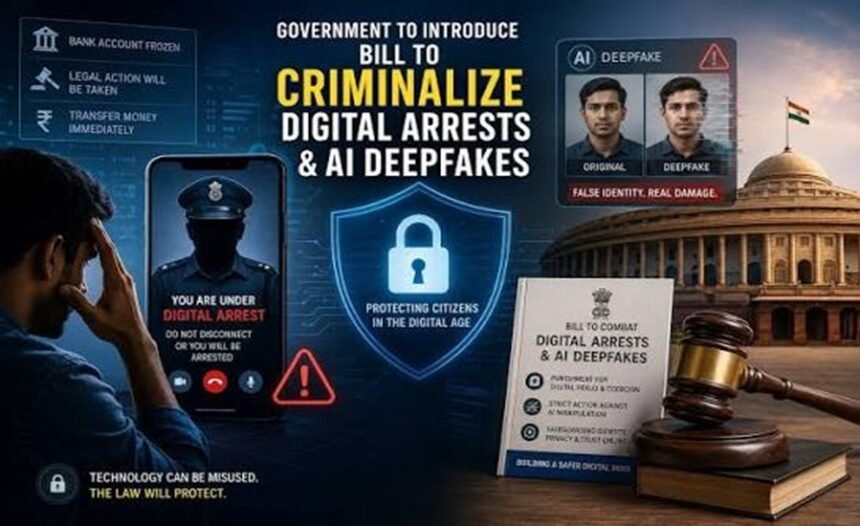
India’s government has laid out how it plans to tackle AI-generated deepfakes, spanning synthetic audio, video, and text, through a mix of existing law and newly amended rules aimed at keeping online spaces safe and accountable.
Several statutes already provide tools against deepfake misuse. The IT Act, 2000 penalizes damage to computer systems (Section 43) and covers offences like identity theft, impersonation, privacy violations, and obscene content (Sections 66C, 66D, 66E, 67, 67A). It also lets authorities block access to unlawful content (Section 69A) and order intermediaries to remove it (Section 79), while police retain investigative powers under Sections 78 and 80. The Bharatiya Nyaya Sanhita, 2023 adds penalties for cheating by impersonation, forgery of electronic records, and spreading false statements that cause public alarm, with organised cybercrime involving deepfakes prosecutable under Section 111.
IT Rules place the burden on platforms
The IT Rules, 2021 require intermediaries to stop users from hosting content that’s deepfake, obscene, misleading, impersonates others (including through AI), or threatens public order, among other categories. Platforms with 50 lakh or more registered users in India, classified as Significant Social Media Intermediaries, face extra obligations: helping trace the originators of sensitive messages, deploying automated detection tools, publishing compliance reports, and appointing India-based grievance officers.
February 2026 amendment sharpens the rules
The biggest shift came on February 10, 2026, when the government amended these rules specifically to address synthetically generated information. Platforms must now label AI-generated content clearly and attach traceable metadata so users can tell what’s synthetic. The amendment also names child sexual exploitation material, non-consensual intimate imagery, and impersonation as harms platforms must actively prevent, not just respond to after the fact.
Timelines got sharply tighter too. Removal of unlawful content following a valid government or court order now has to happen within 3 hours, down from 36. Grievance redressal timelines dropped from 72 hours to 36, and for sensitive cases like nudity or impersonation, from 24 hours down to just 2. Platforms that don’t comply lose their legal shield under Section 79 and can face prosecution.
Building detection and governance capacity
Beyond the rules themselves, the government has built out supporting infrastructure. The India AI Governance Guidelines, released November 5, 2025, set a risk-based framework for AI development. Under the IndiaAI Mission’s Safe & Trusted AI pillar, 13 responsible-AI projects have been approved at academic institutions, including detection tools like Saakshya (IIT Jodhpur and IIT Madras), AI Vishleshak for audio-visual forgery detection, and a real-time voice deepfake detector from IIT Kharagpur.
Enforcement and reporting channels
On the enforcement side, Grievance Appellate Committees give users a way to challenge platform decisions, while the Indian Cyber Crime Coordination Centre coordinates takedown notices across states through its SAHYOG portal. Citizens can report deepfakes and related crimes directly at cybercrime.gov.in or via the 1930 helpline. The Samanvaya platform, meanwhile, has helped link cybercrime cases across states, contributing to 12,987 arrests and over 70,000 investigation assistance requests so far.
Key Takeaway: The government also issued advisories in February and March 2026 covering religious content handling and the misuse of synthetically generated information, alongside a November 2025 SOP on curbing non-consensual intimate imagery. CERT-In continues to publish deepfake safety guidance, most recently an advisory from November 2024.
Union Minister of State for Electronics and IT Jitin Prasada shared these details in the Lok Sabha on August 5, 2026.
MCQ’s:
1. Under the amended Information Technology (Intermediary Guidelines and Digital Media Ethics Code) Rules, notified on 10 February 2026, which of the following became mandatory for AI-generated content?
A. Mandatory government approval before publication
B. Clear labelling of AI-generated content along with traceable metadata
C. Complete prohibition on the use of generative AI
D. Mandatory licensing of all AI developers
2. Under the Information Technology (Intermediary Guidelines and Digital Media Ethics Code) Rules, 2021, a Significant Social Media Intermediary (SSMI) is generally defined as a platform having:
A. More than 5 lakh registered users in India
B. More than 10 lakh registered users in India
C. More than 50 lakh registered users in India
D. More than 1 crore registered users in India
Read more: An Electric Triumph: EV Sales Skyrocket 46-Fold as India’s Eco-Friendly Mobility Goes Global