
India and the Maldives have completed the first round of negotiations for their Free Trade Agreement (FTA). The talks ran virtually from June 29 to July 7, 2026, and both sides came away with real progress across several negotiating tracks, along with common ground on a number of issues. For two countries looking to deepen trade and investment ties, this marks a meaningful step forward.
Who Led the Talks
India’s negotiating team was headed by Chief Negotiator Ujjwal Kumar Ghosh, Joint Secretary at the Department of Commerce. On the Maldivian side, Chief Negotiator Yusuf Riza led the delegation. Over the course of the round, officials from both countries sat down for eight technical sessions, working through text-based discussions that touched on eight separate policy areas. The format allowed negotiators to dig into the details track by track rather than rushing through a single broad conversation, which likely explains the breadth of convergence reached in just one round.
A Ministerial Follow-Up
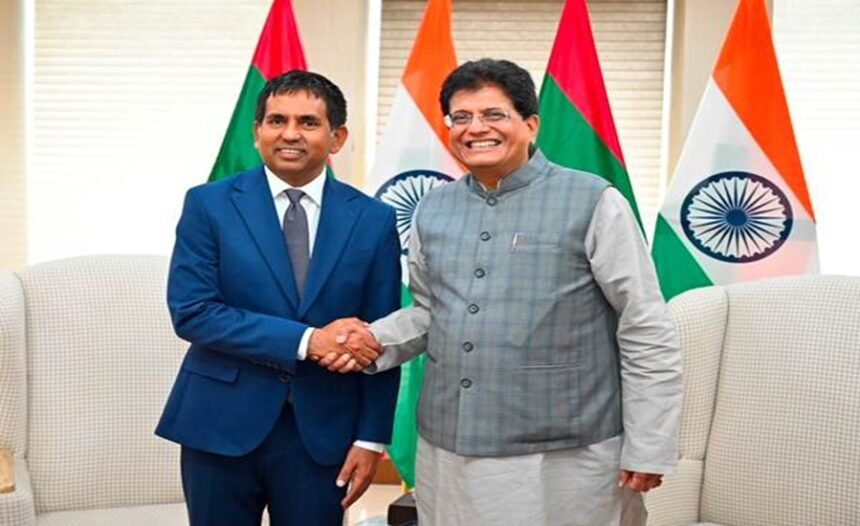
Just a day after the talks concluded, on July 8, 2026, Union Minister of Commerce and Industry Piyush Goyal met with Maldives’ Minister of Economic Development, Transport and Trade, Mohamed Saeed. The meeting gave both sides a chance to review how various bilateral economic initiatives are progressing, the FTA negotiations included.
The timing carries some extra weight this year. India and the Maldives are marking 60 years of diplomatic relations, and both ministers used the occasion to reaffirm their commitment to wrapping up two major agreements: the Bilateral Investment Treaty (BIT) and the FTA. Beyond these two agreements, the ministers also agreed to strengthen cooperation in areas like tourism, startups, digital payments, MSMEs and trade, aiming to open up new economic opportunities for both countries.
The Trade Numbers
India is currently the second-largest trading partner of the Maldives, and the underlying trade figures help explain why both sides are keen to move quickly on an FTA. Bilateral trade between the two countries reached USD 771.76 million in 2025–26, up from USD 679.70 million in 2024–25. That’s a growth of 13.54 per cent year-on-year, a pace that suggests the two economies are already finding more ways to work together even before a formal agreement is in place.
Key takeaway: The proposed FTA is expected to build on this momentum in a few concrete ways: better market access for businesses on both sides, easier pathways for investment, and broader economic cooperation beyond just goods and services. The agreement is being shaped around fairness and reciprocity, which negotiators hope will make it durable rather than lopsided.
If the pace of this first round holds, the FTA could end up doing more than boost trade numbers. Combined with the BIT and the wider push on tourism, digital payments and MSME cooperation, it points to a broader strategic partnership between India and the Maldives, one that both governments seem eager to lock in as the two countries mark six decades of diplomatic relations.
MCQs:
1. The first round of India–Maldives Free Trade Agreement (FTA) negotiations was conducted during which period?
A. June 1–10, 2026
B. June 29–July 7, 2026
C. July 10–18, 2026
D. August 1–8, 2026
2. Which of the following agreements are India and the Maldives currently working to conclude?
A. Comprehensive Economic Partnership Agreement (CEPA) only
B. Defence Cooperation Agreement and CEPA
C. Free Trade Agreement (FTA) and Bilateral Investment Treaty (BIT)
D. Double Taxation Avoidance Agreement (DTAA) only
Read more: (MSDE)Skill Development & Entrepreneurship Ministry Completes 12 Years