
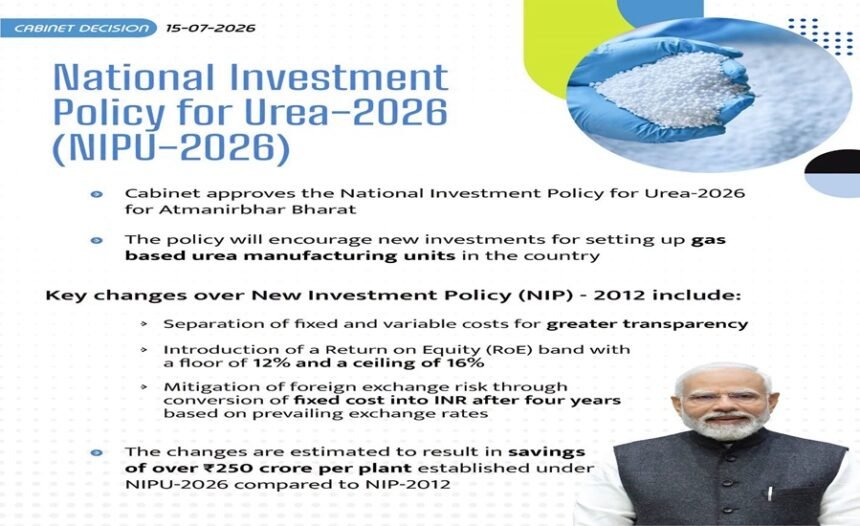
The National Investment Policy for Urea-2026 (NIPU-2026) is cleared by The Cabinet Committee on Economic Affairs, led by PM Narendra Modi, aimed at Atmanirbhar Bharat. The goal is straightforward: get more gas-based urea plants built in India, lift domestic production, and cut down on how much urea the country needs to import.
Reworking the numbers to attract investment
NIPU-2026 is meant to encourage new gas-based urea plants across the country, moving India closer to producing enough of its own urea rather than relying on the global market to fill the gap.
Compared to the earlier New Investment Policy of 2012, the new version changes how the financials work. Fixed and variable costs are now separated out, rather than bundled together. There’s a Return on Equity band set between 12 and 16 per cent, giving investors a clearer sense of what returns to expect. And to deal with currency risk, fixed costs get converted into rupees after four years, based on whatever the exchange rate is at that point, so companies aren’t stuck absorbing years of currency swings. Taken together, the government expects these changes to save more than ₹250 crore for each new plant built under the policy, compared to what it would have cost under the old framework.
Building capacity, cutting import reliance
Every new urea plant going forward will follow NIPU-2026’s rules. The 2012 policy it replaces was designed to draw investment into both brownfield projects, revamping or expanding existing plants, and greenfield ones built from scratch. It worked, to a point: six new urea units came out of it, four through joint ventures involving public sector undertakings and two built by private companies. That investment window closed in October 2019.
India currently runs 33 urea manufacturing units, with a combined installed capacity of 269.42 lakh metric tonnes. That’s a substantial base, but it still isn’t enough to meet the country’s demand, which means imports remain necessary to cover the shortfall. The Department of Fertilizers has been fielding proposals from companies interested in building new plants, and the government felt the existing policy needed an update to make those projects financially attractive enough to actually get built.
Why this matters going forward
Urea is the backbone of India’s fertilizer use, and the country has spent years importing a meaningful share of what it consumes. Every tonne produced domestically instead of imported has knock-on effects: less exposure to global price swings, less pressure on foreign exchange, and more predictability for farmers who depend on the fertilizer being available and affordably priced.
The changes in NIPU-2026 aren’t cosmetic. Splitting fixed and variable costs gives investors a cleaner picture of what they’re signing up for. The RoE band offers a guaranteed floor without an open-ended ceiling. And the currency conversion mechanism addresses something that’s genuinely discouraged investment in the past, the risk of committing capital in dollar or foreign-currency terms while earning revenue in rupees over a project’s lifetime.
Key Takeaway: None of these guarantees new plants get built overnight. Setting up a gas-based urea facility takes years and significant capital regardless of how favorable the policy terms are. But by making the economics clearer and shaving costs for developers, NIPU-2026 gives the Department of Fertilizers a real answer to the proposals already sitting on its desk, and gives India a more concrete path toward producing more of its own urea rather than depending on imports to make up the difference.
MCQ’s:
1. According to the policy, the revised framework is expected to save more than ______ per new plant compared to the earlier policy.
A. ₹100 crore
B. ₹150 crore
C. ₹250 crore
D. ₹500 crore
2. Every new urea plant established in India will now follow:
A. The New Investment Policy, 2012
B. NIPU-2026
C. PM GatiShakti guidelines
D. National Fertilizer Mission
Read more: Mobile Electronics Exports India – High Value Jobs & Economic Growth