

The Jan Samarth Portal turned four this year on June 6, 2022 marks its launch date, and it’s now India’s go-to integrated digital platform for credit-linked government schemes. It works as a single-window portal, cutting through the usual red tape around institutional credit and covering sectors like agriculture, business, housing, renewable energy and livelihoods. Over these four years, it’s widened access to government-backed credit, making the process more transparent and efficient for people across the country from every walk of life.
A single-window platform for institutional credit
The portal was built to close the gap between beneficiaries and lending institutions, which gives applicants a direct digital line to lenders instead of routing them through scattered offline processes. Paperwork drops, and loan applications move through an end-to-end digital pipeline.
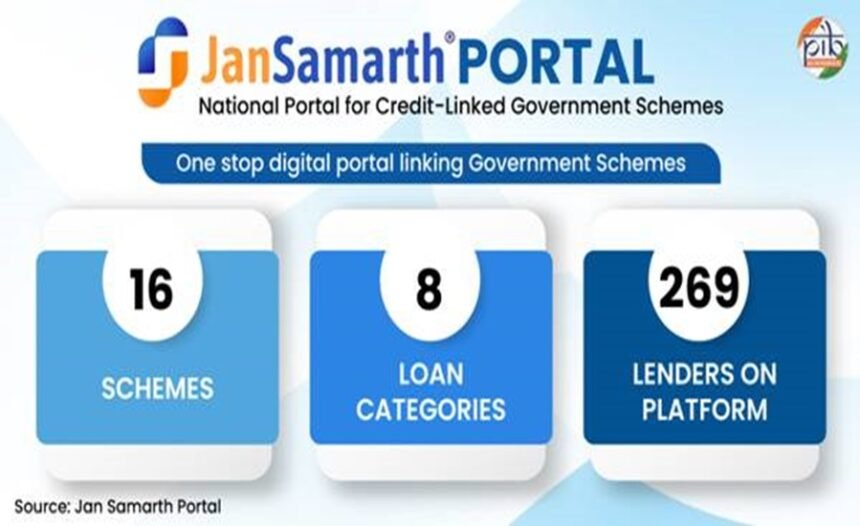
It runs in eight languages: English, Hindi, Gujarati, Telugu, Tamil, Marathi, Bengali and Kannada. That reach serves entrepreneurs, farmers, women-led enterprises and people seeking livelihood support. Right now it handles applications under 16 Central Government credit-linked schemes covering agriculture, business, renewable energy, housing, livelihoods and infrastructure.
269 Member Lending Institutions have signed on: 12 Public Sector Banks, 20 Private Sector Banks, 19 NBFCs, 28 Regional Rural Banks, 7 Small Finance Banks, 180 District Central Cooperative Banks, 2 Scheduled State Cooperative Banks and one All-India Financial Institution.
How the tech handles loan processing
Applicants can apply any time, day or night. A short set of eligibility questions points them to the right scheme, the system checks eligibility automatically, pulls in details from linked government databases, and issues an in-principle loan sanction before routing the application to the chosen bank branch through an automated rule engine.
From there, applicants get updates as their loan moves through processing, which removes the need for them to be stagnant or making any repeat trips to a branch, thereby saving time.
Behind the scenes, the platform pulls data from the Local Government Directory, UIDAI, UDYAM, AgriStack, the DPIIT Startup Portal, LOKoS, CBDT and GST, plus organizations like NSDL, NeSL, CIBIL, NCGTC and CGTMSE, to keep approvals moving quickly. Moreever, there is also an assisted mode through bank business correspondents for those who need when they’re applying, and the portal works through both its website and mobile apps.
Over ₹3 lakh crore in applications so far
By June 1, 2026, the portal had processed roughly 54.10 lakh loan applications worth ₹3,00,951 crore. Banks have digitally approved 49.55 lakh beneficiaries for loans totaling ₹2,76,493.78 crore, a sign that digital lending under these government schemes is catching on.
The impact of the Jan Samarth portal is palpable and shows up in real businesses too. People have availed themsleves of schemes on the portal inorder to grow packaging businesses, start fisheries, and set up dairy units. In addition, other agri-ventures, backing entrepreneurship and rural livelihoods along the way.
Key Takeaway: Four years in, the Jan Samarth Portal has become one of the main channels for government-backed institutional credit in India. With 54 lakh-plus applications processed, 16 schemes on offer and 269 lending institutions on board, it keeps making loans faster and more transparent to reach for entrepreneurs, farmers and people building their livelihoods.
MCQ’s:
1. Which of the following databases/platforms is integrated with the Jan Samarth Portal?
- UIDAI
- UDYAM
- AgriStack
- GST
A. 1 and 2 only
B. 1, 2 and 3 only
C. 2, 3 and 4 only
D. 1, 2, 3 and 4
2. The Jan Samarth Portal was launched on:
A. June 6, 2020
B. June 6, 2021
C. June 6, 2022
D. July 1, 2022