
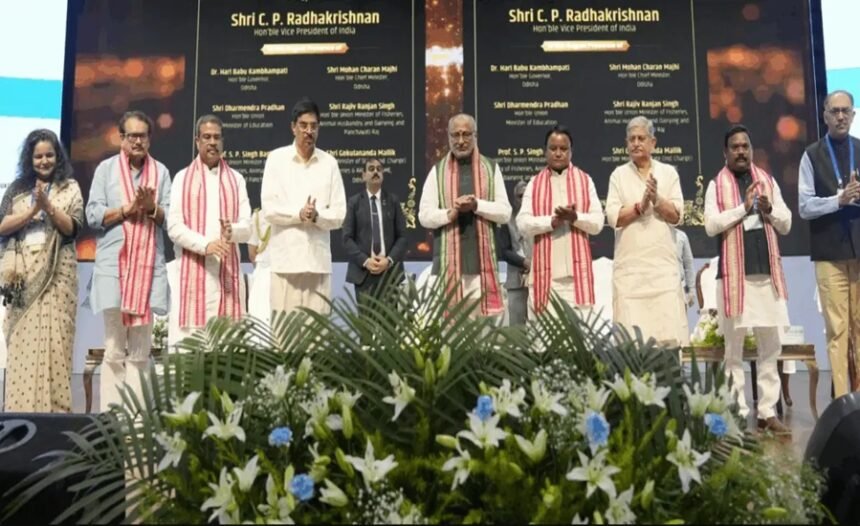
The Department of Fisheries, Government of India, is holding a National Launch of the Letter of Authorization (LoA) for Sustainable Harnessing of Fisheries and High Seas fishing on July 9, 2026, in Bhubaneshwar, Odisha. Vice President C.P. Radhakrishnan will launch the LoA, and he’ll also launch the Odisha Deep Sea Mission Document at the same event.
The launch will bring together Dr. Hari Babu Kambhampati, Governor of Odisha; Mohan Charan Majhi, Chief Minister of Odisha; Rajiv Ranjan Singh, Union Minister for Fisheries, Animal Husbandry & Dairying and Panchayati Raj; Dharmendra Pradhan, Union Minister for Education; Prof. S. P. Singh Baghel, Minister of State for Fisheries, Animal Husbandry & Dairying and Panchayati Raj; Gokulananda Mallik, Minister of State (Independent Charge), Fisheries & ARD and MSME,
Government of Odisha; Aparajita Sarangi, Member of Parliament, Bhubaneswar; Sukanta Panigrahi, Member of Parliament, Kandhamal; and Prasanta Kumar Jagadev, MLA, Khurda. Around 1,000 fish farmers and fishers, including women, will attend in person, along with officials from the Odisha government and various ministries and departments.
Building Up Fisheries Cooperatives
The Department of Fisheries has been putting real focus into strengthening fisheries farmer producer organizations (FFPOs) as well as fisheries cooperatives and pushing digitization across the sector through several initiatives.
The Vice President will hand out LoAs to fisheries cooperative societies, including National Cooperative Exports Limited (NCEL), and to fishing vessel owners, allowing eligible Indian-flagged fishing vessels to fish in the high seas under regulation. The cooperative societies receiving the LoA are Shree Mahavir Machhimar Sahakari Mandali Ltd, Martanda Prassanna Colaba Matsyodyog Vividh Karyakari Sahakari Sanstha Maryadit, South Goa Mechanized Boat Owners Coop. & Marketing Society Ltd, Paradeep Marine Primary Fish Production & Marketing Co-op. Society Ltd, Thengapattanam Deep Sea Fish Producers Cooperative Society, and Malpe Fishermen’s Primary Co-Operative Society Ltd.
What the LoA Actually Does
The Letter of Authorization is a mandatory requirement under the Guidelines for Sustainable Harnessing of Fisheries in the High Seas by Indian-Flagged Fishing Vessels, 2025. It’s built as a transparent, accountable framework for Indian-flagged vessels fishing in the high seas. Each LoA is tied to a specific vessel, can’t be transferred, and is integrated with the ReALCraft Fishing Vessel Registration Portal, so operations stay orderly, traceable and monitored. It’s issued and renewed at minimal cost, with no procedural hurdles and real-time application tracking, making compliance easier for fishers and vessel operators.
Vessels with an LoA must follow conservation and management measures set by the relevant Regional Fisheries Management Organisations (RFMOs), covering catch limits, gear regulations, bycatch mitigation, Fish Aggregating Device (FAD) management, voyage reporting and other requirements for responsible fishing.
The LoA initiative is meant to strengthen Fish Farmer Producer Organizations and fisheries cooperatives by helping them get into sustainable deep-sea and high-seas fisheries, giving them access to high-value resources and better income opportunities. The whole process is online, transparent, and time-bound, which should improve service delivery, transparency, traceability, and governance across the fisheries sector.
Odisha’s Deep Sea Fishing Mission
The Odisha Deep Sea Fishing Mission (2026 to 2036) is a flagship Blue Economy initiative from the Odisha government, aimed at unlocking the state’s offshore and deep-sea fisheries potential and turning Odisha into a leading deep-sea fishing and marine export hub. Through investment in modern fishing infrastructure, value chains, scientific fisheries management and market linkages, the Mission wants to boost fish production, create jobs, raise fisher incomes and drive sustainable growth in the marine fisheries sector.
Launching the LoA and the Odisha Deep Sea Fishing Mission Document marks the start of a regulated, transparent and sustainable system for authorized fishing by Indian-flagged vessels beyond India’s EEZ. It’s meant to empower these vessels toward sustainable, responsible high-seas fishing, and reflects India’s commitment to responsible use of oceanic fisheries resources, stronger fisher livelihoods, higher seafood exports, compliance with global sustainability standards, and progress toward a prosperous, inclusive Blue Economy.
Background: India’s Marine Resources
India has a coastline of roughly 11,099 km and an Exclusive Economic Zone of about 24 lakh sq. km. The marine fisheries potential within India’s EEZ is estimated at 58.6 lakh MT, supporting the livelihoods of around 50 lakh fishers and contributing heavily to food security, nutrition, employment, income and export revenue. India is currently among the world’s leading fisheries and aquaculture producers and exported seafood worth around ₹73,890 crore in FY 2025-26.
Why the High Seas Matter
Most fishing activity stays within 40 to 50 nautical miles of the coast, while deeper waters and areas beyond national jurisdiction hold real potential for high-value species, tuna and tuna-like resources especially. Recognising this, the Government of India has notified an enabling framework for sustainable harnessing of fisheries from the Indian EEZ and the High Seas, including the Guidelines for Sustainable Harnessing of Fisheries in the High Seas by Indian-Flagged Fishing Vessels, 2025.
In the Union Budget 2025-26, the Government had already announced its plan to bring in this enabling framework, with special focus on island territories like Andaman & Nicobar Islands and Lakshadweep, which together make up nearly 49% of India’s EEZ area. That announcement reflected the Government’s push to unlock the marine fishery sector’s untapped potential while protecting sustainability, equity, national maritime interests and the long-term livelihood of security of fishing communities.
Following through on this, the Guidelines for Sustainable Harnessing of Fisheries in the High Seas by Indian-Flagged Fishing Vessels, 2025, were notified on December 9, 2025. The Guidelines are a landmark policy move enabling authorized, regulated and responsible fishing by Indian-flagged vessels in the High Seas, beyond India’s EEZ, marking an important step in India’s move into high-value oceanic fisheries in areas beyond national jurisdiction, while staying aligned with national laws, international obligations and conservation requirements.
Key Takeaway: The launch of the Letter of Authorization (LoA) for sustainable high-seas fishing and the Odisha Deep Sea Fishing Mission (2026–2036) marks a major step in advancing India’s Blue Economy through regulated, transparent, and sustainable exploitation of marine resources.
Issued under the Guidelines for Sustainable Harnessing of Fisheries in the High Seas by Indian-Flagged Fishing Vessels, 2025, the LoA framework promotes responsible fishing beyond India’s EEZ while ensuring compliance with international conservation norms. This initiative is significant in the context of marine governance, fisheries policy, the Blue Economy, coastal livelihoods, seafood exports, and sustainable management of ocean resources.
M.C.Q.
Question 1: The Letter of Authorisation (LoA) for sustainable high-seas fishing is issued under which set of guidelines?
- A. National Fisheries Policy, 2020
- B. Marine Fishing Regulation Guidelines, 2024
- C. Guidelines for Sustainable Harnessing of Fisheries in the High Seas by Indian-Flagged Fishing Vessels, 2025
- D. Blue Economy Framework, 2023
Question 2: Indian-flagged fishing vessels operating under the Letter of Authorisation (LoA) are required to comply with conservation and management measures prescribed by:
- A. Food and Agriculture Organization (FAO)
- B. Indian Coast Guard
- C. Central Marine Fisheries Research Institute (CMFRI)
- D. Regional Fisheries Management Organisations (RFMOs)
Read More: INS Mahendragiri: India’s Powerful New Stealth Frigate