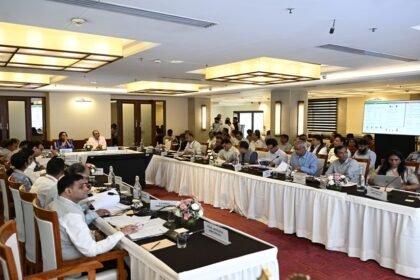

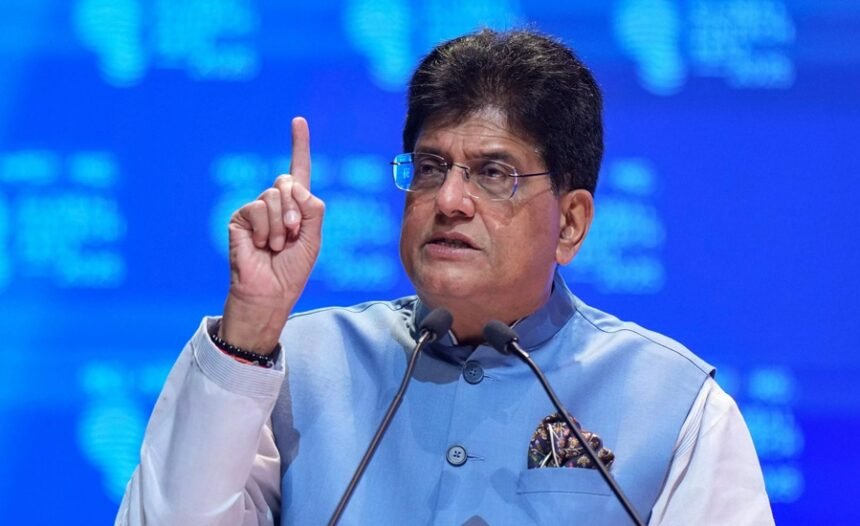
Union Minister of Commerce and Industry Piyush Goyal today asked State Governments to make full use of the BHAVYA Industrial Parks Scheme and put exports at the top of their priority list, calling for a coordinated national push to strengthen India’s export competitiveness. Speaking at the one-day Board of Trade (BoT) meeting in New Delhi, the Minister laid out a seven-point action agenda for States, Export Promotion Councils (EPCs), industry associations and exporters to speed up India’s export growth.
The Board of Trade, the top consultative platform under the Department of Commerce, met under Goyal’s chairmanship. Minister of State for Commerce and Industry Jitin Prasada, newly inducted Board members, Ministers and representatives from States and Union Territories, EPCs, top industry chambers and non-official members all took part.
Making Exports a Priority, Fixing Land and Labour
As the first point on the agenda, the Minister asked all stakeholders to treat exports as a high-priority item. He urged States, line ministries, EPCs and industry associations to set up export committees, meet regularly with exporters, and hold monthly review meetings, including over video conferencing where needed. As the second point, Goyal urged States to actively join the BHAVYA Industrial Parks Scheme, whose first round is currently open. He also asked States that haven’t yet notified labour rules under the labour codes to do so soon, calling land and labour two critical business enablers that need urgent attention.
The Minister’s third point was about strengthening quality infrastructure. He assured States and industry that the Government would fully back the setting up of testing facilities in government, semi-government and university laboratories, which would cut testing costs and make Indian products more competitive.
As the fourth point, Goyal pointed to the support available under the Export Promotion Mission (EPM), especially for micro and small enterprises. He said the Mission would fund a good chunk of the cost of getting international approvals and certifications, including pharmaceuticals, agricultural products, SPS and TBT requirements, testing costs, and compliance with rules in developed markets. He also asked States to line up their incentive structures and industrial policies with Central Government initiatives, to build economies of scale and encourage high-quality, high-productivity manufacturing.
Fighting Unfair Trade, Cutting Imports
Under the fifth point, the Minister encouraged industries hurt by unfair trade practices to approach the Directorate General of Trade Remedies (DGTR). He said DGTR would support domestic industries facing injury from dumping or predatory pricing by foreign producers, and could offer remedies through anti-dumping measures, safeguard duties and other trade remedy tools. He also flagged DGTR’s outreach efforts, including Jan Sunwai, for addressing industry concerns.
The sixth point was about import substitution. Goyal urged States and industry to spot products that are currently imported but could be made competitively in India. He said this would cut import dependence, save foreign exchange, strengthen domestic supply chains, and reduce the risks that come from relying too heavily on foreign suppliers.
Getting Into Global Markets
As the seventh point, the Minister urged States and industry associations to take part actively in international exhibitions, trade fairs and business delegations. He asked States to prepare lists of associations and exporters keen to explore overseas markets, particularly new exporters and MSMEs. He said the Export Promotion Mission would help eligible enterprises with overseas exhibitions and international business outreach, letting them tap into India’s growing network of Free Trade Agreements.
A Record Year for Exports
Setting the broader agenda for the meeting, Goyal noted that India closed FY 2025-26 with its highest-ever exports at USD 863 billion, up 4.6 per cent, despite tariff realignments, freight disruptions and slowing global demand. Merchandise exports held steady at around USD 442 billion, while services exports hit a record of over USD 421 billion.
Speaking about this record performance, the Minister said it came despite serious global headwinds, tariff realignments, freight disruptions and weakening demand among them. He credited the strong numbers to the resilience of Indian exporters, market diversification, and the reforms carried out under the leadership of Prime Minister Narendra Modi.
A 90-Day Push and the ₹25,000 Crore Mission
The Minister announced a time-bound 90-Day Drive under the Districts as Export Hubs initiative, covering 120 priority districts across 27 States and Union Territories. Backed by 24 DGFT Regional Authorities and 11 partner agencies, the drive will track measurable outcomes like new exporter registrations and export value growth, while tying in with the One District One Product initiative, GI products and MSME clusters.
Goyal placed the Export Promotion Mission, jointly run by the Ministries of Commerce, MSME and Finance with an outlay of over ₹25,000 crore, at the centre of MSME-led export growth. Built on two pillars, NIRYAT PROTSAHAN for trade finance and NIRYAT DISHA for market access, and eleven interventions covering credit, collateral, factoring, warehousing, freight, compliance, trade intelligence and Brand India, the Mission covers the exporter’s entire journey.
What the Board Reviewed
The Board went through presentations on key pillars of India’s trade and industrial ecosystem. These covered India’s Free Trade Agreements, which have opened markets worth over USD 27 trillion in GDP; DGTR and its new SETU digital platform; the Government e-Marketplace (GeM), where procurement has crossed ₹5 lakh crore with 45 per cent going to MSMEs; DPIIT’s startup ecosystem of more than 2.35 lakh startups and the Fund of Funds 2.0.
The BHAVYA Industrial Parks Scheme, with an outlay of ₹33,660 crore for developing 100 industrial parks; the Ministry of Textiles’ Vision 2030, targeting USD 100 billion in exports; the data-centre ecosystem, with nearly ₹7 lakh crore in announced investments; and electronics manufacturing, presented by Apple India Managing Director Virat Bhatia, who highlighted PLI-driven mobile phone production worth roughly ₹6.25 lakh crore.
The Minister called cross-border e-commerce the lowest-barrier entry point for first-time exporters and urged States to make use of Dak Ghar Niryat Kendras so every district can become an exporting district. He said import substitution and export promotion work together toward an Aatmanirbhar Bharat, reaffirmed the Government’s commitment to strengthening testing and certification infrastructure, and pointed to strong opportunities in container manufacturing.
During the meeting, Ministers and representatives from States and Union Territories shared their own experiences, best practices and views on export promotion, and reaffirmed their support for the Centre’s push to strengthen India’s external trade. Representatives from Export Promotion Councils, top chambers and industry associations also offered suggestions to boost India’s export competitiveness. The Minister set a target of USD 1 trillion in exports, roughly USD 530 billion in merchandise exports and USD 470 billion in services exports, calling it ambitious but achievable through coordinated action by the Centre, States, industry and exporters.
Calling for a Stronger Centre-State Partnership
Goyal called for a stronger Centre-State partnership and urged States to put exports firmly on their governance agenda, set up State Export Promotion Committees without delay, review district-level export performance monthly, fix regulatory, taxation and infrastructure bottlenecks, and align State-level schemes with Central Government programmes so MSMEs get seamless support.
He said he was confident that the combined efforts of the States, the energy of India’s youth, and the leadership of Prime Minister Narendra Modi would speed up the country’s journey toward becoming a globally competitive, self-reliant and developed nation.
Who Attended
The meeting was attended by Bimal Borah (Assam), Shreyasi Singh (Bihar), Manjinder Singh Sirsa (Delhi), Subhash Pal Desai (Goa), Kamlesh Bhai Patel (Gujarat), Rao Narbir Singh (Haryana), Harshwardhan Chauhan (Himachal Pradesh), Sanjay Prasad Yadav (Jharkhand), Chetanya Kumar Kashyap (Madhya Pradesh), P. U. F. Rodingliana (Mizoram), Tshering Thendup Bhutia (Sikkim), Hekani Jakhalu (Nagaland), D. Sridhar Babu (Telangana), Bharat Singh Chaudhary (Uttarakhand), Nand Gopal Gupta (Uttar Pradesh) and Tapas Roy (West Bengal).
Key Takeaway: The Board of Trade meeting underscored the Government’s strategy to make exports a key driver of India’s economic growth through stronger Centre-State coordination, MSME empowerment and enhanced global competitiveness.
The important points to note is the launch of the ₹25,000 crore Export Promotion Mission with its two pillars, NIRYAT PROTSAHAN (trade finance) and NIRYAT DISHA (market access); the 90-Day Drive under the Districts as Export Hubs initiative; the BHAVYA Industrial Parks Scheme with an outlay of ₹33,660 crore for 100 industrial parks; the role of the Directorate General of Trade Remedies (DGTR) in addressing unfair trade practices; and the emphasis on Free Trade Agreements (FTAs), cross-border e-commerce, One District One Product (ODOP), GI products and Dak Ghar Niryat Kendras to expand India’s export base.
The meeting also highlighted India’s record USD 863 billion exports in FY 2025–26 and reaffirmed the ambitious target of USD 1 trillion in exports, reflecting the Government’s focus on export-led growth, import substitution, manufacturing competitiveness and the vision of Aatmanirbhar Bharat.
M.C.Q.
Question 1: The recently announced Export Promotion Mission is built around which two pillars?
- A. Make in India and Startup India
- B. Production Linked Incentive and PM Gati Shakti
- C. NIRYAT PROTSAHAN and NIRYAT DISHA
- D. One District One Product and GeM
Question 2: The BHAVYA Industrial Parks Scheme aims to develop:
- A. 50 Mega Industrial Parks
- B. 75 Textile Parks
- C. 200 Logistics Parks
- D. 100 Industrial Parks
Read More: World Bank Income Classification: Sri Lanka’s Remarkable Rise