
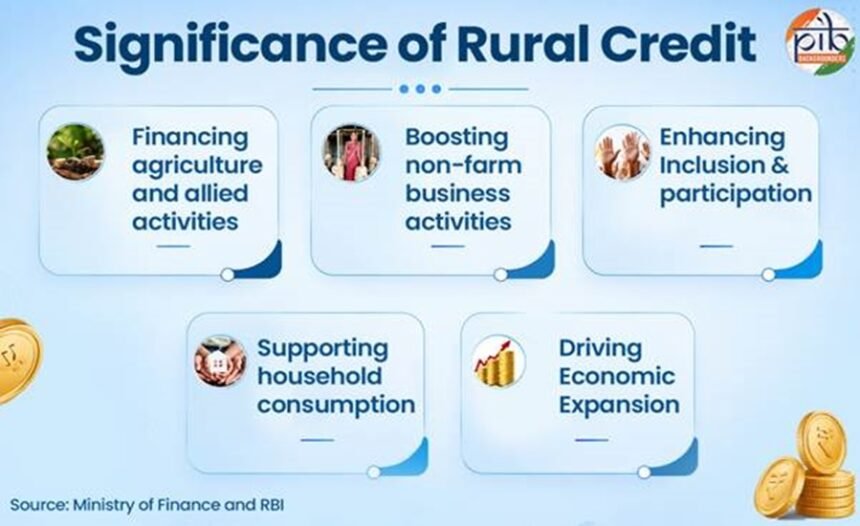
India’s rural credit network has grown into a major piece of the country’s agricultural and rural economy, reaching farmers, allied sectors, rural businesses and households. What used to be dominated by informal lenders has given way to a mix of banks, cooperatives and digital tools aimed at getting affordable credit to more people.
NABARD, commercial banks, regional rural banks, cooperative banks and small finance banks all handle pieces of this. Government schemes, digital platforms and policy changes have added to what’s on offer.
The Credit Ecosystem
The system covers short, medium and long-term financing for farming, allied activities, rural enterprises and household needs. It backs income generation and asset building across rural India.
NABARD sits at the center of it, through refinance support, infrastructure financing and oversight of cooperative and regional rural banks. Its Rural Economic Conditions and Sentiments Survey from May 2026 found that 77.2% of rural households reported higher consumption levels. About 51% relied only on formal credit sources, and over 27% used a mix of formal and informal channels.
How the Framework Got Here
A few milestones stand out over the decades:
1955: The National Agricultural Credit (Long-term Operations) Fund was created, alongside the State Bank of India.
1969: Fourteen major commercial banks were nationalised, which pushed lending toward agriculture and other priority sectors.
1982: NABARD was established.
1992: The SHG-Bank Linkage Programme launched.
1998: The Kisan Credit Card Scheme arrived, meant to get farmers timely, affordable credit.
2014: Pradhan Mantri Jan Dhan Yojana rolled out, widening banking access and enabling Direct Benefit Transfers.
2015: Pradhan Mantri Mudra Yojana began offering collateral-free loans to small businesses.
2022 onward: Digital pushes like the Jan Samarth Portal and e-KCC started simplifying credit delivery.
Who’s Doing the Lending
Scheduled Commercial Banks. Close to 120 SCBs run branches, business correspondents and digital services nationwide. Rural branches went from 41,464 in 2014 to 56,193 by July 2025.
Regional Rural Banks. Set up under the RRB Act of 1976, the 28 RRBs run more than 22,000 branches across 700 districts, working mainly with farmers, artisans and rural entrepreneurs.
Cooperative Banks. State Cooperative Banks, District Central Cooperative Banks, Primary Agricultural Credit Societies and agriculture and rural development banks make up this layer, pushing credit into remote areas.
Small Finance Banks. Eleven SFBs, launched after the 2014-15 Union Budget, serve underserved communities, small businesses and farmers.
The Policy Side
Priority Sector Lending. The RBI requires banks to put at least 18% of Adjusted Net Bank Credit (or Credit Equivalent of Off-Balance Sheet Exposures) toward agriculture. Of that, 14% goes to non-corporate farmers and 10% specifically to small and marginal farmers. NABARD backs this up with concessional refinance through its own credit funds.
Ground Level Credit targets. Agricultural credit disbursement grew more than 13% annually between FY15 and FY24. The government set a ₹32.5 lakh crore target for FY 2025-26, with ₹5 lakh crore earmarked for animal husbandry, dairying and fisheries. That’s four times the ₹8 lakh crore target from FY 2014-15.
Self-Help Groups. More than 10.05 crore rural women had been organised into over 90.9 lakh SHGs as of July 2025. Under DAY-NRLM, over 19.83 lakh SHGs have drawn cumulative loans exceeding ₹13.28 lakh crore. More than 50,500 Bank Sakhis help women open accounts, access loans and stay on top of repayment.
PACS. In 2023, the government approved two lakh new multipurpose PACS, dairy and fishery cooperatives. By January 2026, more than 32,800 new societies had registered, and over 61,800 PACS had moved onto a national ERP-based platform.
Modified Interest Subvention Scheme. Farmers get short-term crop loans through KCCs at 7% interest, cut to 4% for prompt repayment. The 2025-26 Union Budget raised the KCC loan limit from ₹3 lakh to ₹5 lakh and expanded collateral-free agricultural loans from ₹1.6 lakh to ₹2 lakh.
PM Dhan Dhanya Krishi Yojana. Approved in July 2025, it targets 100 low-performing agricultural districts by pulling together 36 central schemes across 11 ministries, with a focus on credit access, productivity, irrigation, crop diversification and post-harvest infrastructure.
Reaching More People
Kisan Credit Card. As of July 8, 2026, commercial banks had received nearly 739 lakh KCC applications, regional rural banks over 365 lakh, and cooperative banks more than 1,178 lakh. NABARD’s e-KCC platform lets applicants apply digitally through banks and Common Service Centres, cutting processing time to around two days.
Jan Dhan Yojana. More than 58.63 crore Jan Dhan accounts had been opened as of June 24, 2026, holding deposits over ₹3 lakh crore. Women hold 32.68 crore of these accounts, and nearly 78% sit in rural or semi-urban areas.
Jan Samarth Portal. Launched in 2022, it connects citizens to government-backed loan and subsidy schemes, KCC loans included, through a single digital platform.
Jan Dhan Darshak App. This app helps people find nearby banking outlets, branches, ATMs, Bank Mitras and Common Service Centres, and helps authorities track banking access. As of March 2025, nearly 99.92% of Indian villages had a banking outlet within five kilometres.
Key Takeaway: Between the institutional network, the policy targets and the digital layer on top, India’s rural credit system has come a long way from where it started. The next stretch will depend on how well these pieces keep working together.
MCQ :
1. Which institution is the apex development financial institution responsible for agricultural and rural development in India?
A. SIDBI
B. NABARD
C. SEBI
D. EXIM Bank
2. Under the RBI’s Priority Sector Lending guidelines, banks are required to allocate at least what percentage of their Adjusted Net Bank Credit (ANBC) to agriculture?
A. 10%
B. 12%
C. 18%
D. 25%
Read more: The Smart Farming Revolution: ICAR’s Breakthrough Climate-Resilient Crops