
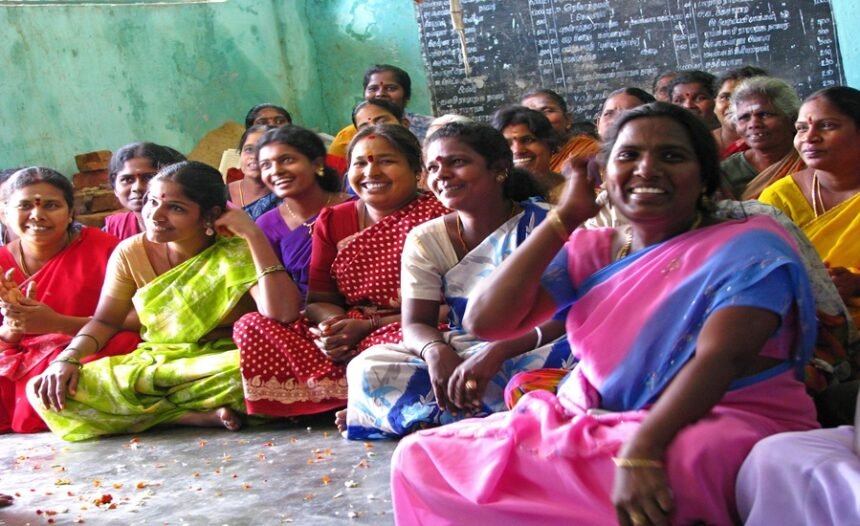
The Ministry of Rural Development runs the Deendayal Antyodaya Yojana – National Rural Livelihoods Mission (DAY-NRLM) everywhere in the country except Delhi and Chandigarh. The idea is to bring rural households together into Self Help Groups (SHGs) and stick with them long enough that they see a real jump in income and a better quality of life overall. So far, that’s added up to 10.08 crore rural women organized into 92 lakh SHGs.
The mission works through four core components: building self-managed, financially sound community institutions through social mobilization; getting the rural poor access to financial services; building sustainable livelihoods; and driving social inclusion and development. These play out through a set of sub-schemes described below.
NRLM and SVEP: institutions and enterprise
The first sub-scheme, National Rural Livelihoods Mission (NRLM) itself, focuses on building lasting institutions for the poor, growing their capabilities, securing their livelihoods, connecting them to financial services, and strengthening outcomes around food, nutrition, health, water and sanitation (FNHW), plus gender inclusion.
Then there’s the Start-up Village Entrepreneurship Programme (SVEP), which helps SHG members and their families set up small non-farm businesses. It operates at the block level, and as of May 2026, it has supported more than 6.5 lakh enterprises.
MKSP: empowering women farmers
Mahila Kisan Sashaktikaran Pariyojana (MKSP) is built specifically around the needs of rural women farmers, aiming for their broader socio-economic empowerment. The core idea is to invest systematically in rural women’s participation and productivity in agriculture, and to help them build agriculture-based livelihoods that actually last. It also works on building up a pool of community resource persons who can help these institutions manage themselves.
DDU-GKY: skilling rural youth for jobs
Deen Dayal Upadhyaya Grameen Kaushalya Yojana (DDU-GKY) offers skill training tied directly to job placement across a range of sectors. Since it launched in 2014-15, it has trained 18.45 lakh rural youth, women included, and placed 12.35 lakh of them in jobs. Social inclusion sits at the heart of the scheme: 9.69 lakh women, 5.94 lakh Scheduled Castes, 3.24 lakh Scheduled Tribes, 3.12 lakh minorities and 0.14 lakh Persons with Disabilities have taken part.
RSETI: building entrepreneurs at the grassroots
Rural Self Employment Training Institutes (RSETIs) push entrepreneurship and self-employment through short, practical, demand-driven training paired with handholding support afterward. They’ve trained 62.45 lakh people in total and helped 45.25 lakh rural youth settle into livelihoods, mostly through self-employment and small enterprises.
Rural women make up a large chunk of this, 43.71 lakh trained, which works out to over 70% of beneficiaries, alongside meaningful numbers from SC, ST, OBC, minority and PwD communities. The whole system runs on a network of 647 RSETIs spread across 634 districts.
Reaching SC, ST and OBC communities
DAY-NRLM also runs targeted efforts to bring Scheduled Castes, Scheduled Tribes and Other Backward Classes into the fold economically. The Mission puts priority on getting vulnerable households into SHGs, strengthening Village Organisations and Cluster Level Federations above them, and making sure these groups can actually access community investment funds, bank credit, livelihood support, skill training and social security schemes.
Tribal and socially excluded communities get particular attention, with focused outreach in aspirational and tribal districts, dedicated capacity-building efforts, coordination with departments like Social Welfare, and backing for agriculture, livestock, non-farm businesses and traditional livelihoods. All of this has fed into stronger financial inclusion, more women stepping into leadership roles, better income generation, and improved access to entitlements for SC, ST and OBC households, which in turn has moved the needle on poverty reduction and social inclusion nationally.
How DDU-GKY prioritizes marginalized groups
DDU-GKY isn’t just open to everyone equally, it’s built with marginalized groups specifically in mind. The scheme sets coverage mandates: 50% for SC/ST candidates, 15% for minorities, and 33% for women, with extra attention given to women-headed households, persons with disabilities and manual scavengers.
Women coming from SC, ST, OBC or EWS backgrounds can get free skill training along with boarding, lodging, post-placement support and a direct route into employment, all without paying anything upfront for the training. This makes DDU-GKY the main pathway to wage employment and career growth for disadvantaged rural women, and the participation numbers reflect that: 9.69 lakh women, 5.94 lakh SCs, 3.24 lakh STs, 3.12 lakh minorities and 0.14 lakh Persons with Disabilities.
RSETI’s reach among women and marginalized groups
Within RSETI too, women form the bulk of those trained, 43.71 lakh of them, more than 70% of all beneficiaries, alongside strong representation from SC, ST, OBC, minority and PwD communities. This runs through the same network of 647 RSETIs across 634 districts mentioned earlier.
Key Takeaway: The Deendayal Antyodaya Yojana – National Rural Livelihoods Mission (DAY-NRLM) has emerged as a cornerstone of rural poverty alleviation by organising over 10 crore women into Self Help Groups and strengthening financial inclusion, livelihood opportunities, entrepreneurship, and skill development across rural India.
Through initiatives such as SVEP, MKSP, DDU-GKY, and RSETIs, the mission promotes women-led enterprises, supports women farmers, enhances employability among rural youth, and prioritises the inclusion of Scheduled Castes, Scheduled Tribes, Other Backward Classes, minorities, and other vulnerable groups. By combining community institution building with access to finance, skill training, and sustainable livelihoods, DAY-NRLM is fostering women’s economic empowerment, reducing rural poverty, and advancing inclusive rural development.
M.C.Q.
Question 1: Which Ministry implements the Deendayal Antyodaya Yojana – National Rural Livelihoods Mission (DAY-NRLM)?
- A. Ministry of Agriculture & Farmers Welfare
- B. Ministry of Rural Development
- C. Ministry of Women & Child Development
- D. Ministry of Skill Development & Entrepreneurship
Question 2: Which of the following is a sub-scheme of DAY-NRLM that focuses specifically on empowering women farmers?
- A. Start-up Village Entrepreneurship Programme (SVEP)
- B. Rural Self Employment Training Institutes (RSETIs)
- C. Mahila Kisan Sashaktikaran Pariyojana (MKSP)
- D. Pradhan Mantri Kaushal Vikas Yojana (PMKVY)
Read More: Soil Degradation: A Strong Fix for Indian Farmers