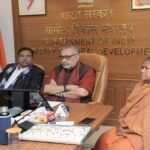


NITI Aayog released a report today titled “Reimagining Care: Strategies for Empowering Caregivers in Viksit Bharat@2047,” launched at NITI Aayog’s premises. The report maps out India’s caregiving landscape and lays out a detailed roadmap for building a system of care that’s organised, professional, accessible, and ready for the future.
At its core, the report puts caregivers themselves at the centre of the care ecosystem, treating caregiving as a skilled, dignified, and valued profession. It places heavy emphasis on quality of care, professional recognition, workforce welfare, institutional support, and making sure families and communities can access reliable, affordable care.
The report also points to a growing need for a trained caregiver workforce, one large enough to meet both current and future demand for care services in India, while flagging the global opportunities that could open up for Indian caregiving professionals.
Who Attended the Launch
Ashok Kumar Lahiri, Vice Chairperson of NITI Aayog, released the report in the presence of Dr. R. Balasubramaniam, Member of NITI Aayog, Nidhi Chhibber, CEO of NITI Aayog, and senior officials from the organisation. The launch also drew representatives from several Central Ministries and Departments, including the Department of Social Justice and Empowerment, the Department of Empowerment of Persons with Disabilities, the Ministry of Skill Development and Entrepreneurship, the Ministry of External Affairs, and the Ministry of Health and Family Welfare. National Institutes, UN agencies such as UNFPA, WHO, and UNRC, along with the World Bank, the Asian Development Bank, the ILO, and other stakeholders running caregiver training programmes, were also present.
India’s Chance to Lead Globally in Caregiving
Speaking at the event, Ashok Kumar Lahiri said global demand for caregivers gives India a unique chance to establish itself as a leader in traditional caregiving worldwide, unlocking real economic value, generating employment, and strengthening recognition and social security for caregivers, while also reinforcing India’s cultural and knowledge-based soft power. He noted that the report lays out a comprehensive roadmap for strengthening institutional coordination, empowering both family and professional caregivers, and positioning India as a global hub for skilled caregiving services.
Caregiving as Part of India’s Civilisational Values
Dr. R. Balasubramaniam pointed out that Seva and Samvedana have always sat at the core of India’s civilisational ethos, and that caregiving is a direct reflection of these enduring values. He said a strong caregiving ecosystem would deepen social inclusion, help build a more caring society, empower communities, generate quality livelihoods, and meaningfully contribute to the Viksit Bharat@2047 vision.
How the Report Was Prepared
NITI Aayog’s Social Justice and Empowerment Division prepared the report, drawing on extensive stakeholder consultations, international benchmarking, surveys, and field visits, and it identifies opportunities for India to become a global leader in caregiving services.
Caregiving as a Pillar of India’s Growth Story
The report frames caregiving as a critical pillar of India’s social and economic transformation, positioning it as an essential enabler of inclusive, sustainable development on the path to Viksit Bharat@2047. Given India’s strong tradition of compassionate caregiving alongside rising global demand for caregivers, the country is well placed to make the most of its demographic dividend and pursue global opportunities to expand its care network and skilled workforce.
Strategic Pillars and Institutional Recommendations
The report structures its recommendations around several strategic pillars: policy, professional recognition of caregivers, workforce development, global cooperation, social security, and family- and community-based care, among others. It also charts a path toward an organised, professional caregiving ecosystem, built around a proposed National Policy on Caregiving and a National Caregiver Council.
Key Takeaway: NITI Aayog’s report, Reimagining Care: Strategies for Empowering Caregivers in Viksit Bharat@2047, presents a roadmap for developing a structured, professional, and accessible caregiving ecosystem by strengthening policy support, workforce development, professional recognition, social security, and institutional coordination.
By proposing measures such as a National Policy on Caregiving and a National Caregiver Council, the report seeks to enhance the quality and availability of care services, generate employment, leverage India’s demographic dividend, and position the country as a global hub for skilled caregiving while advancing the broader vision of inclusive and sustainable development under Viksit Bharat@2047.
M.C.Q.
Question 1: Which organization released the report titled “Reimagining Care: Strategies for Empowering Caregivers in Viksit Bharat@2047”?
- A. Ministry of Health and Family Welfare
- B. NITI Aayog
- C. Ministry of Social Justice and Empowerment
- D. National Skill Development Corporation
Question 2: Which of the following institutional measures has been proposed in the report “Reimagining Care: Strategies for Empowering Caregivers in Viksit Bharat@2047”?
- A. National Health Workforce Commission only
- B. National Caregiver Council and a National Policy on Caregiving
- C. National Social Security Authority only
- D. National Elderly Welfare Commission
Read More: New Deputy Naval Chief AN Pramod: A Remarkable 36-Year Career