
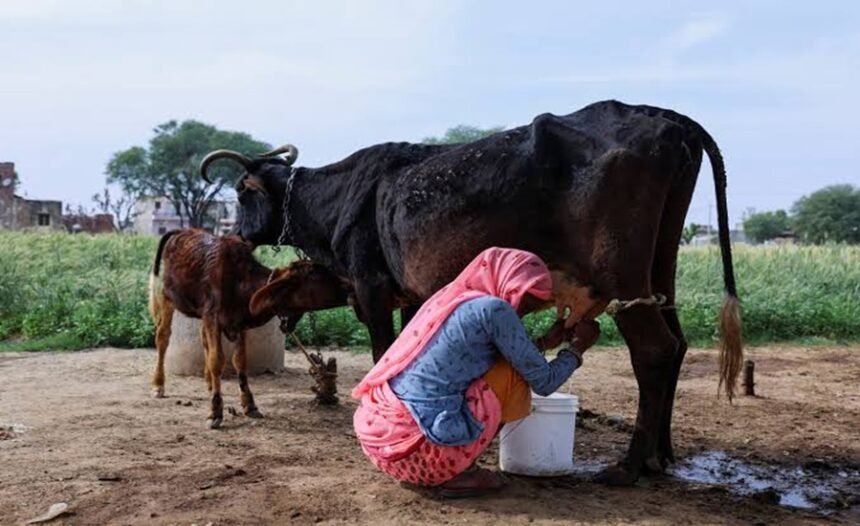
A massive decline in bovine milk production in India, especially among buffaloes in the trans-Gangetic plains of northwestern India, one of the country’s biggest sources of milk, has now been attributed to climate change. The phenomenon has a profound impact on the milk industry that serves consumers every day.
Climate change significantly undermines livestock productivity worldwide, but a new study published in Scientific Reports has found that global warming acutely affects dairy production across the global south, especially “the high milk production tract of Haryana.” India is the world’s largest milk producer. Scientists studied data to assess the impact of climatic variables, including yearly minimum, maximum and mean temperatures, heavy rainfall, the temperature-humidity index, and evapotranspiration, on milk yield and production in buffaloes, indigenous cattle and cross-bred cattle in Haryana, spanning over a decade from 2004 to 2019.
The researchers studied livestock populations across 1,148 villages, covering 4.66 million cross-bred cattle, 2.86 million indigenous cattle and 35.56 million buffaloes. The study tracked milk yield across these three bovine categories and found that high temperatures (over 38°C), combined with high humidity (over 70%) during July and August, when summer and monsoon humidity peaks, “significantly reduce milk production.” Interestingly, winter temperatures had a negligible effect.
Adaptive Strategies
Evapotranspiration in May and June turned out to be an important factor, alongside the temperature-humidity index and heatwaves. Solar radiation, ambient temperature and vapour pressure were also part of the climate impact assessments. Given that agrarian livelihoods are likely to be affected profoundly by global warming, the paper noted that these results underscore the role potential evapotranspiration plays in shaping adaptive strategies for sustainable livestock production.
Buffaloes, with their darker hue and bare skin, are particularly prone to absorbing solar radiation. They also have fewer sweat glands than cattle, so a unit increase in potential evapotranspiration (mm/day) reduces milk yield by around 1.4 litres per buffalo per day, according to the paper. Cross-bred cattle also showed a significant decline in productivity during heatwaves, but indigenous cattle breeds such as Sahiwal and Hariana did not, likely due to adaptations such as loose skin, efficient sweating and lower metabolic heat production.
The higher the temperature-humidity index, the greater the impact on livestock physiology and productivity: animals eat less, and heat triggers homeostatic responses “in the form of panting, sweating and reduced activity,” the paper said. Stress hormones and raised cortisol levels “impairs milk ejection and thereby causes a drop in milk yield and, in severe cases, livestock mortality,” the paper added.
The Advantage of Indigenous Cattle
Fodder also becomes a casualty of rising surface temperatures, affecting the livestock production system, as changes occur in the quantity, quality and seasonal availability of feed and fodder. The paper estimates that such stressors in India lead to a loss of 3.2 million tonnes of milk, worth Rs. 2,661 crore in monetary losses, a figure that could rise to 15 million tonnes by the 2050s.
Abhinav Gaurav, lead advisor for sustainable dairy at Environmental Defense Fund India, a Delhi-based non-profit, told The Hindu that heat stress significantly affects the milk productivity, health and well-being of cattle and buffaloes. He explained that during intense summer months, lactating animals become more vulnerable to heat stress, as they divert energy from milk production toward regulating body temperature, resulting in a 20–30% decline in milk yield.
Beyond the direct impact on animals’ health, production and wellbeing, rising temperatures and prolonged summers also affect the broader dairy production system, reducing the production and availability of fodder and feed, increasing water scarcity, raising instances of pest and disease attacks, and compromising animal immune systems.
Dr. Gaurav referenced a report in The Lancet estimating that climate change-induced temperature rise could reduce Indian milk production by 25% by 2085. He noted that since India is the largest milk producer and consumer in the world, these production losses would put the livelihoods and nutrition of millions at risk, particularly the 80 million smallholder dairy farmers who contribute 85% of total milk production.
Interestingly, Haryana’s farmers were found to be well aware of relevant technologies and practices, and had implemented them during the summer season, including wallowing ponds for buffalo, agroforestry, keeping livestock in sheds, altering microclimates through sprinklers, foggers and mist, and feeding management, which reduced the negative effects of extreme summer months. This finding came from the paper, authored by researchers from the ICAR-National Dairy Research Institute and collaborating institutions.
Traits That Help Tolerate Heat
Indigenous cattle are more tolerant of heat stress and better at maintaining homeostasis, meaning they regulate their internal environment more effectively, with more advanced evaporative cooling compared to buffaloes. The authors also noted that indigenous breeds show stronger immunity against local parasites and pathogens, a resilience that indirectly supports climate tolerance, since heat stress often compromises immune function.
The National Bureau of Animal Genetic Resources has identified heat-tolerance traits in cattle, such as heat shock proteins, coat colour and hair characteristics, according to Dr. Gaurav. The research also showed that the Sahiwal breed of cattle is significantly more heat-tolerant than exotic breeds with comparable milk productivity. The findings point to the need for a strategic shift toward resilience-oriented livestock management, with the paper recommending that potential evapotranspiration and the temperature-humidity index be integrated into regional early warning systems to allow for proactive management.
It further stated that long-term climate resilience should prioritise thermo-tolerant breeding programs that leverage Bos indicus traits. The paper concluded that indigenous breeds should be conserved as “reservoirs of climate-resilient traits,” and that policies must prioritise in-situ conservation and farmer-led breed improvement programmes.
Dr. Gaurav said the larger challenge now lies in scaling these solutions for millions of smallholder farmers, who often face limited awareness, inadequate financial resources, and the absence of a coordinated national climate-smart dairy strategy.
Key Takeaway: Climate change is emerging as a major threat to India’s dairy sector, with rising temperatures, humidity and heat stress significantly reducing milk production, particularly among buffaloes in the trans-Gangetic plains. The study highlights temperature-humidity index (THI) and potential evapotranspiration as key indicators influencing livestock productivity and recommends their integration into early warning systems for climate-resilient dairy management.
It also underscores the superior heat tolerance of indigenous cattle breeds such as Sahiwal and Hariana, emphasising the need for thermo-tolerant breeding programmes, conservation of native genetic resources, and wider adoption of climate-smart livestock practices. With climate-induced milk losses expected to rise sharply in the coming decades, strengthening adaptive measures, improving fodder and water management, and supporting smallholder dairy farmers will be critical to ensuring India’s long-term dairy and nutritional security.
M.C.Q.
Question 1: According to the recent study on climate change and dairy production in India, which two indicators were recommended for integration into regional early warning systems for livestock management?
- A. Soil Moisture Index and Rainfall Anomaly Index
- B. Temperature-Humidity Index (THI) and Potential Evapotranspiration (PET)
- C. Air Quality Index (AQI) and UV Index
- D. Heat Index and Wind Chill Factor
Question 2: Which of the following indigenous cattle breeds was identified in the study as being highly tolerant to heat stress?
- A. Jersey
- B. Holstein Friesian
- C. Sahiwal
- D. Brown Swiss
Read More: Poshan Tracker: India’s Proven Nutrition Monitoring System