
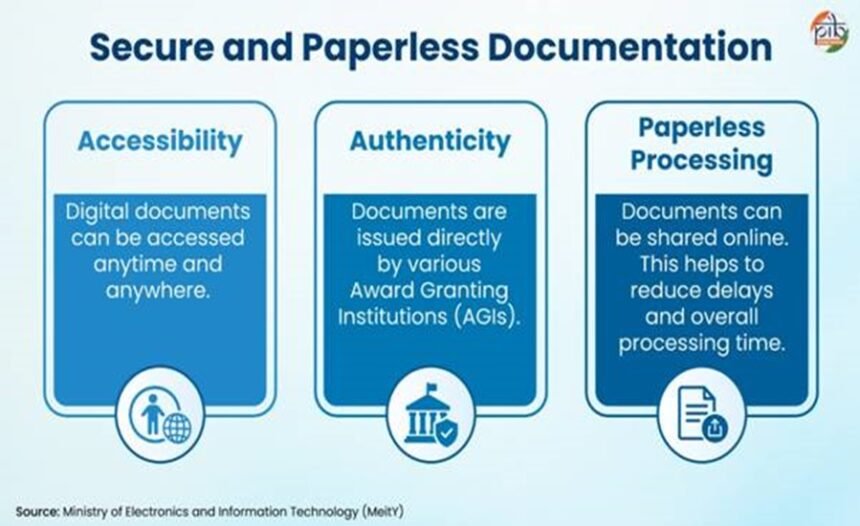
The National Academic Depository (NAD) was built to be a system that digitally stores, issues, verifies, and authenticates academic credentials nationwide. So students can get to their records from anywhere, without needing the physical certificate in hand or worrying it’ll be forged.
India runs one of the biggest education systems on the planet. As of 2024-25, that’s roughly 14.71 lakh schools, 1,420 universities, 53,583 colleges, 16,795 standalone institutions, and 280 R&D institutes all producing millions of academic records a year in the form of degrees, diplomas, certificates, mark sheets, and evaluation reports.
Keeping track of paper records at that scale has never worked well. Physical documents go missing, get damaged, sometimes get faked outright, and verifying them by hand takes time that students, institutions, employers, and government offices all end up losing.
NEP 2020 already shook things up on the academic side, with reforms like Multiple Entry-Multiple Exit (MEME), the National Credit Framework (NCrF), and the Academic Bank of Credits (ABC) giving students more freedom to move between institutions and stages of learning. That flexibility only works, though, if there’s a records system that can keep up secure, and able to talk across institutions.
NAD has run on top of DigiLocker since 2020. DigiLocker itself goes back further, it launched under Digital India on 1 July 2015 and now acts as the platform where digital credentials actually get issued and accessed, while NAD is the repository and verification layer behind it.
Two more pieces round out the ecosystem: APAAR (Automated Permanent Academic Account Registry) and the Academic Bank of Credits, both of which track credits and support students moving between institutions. Together, all of this forms one connected system for managing academic records across a person’s whole life.
There’s also a link to e-Sanad, the government’s service for electronic verification, attestation, and apostille of documents which matters a lot for anyone applying to study or work overseas and needing their credentials checked out.
Coverage is broad: Central, State, Private, and Deemed Universities, Institutions of National Importance, CBSE and other school boards, plus a wide swath of higher-ed institutions. On the user side, that means students, universities, employers, banks, government departments, and verification agencies at home and abroad.
Who runs it
The Ministry of Education is the parent ministry. The University Grants Commission (UGC) is the nodal agency actually implementing it, through DigiLocker.
Institutions issue the credentials, students control access to them, and authorised parties can verify them instantly. Under the Information Technology Act, 2000, these digital records hold the same legal standing as the paper originals.
What backs it legally
- The Information Technology Act, 2000 gives electronic records and digital signatures legal recognition.
- The Digital Locker Rules, 2016 require that documents only get shared with a user’s explicit consent.
- The National e-Authentication Framework (NeAF) handles secure identity checks.
The workflow, step by step
An institution generates the award like degree, diploma, certificate, mark sheet once a student finishes their exams or programme. That record gets issued digitally through NAD via DigiLocker, and it’s automatically linked to the student’s account. From there, the student can share it with consent with an employer, another school, a bank, whoever needs it. The receiving party verifies it straight through the system, which rules out tampering. And the whole thing stays digital, so there’s no physical document to lose in the first place.
Why it matters
Students get credentials that stay accessible for life, wherever they end up. Institutions and exam boards get a trusted way to issue records without the usual administrative load. Employers, banks, licensing bodies, and government departments get to verify credentials almost instantly instead of waiting on manual checks.
Beyond speed, it also cuts down on fraud and brings more transparency to the system, putting India in step with how other countries are handling digital credentials.
Key Takeaway: Taken as a whole, NAD is one of the more concrete steps in India’s digital education to push secure records, consent-based sharing, real-time verification, all sitting inside the bigger DigiLocker and Digital India framework as it builds toward a more digitally capable education system.
MCQs:
1. The National Academic Depository (NAD) is primarily designed to:
A) Conduct online examinations
B) Store and verify academic credentials digitally
C) Provide scholarships to students
D) Accredit universities
2. Since 2020, the National Academic Depository has operated on top of:
A) UMANG
B) BharatNet
C) DigiLocker
D) e-Shram
Read more: GST Reforms in Textiles & Apparel – Logistics Impact